
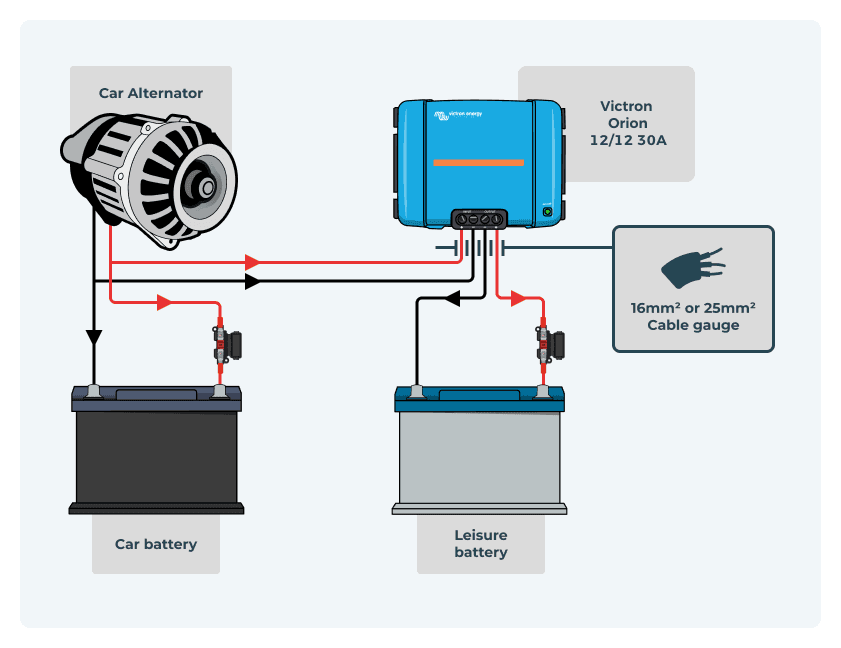
Hundreds of four-wheeled adventurers have made the switch from older split charging systems to modern B2B chargers and never looked back, but are they right for your build? And what kind do you even need?
In this comprehensive guide, we'll cover everything you need to know about B2B chargers. We'll cover what they do, how they work, and the step-by-step process you'll need to choose the right one for your campervan.
What is a B2B charger?
A B2B charger handles the transfer of power between your alternator and the leisure battery system. They're also sometimes called battery-to-battery chargers or DC-DC chargers.
Your alternator is the part of your engine that converts mechanical energy into electrical energy to recharge the standard (starter battery) that powers core systems like ignition and headlights.
With a leisure battery, there's now a whole new (often much bigger) battery to charge up. A B2B battery is simply a device that ensures the optimum balance between charging your starter battery and leisure battery.
Where a split charge relay can decide which battery to charge and when to charge it, a B2B charger takes this a step further by deciding how to charge your leisure battery for maximum efficiency and lifecycle.
How B2B chargers work
Traditional 12V alternators produce a fixed charge voltage of about 14V volts while driving, so the leisure battery is charged from the alternator whilst driving. This is enough to replenish the standard starter battery in the van enough that it can activate the ignition and turn the engine over when starting the engine.
However, this fixed voltage isn't enough to fully charge most leisure batteries, and can only achieve around 80% capacity. A full charge cycle requires both higher voltage and variable voltage during the different phases of optimal charging. This is because achieving the final 20% of charging (during what's known as the ‘absorption phase') requires around 14.4V.
Charging your leisure battery to the 80% achievable without B2B chargers is a cheaper alternative, but isn't ideal for battery health.
Partial charging can lead to sulfation in AGM and Lead-Acid betteries, where the sulfate crystallises and causes reduced capacity or early failure.
Even with modern lithium batteries you'll be sarcraficing 20% of the usable capacity, so it's important to weigh up the long-term costs of cheaper charging solutions.
B2B chargers alleviate these issues with multi-stage charging.
They're also the only type of split charging that works with modern smart alternators, which have variable output to increase fuel efficiency. However, they don't work with more rudimentary leisure battery charging systems like split charge relays.
The multi-stage charging process
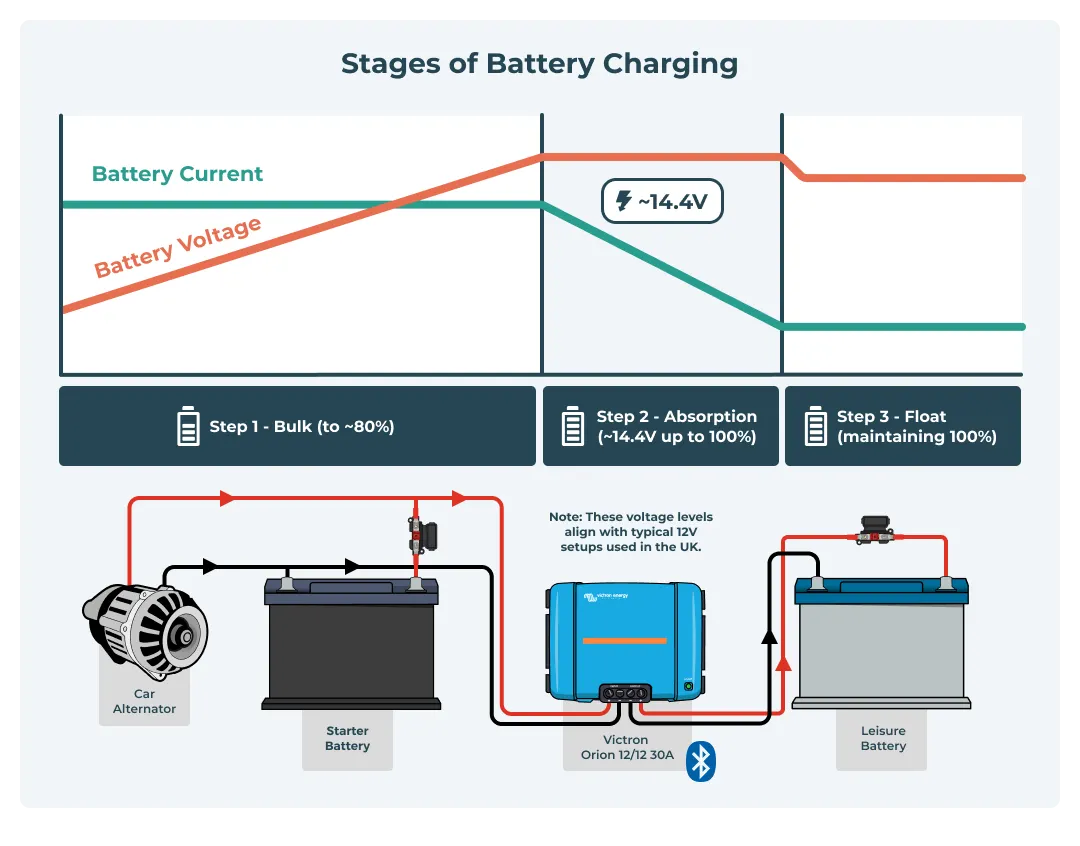
Modern B2B chargers use a three-stage charging process, and many have multiple modes specifically tailored to the chemistry of the battery you're using. These phases are:
- Bulk charging. This is the fastest charging phase where the charger delivers the maximum current allowed by the alternator to quickly replenish the battery. This phase recharges the battery to about 80% capacity.
- Absorption charging. Once the battery reaches a set voltage, the charger then shifts into absorption mode. This maintains a steady high voltage (i.e. 14.4V volts), while gradually reducing current until the battery safely hits 100%.
- Float charging. To prevent overcharging, the B2B charger then stops. However, it still enters float mode. This provides a constant low current to keep the battery at 100% over time.
This process works the same as the mains battery chargers that people use to recharge car batteries, ensuring a safe charging cycle that prolongs the life cycle of your leisure batteries, and forms a core part of understanding your campervan electrical system fundamentals.
Why you should choose a B2B charger
Battery-to-battery (B2B) chargers offer a range of advantages over older split charging methods. Let's take a closer look.
1. Optimal battery charging
B2B chargers safely ensure your battery is charged to its full potential. This 100% charge is more than other methods can achieve and the multi-stage charging process also prevents overcharging or undercharging. Most also have separate modes tailored to different battery chemistries, (lithium, AGM, gel etc.), meaning your set-up is future-proofed should you change battery type.
2. Compatibility with modern vehicles
B2B chargers are the only split charging method that works with modern smart alternators. Smart alternators vary their output to improve fuel efficiency, but this means huge fluctuations in charging and incompatibility with simpler split charge relays. If your campervan is from 2015 or onwards, it will have a Euro 5 or higher classification, and you'll need a B2B charging system to charge your leisure battery while driving
3. Efficiency in energy use
B2B chargers regulate and match the needs of your battery to the output of your alternator. This optimisation minimises wasted energy and contributes to a more overall efficient system. This helps to maintain fuel efficiency and prolongs the life of your alternator.
4. Advanced features and versatility
Modern B2B chargers come with a range of extra features and functionality in the unit. For example, some include solar charging, integrating an MPPT (Maximum Power Point Tracking) controller to combine solar energy with alternator power during charging. Some also have two-way charging to recharge a flat starter battery with reverse flow, or safety features like built-in high voltage and overheating protection. Most will also have bluetooth functionality, so you can keep up to date with your charging.
6. Long-term cost savings
While B2B chargers are more expensive than simple solutions like manual switch systems, the long-term cost savings can add up. Maintaining optimum charge levels and using a multi-stage process prevents damage to leisure batteries and keeps them working significantly longer. It also means less strain on your alternator and cumulative fuel savings over time.
Types of B2B chargers
B2B chargers come in a few different forms. Some set-ups will work with any of these while others might require a specific type. Here's a rundown of the main options available today
Basic non-isolated B2B chargers
These are the most basic and cost-effective options available for campervans. They share a common electrical ground between the starter and leisure batteries, transferring power directly.
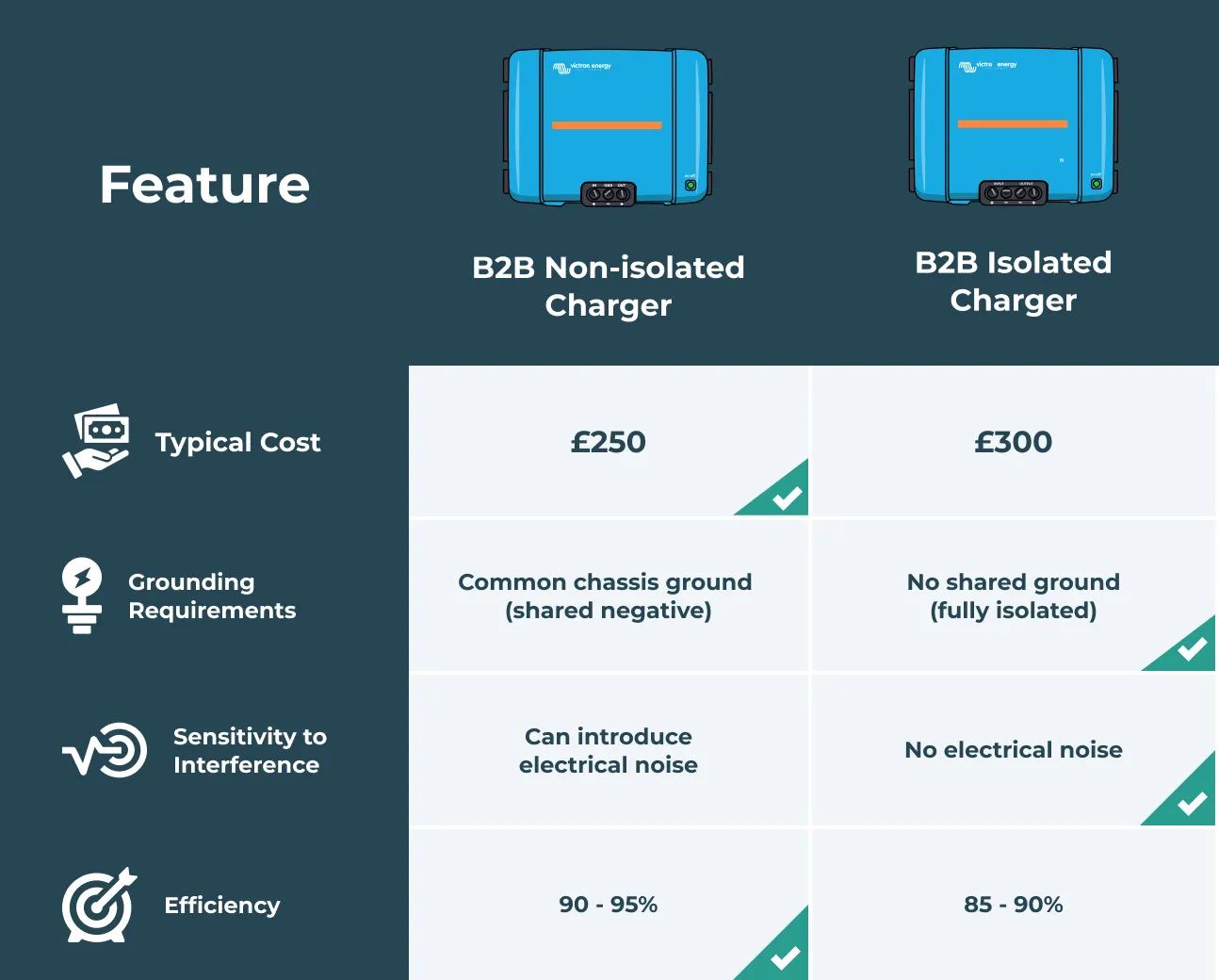
This straightforward design makes them easier to fit and maintain than other options, and they provide decent enough charging for non-lithium batteries in campervans with older alternators.
Since they share a ground, electrical interference due to small voltage differences between components of the system is a risk. This isn't normally an issue in real-world use but can affect some sensitive electronics like medical equipment.
We wouldn't recommend running a mobile surgery from your campervan, but even if your electrical appliances are simple, a basic B2B system isn't ideal for modern smart alternators.
Basic isolated B2B chargers
Isolated chargers step up the complexity and capability by including an internal transformer that separates the electrical current between the starter and leisure battery.
This prevents any issues caused by imbalances in electrical grounds or interference while making operation safer. This separation makes isolated models also work better within more demanding electrical systems that are sensitive to interference.
Isolated models also tend to come with more advanced features like reverse polarity protection to protect your battery if you incorrectly hook up at foreign campsites.
Basic isolated B2B chargers are the most cost-effective method of charging lithium-ion batteries. They also prevent electrical noise and provide better protection against faults.
Smart B2B chargers
Smart chargers represent the best of the best in B2B charger technology, and these advanced options offer a range of features designed to maximise efficiency, adaptability, and safety.
As well as multi-stage charging, they often also include temperature compensation, multiple programmable settings, and even integration with battery monitoring systems to keep an eye on battery health.
They're also designed to handle the fluctuating voltage output from smart alternators, and actively monitor and adjust the charging process more intelligently than other systems. Many models also include Bluetooth connectivity and integrated apps to monitor system performance in real-time.
You'll find smart B2B chargers that are non-isolated for campervans, as well as isolated models designed for both campervans and the marine market where it's difficult to install a common ground.
B2B Chargers vs. split charge relays
So, do you actually need any of these systems? What about a simpler VSR split charge relay?
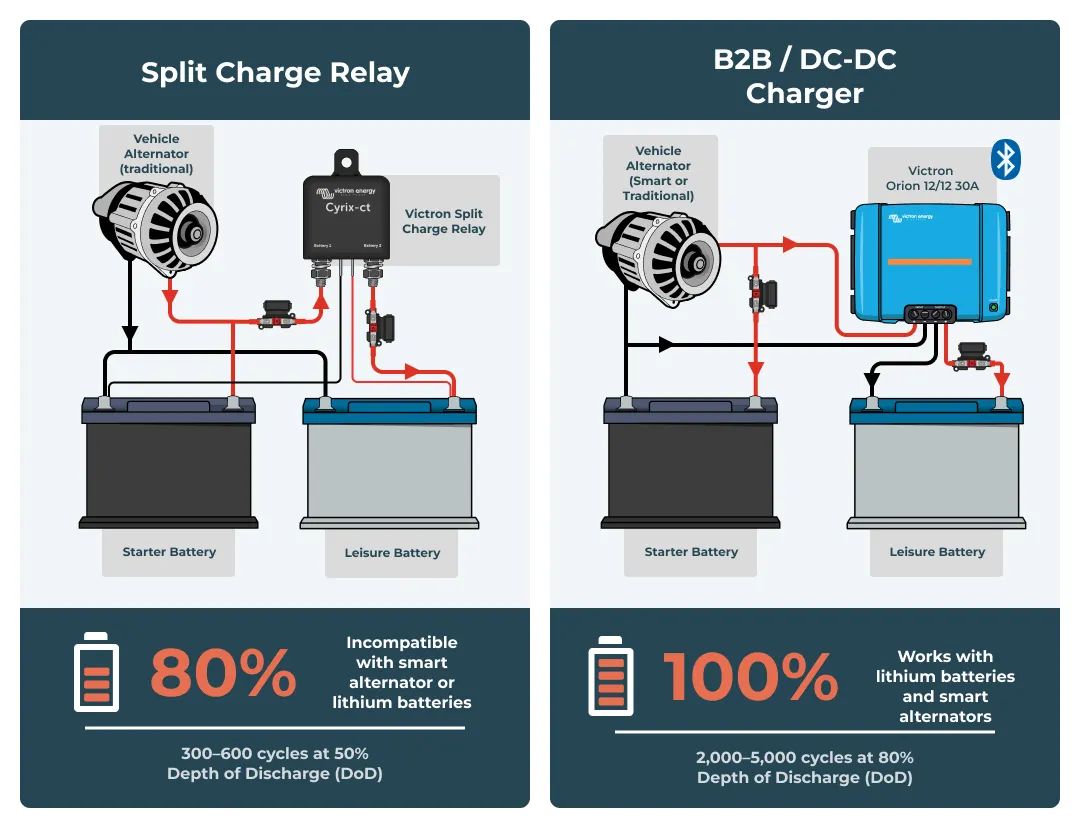
Split charge relays (SCR) directly connect the starter with your leisure batteries while driving. This allows the alternator to charge both but doesn't do anything to regulate voltage, capping your batteries at 80% charge.
This makes split charge relays inefficient compared to modern B2B systems. They're also inappropriate for lithium batteries and incompatible with modern smart alternators.
If you have a regular alternator and traditional battery chemistry like lead-acid or AGM, you can definitely save money by going for a simple voltage-sensing relay type SCR.
But, if budget allows and you're looking for the best performance, modern battery-to-battery chargers are objectively better. You'll get efficient charging to 100%, longer battery life, and more flexibility for the investment.
Isolated vs non-isolated B2B chargers
Most modern smart B2B chargers are isolated, so this part won't be relevant if you've already decided you want the best of the best. However, if you're looking to save costs with a more basic B2B charger, then listen up. An isolated battery-to-battery charger is essential if your leisure and starter batteries have different grounding.
Most campervans will use the vehicle's chassis for this, creating a ‘common chassis ground'. However, in modern vehicles with significant composite parts, it's easy for these different grounding points to not actually sync up, so check grounding points are metallically connected to each other, through either bolts or welds.
If it isn't possible to share a ground between your leisure battery and starter battery, then you'll need an isolated system. This brings the added benefit of being better for powering sensitive equipment like navigation systems or hi-fi's.
Isolated systems ensure power flows from the source to the leisure battery without any direct conduction between the circuits. We call this galvanic isolation and it's possible as the B2B charger houses an internal transformer which transfers the energy through a magnetic field. This filters electrical ‘noise' from the alternator's variable output.
Isolated B2B chargers also prevent ground loops, which means there's no risk of interference if your grounding points have small voltage differences. This provides a cleaner power source and enhances safety.
So, non-isolated systems are cheaper, but you need to be certain that interference won't cause any electrical issues and your grounding is up to scratch.
If you aren't sure, we would recommend playing it safe and opting for an isolated B2B charger, or better yet, an isolated smart B2B charger.
Installation complexity
So, B2B chargers are all singing and dancing, but what are they like to fit? You'll often hear that B2B chargers are a bit more complex to install than simple manual switch and VCR systems, but with the right approach, there's no reason not to self-install.
First things first, B2B chargers generate heat, so you'll have to install it as close to the leisure battery as possible while leaving some space to allow air to circulate and facilitate cooling.
You'll need to connect the positive terminals of the starter and leisure batteries through the B2B charger, with the correct fuses at each side as close to the batteries as possible.
You'll then do the same with the negative terminals to create a complete circuit, and then connect the B2B charger to the alternator either directly or through the D+ connector in your van.
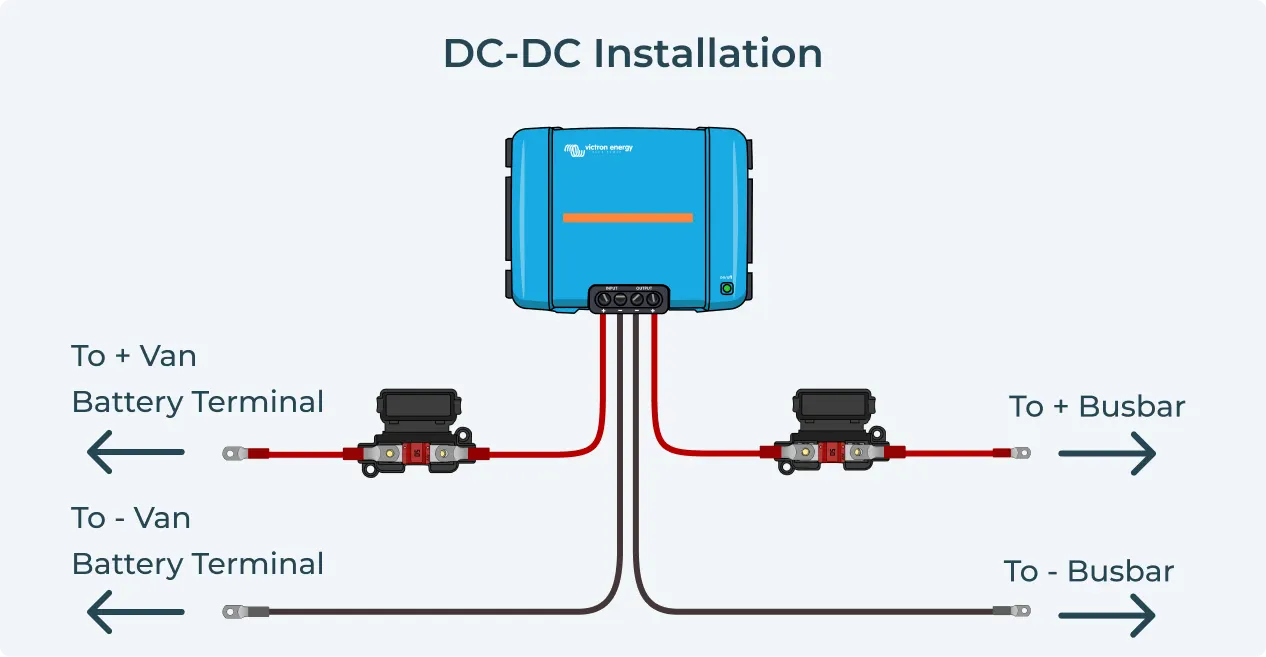
You'll need to use the right thickness of cables to minimize voltage drop and ensure your install follows basic electrical installation guidelines. Make sure any heavy duty protection components are sized to match the charger current. For a full detailed rundown, check out our other guide on How to Install a DC-DC charger
If you order your plug-and-play battery-to-battery system through Vunked, you'll also receive detailed install instructions and complete wiring diagrams.
Compatibility considerations
So, we've covered the basic types of B2B chargers, but which should you actually buy? A lot of this will depend on the rest of your electrical set-up, as well as the nature of your van's existing electrical generation system.
A B2B charger that isn't compatible with your battery type, alternator type, or alternator output can lead to damaged batteries or even system failure, so let's look at what you really need to know.
Alternator type
We've touched on this already, but if you have a smart alternator (2015-onwards), you'll need a B2B charger. These are the best you can get and offer the most efficient charging along with better compatibility with different systems.
We would still recommend a smart B2B charger with older alternator types, but there's more wiggle room here if you are looking to save costs with a basic VSR system.
Alternator output
All alternators have what's called ‘maximum output capacity'. This is how much current they can produce when they're working at full capacity during high revs.
Most alternators will be rated for a maximum of between 120A and 250A, depending on the model of van and engine size. However, they don't normally operate at this capacity, and will usually output around 50% - 60% during normal steady driving.
To prevent overloading the alternator by asking for more charging power than it can provide, your B2B charger shouldn't exceed 40-50% of the alternator's rated capacity. For example, if your alternator is rated to 150A maximum output, it shouldn't support more than a 60A DC-DC charger.
Remember, these are just maximum values, so a 30A DC-DC charger will still work fine with a 100A-rated alternator; on short drives, it just won't provide as fast or a faster charge as a larger correctly matched model.
Also remember that your alternator also powers vehicle systems like headlights, air conditioning, and centre console electronics; since it only produces around 50% of its rated power, overloading the alternator could affect these core systems. It can also lead to overheating of the alternator, extra strain, and even outright failure.
If you find your alternator is struggling to keep up with demand, you either need a smaller B2B charger or a more powerful upgraded alternator, and it’s worth revisiting your DC to DC charger wiring setup to ensure everything is correctly specified.
It's also a good idea to check on the age and condition of your alternator as some older vehicles like VW campers have extremely low output alternators. Similarly, worn alternators may not actually output what they say, leading to inefficient charging.
How to check your alternator type
You should be able to find the type of your alternator from a quick search. Pre-2015 models are unlikely to use a smart alternator, whereas post-2015 models that were sold in the EU will definitely have one.
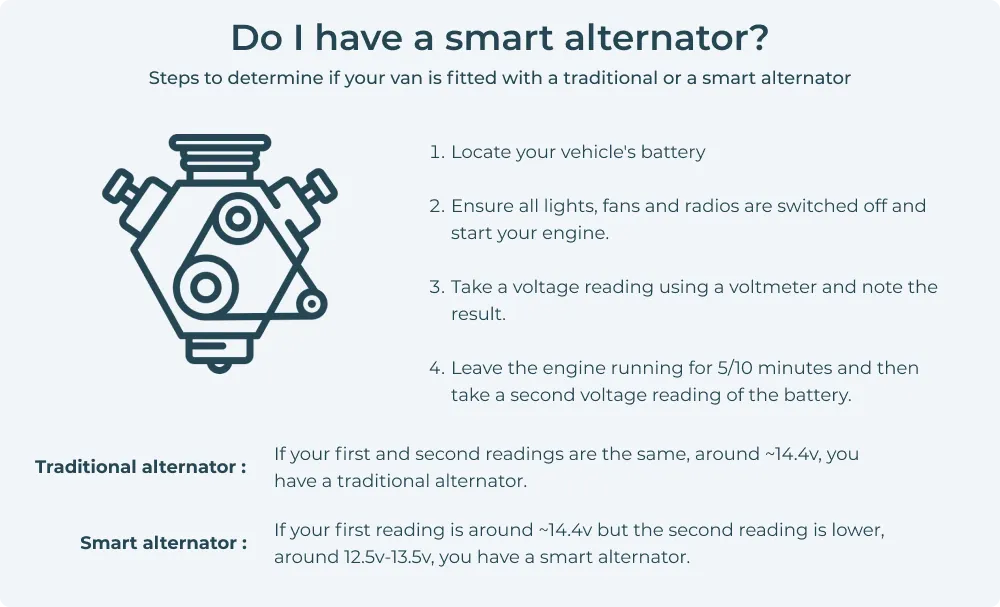
You can also:
- Check the label on the alternator itself, which will usually state its maximum output rating in amps (A).
- Look at the vehicle's manual and search for the alternator's part number
- Input your vehicle's registration with online parts suppliers like Bulleye or Euro Car Parts. This should find the corresponding alternator to your vehicle along with its output rating.
- Do a manual test, read our blog - How to know if I have a smart alternatior
Battery type
While alternator type and split charging methods are a bit more cut-and-dry, battery chemistries open up a whole new can of worms. Different batteries demand specific charging profiles, and not all chargers will work with all battery types.
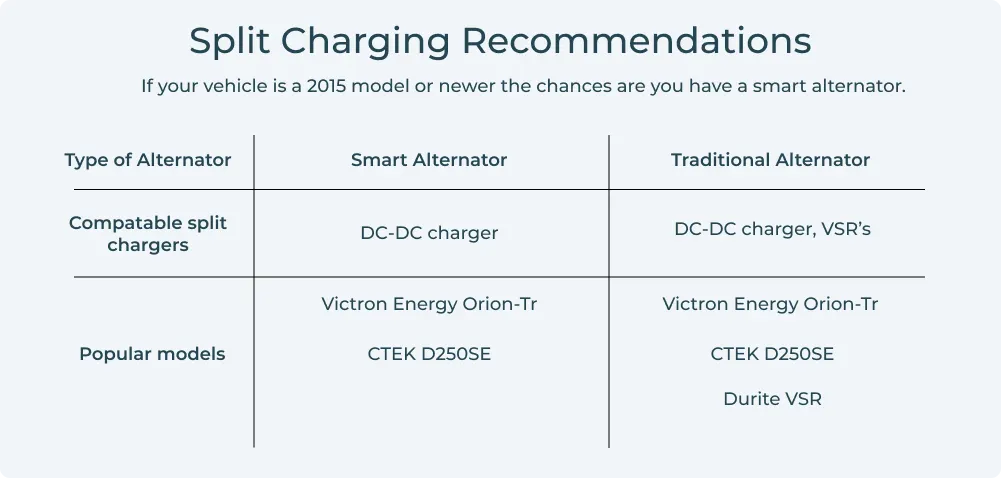
You'll need to ensure the B2B charger you choose is compatible with the battery type you choose; you'll also need to make sure it's capable of recharging the size of the battery or battery bank in place.
This fluctuates depending on battery chemistry, and a 100Ah Lithium battery has completely different charging requirements than a 100Ah AGM battery due to different max charging current and different usable capacities of charge.
For example, a 100Ah AGM battery could be paired with a 20A charger, while a 100Ah lithium battery bank could require a charger capable of delivering up to 50A, especially if you’re building a battery and solar panel kit for your campervan.
To make this easy, the following table breaks down common battery types and their unique B2B charging considerations:
Battery type | Overview | Max charging current | Usable capacity |
|---|---|---|---|
Lead-acid batteries | Cost-effective, widely used, requires a consistent charging profile to prevent sulfation and prolong lifespan. | 15-20% of capacity. For a 100Ah battery: 15-20A. | Discharge to 50% of total capacity. Example: 100Ah → 50Ah usable capacity. |
AGM (Absorbed Glass Mat) batteries | Subtype of lead-acid, supports deeper discharges and faster recharge times, needs precise voltage regulation. | Up to 20% of capacity. For a 100Ah AGM battery: 20A. | Discharge up to 80% of total capacity. Example: 100Ah → 80Ah usable capacity. |
Gel batteries | Durable, deep-cycle, requires careful voltage control to avoid overheating and damage. | Around 30% of capacity. For a 100Ah battery: 30A. | Discharge to 50% of total capacity. Example: 100Ah → 50Ah usable capacity. |
Lithium-ion batteries | High efficiency, higher usable capacity, needs specific charging profiles, including temperature monitoring. | Up to 50% of capacity. For a 100Ah lithium battery: 50A. Some allow charging at higher percentages. | Discharge 90-95% of total capacity. Example: 100Ah → 90-95Ah usable capacity. |
Due to the significantly deeper discharge we recommend using modern lithium-ion batteries if budget allows. However, AGM is more than sufficient for basic set-ups, and provides some niche advantages such as better charging in extremely cold temperatures. |
If you're planning on running a bank of multiple batteries, some B2B chargers also feature parallel charging. This lets the charger handle multiple batteries simultaneously, so keep an eye out for this feature.
If budget allows, we would always recommend going with a modern Lithium-Ion battery. AGM and Gel batteries are old technology and offer inferior performance in almost every way, especially in more demanding campervan electrical systems for different lifestyles.
Integration with solar systems
Many modern campervans integrate solar power systems into their energy system, supplying free, clean energy to recharge leisure batteries when living off grid, and the choice of solar panels for campervans will strongly influence how well this works in practice.
If you're looking to integrate solar into your set-up, then you can combine the two, and it can be helpful to start from complete campervan solar panel kits that match your charging needs.
Some smart B2B chargers with integrated control systems can be used to combine the two energy sources. This means that while you're driving, your solar panels are contributing to recharging your leisure batteries
These control systems come in either PWM or MPPT. PWM is cheaper, but less efficient for large systems. MPPT, on the other hand, maximises energy extraction and is ideal for campervans.
Combining these technologies sounds great in theory, but we recommend keeping your DC-DC charger and solar charge controller seperate. Combined DC-DC and solar charge controllers often come in one size, meaning it's unlikely they'll be perfectly sized for your battery setup.
Similarly, your solar charge controller should also be specific to the size of your solar panels, so keeping it seperate from the B2B charger means you can size it properly for your needs.
Keeping them seperate also means you can buy a separate MPPT and keep your existing B2B charger if you decide to integrate solar down the line or change the size of your panels.
Choosing the right B2B charger
It can be tempting to go for the biggest and best B2B charger available to get the quickest charging times, but this runs the risk of exceeding your alternator's capacity.
Start with identifying your alternator type. If it's a smart alternator, then you'll be choosing between smart B2B chargers. If not, you'll have a bit more flexibility with model choice.
Next, consider your alternator's maximum output. Choose a B2B charger that's around half of this figure. Finally, ensure its charging output capacity is matched to the type and size of battery you want to use using our table.
Remember, there are alternator upgrades available if you find that the current system simply can't safely charge the type and size of batteries you're using. You might need to look at these if you're planning on large banks of lithium batteries or running an inverter for 230V power.
You'll also need to consider whether you plan to run solar power now or in the future and need a smart B2B charger with integrated MPPT functionality, especially if you’re aiming for a campsite hook up campervan electrical system that can charge from both alternator and shore power.
Finally, remember that while lithium batteries do allow for high charge rates of 50%, slower charging will still be better for their health long-term, so there's no need to overlook a B2B charger that supplies less than the maximum 50%.
Victron Energy vs. Renogy: DC-DC Chargers
So, now you know how to choose the right size and type of B2B charger, but what about the best brand? Let's compare the leading suppliers of DC-DC chargers, including well-known options from Victron Energy, Renogy, and Sterling Power.
Victron Energy and Renogy are the two main manufacturers of DC-DC chargers for campervans, with each catering for different budgets and feature requirements.
Victron Energy | Renogy | |
|---|---|---|
Build quality & reliability | High-end, long-term durability, known for premium components and excellent heat dissipation. | Acceptable build quality, generally less rugged as Victron. |
Features and technology | Advanced features like Bluetooth monitoring via the VictronConnect app, high efficiency, compatibility with lithium batteries. | Basic functionality with some models offering Bluetooth (usually via an extra module), fewer advanced customisation options. |
Performance and efficiency | More efficient, optimised charging algorithms, better performance under varying loads. | Slightly lower efficiency and may experience voltage drops under high loads. |
Price and value | More expensive but offers premium quality and advanced features. | More affordable, making it a good option for budget-conscious users. |
Support and warranty | Excellent customer support, well-documented resources, strong user community. | Okay support, sometimes criticized for slow response times. |
We recommend Victron if you're looking for top-tier performance, reliability, and advanced features, especially for off-grid or professional setups, and you can even choose from complete Victron off-grid campervan systems if you want an integrated solution. If you're looking for a budget friendly option for lighter use and can compromise on features, Renogy might be more suitable. |
Ready-to-ship kits or tailored advice can often be turned around within an hour. You can also make all of this simple by using Vunked's electrical system builder. With our online tool, simply tell us your requirements and we'll put together a complete compatible electrical system in kit form.
You'll receive every bit and piece needed for installation, along with detailed instructions and comprehensive wiring diagrams, ideal if you prefer following clear campervan 12V wiring diagrams. We also now supply premade ready to install electrical system kits designed for everything from weekend getaways to full-time off-grid living.
You can also get in touch or even book a free campervan electric consultation if you're still struggling with finding the perfect B2B charger set-up for your four-wheeled dream home.
Do I need a B2B charger for my campervan?
You will need a B2B charger for your campervan if your vehicle uses lithium-ion leisure batteries or has a smart alternator. It's still a nice-to-have if not, but not absolutely essential.
Can I use a B2B charger with a smart alternator?
Yes, you'll need to use a smart B2B charger with a smart alternator as it can dynamically adjust the charging process to account for the variable voltage smart alternators produce.
Do I need a 25A or 40A DC-DC charger?
The size of DC-DC charger you need will depend entirely on the maximum output rating of your alternator and the charging needs of your specific battery set-up.
What is the difference between a B2B charger and a split charge relay?
A split charge relay simply splits the charging output of your alternator between your van battery and your leisure battery. A B2B charger on the other hand can dynamically adjust this charge using different charging profiles to ensure full charge and maximum efficiency. Split charge relays also don't work well with lithium batteries and are completely incompatible with smart alternators.