
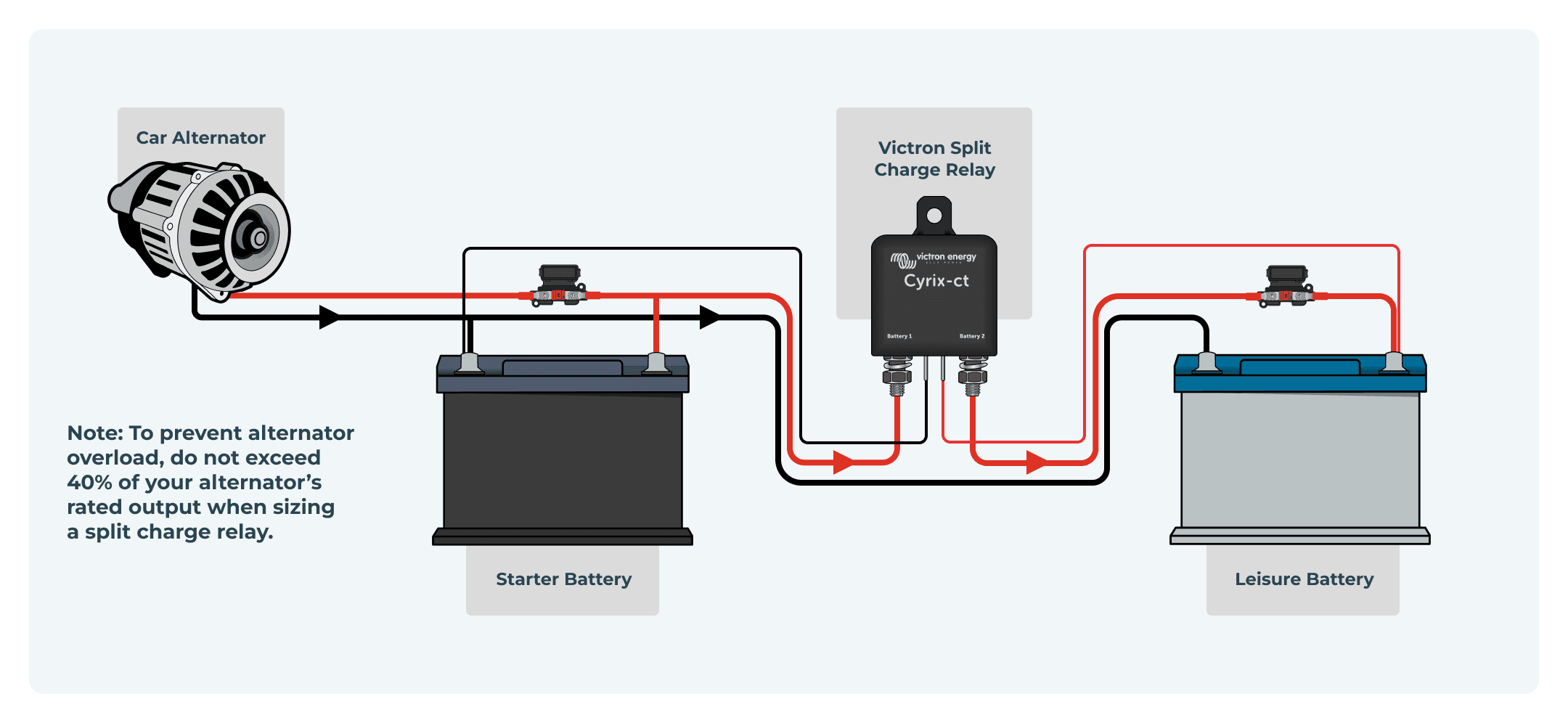
Split charge relays offer an affordable and convenient way to charge your leisure batteries while driving. This is crucial when you’re planning to adventure off-grid and need a way to keep your appliances running longer.
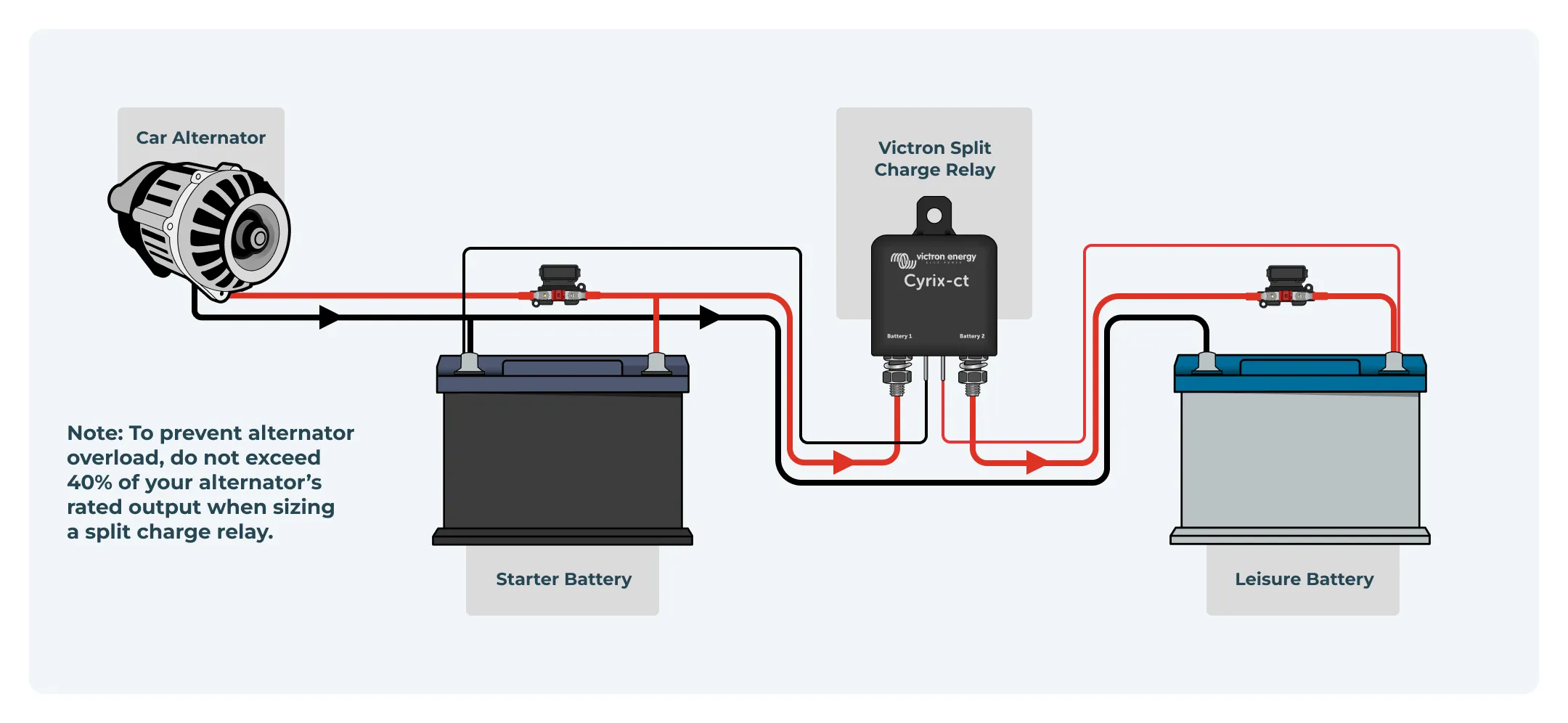
However, they aren’t compatible with every system, and it’s important to understand their advantages and limitations compared to more modern solutions. To help with this, we’ve created this comprehensive guide to split charge relays.
We’ll cover the different types of split charging systems available, how to select and set up a split charge relay, and what vehicles they’re compatible with. We’ll also look at troubleshooting and safety tips to keep you exploring longer.
What is a campervan split charge relay?
In short, a split charge relay is an electrical device that lets you charge your leisure battery while driving. Unlike DC-DC chargers, which are required for newer vans and dynamic charging, Split charge relays are simpler devices used with traditional battery chemistries and regular alternators. You can learn more about B2B chargers in our
ultimate DC-DC charging guide.
In a regular van, the alternator is the part that converts the mechanical energy of the engine turning over into electrical energy to recharge a standard battery.
In a campervan, there are also leisure batteries to consider. A split charge relay allows your alternator to charge your leisure battery once your starter battery hits a preset voltage. This keeps both batteries charged with minimal fuss.
Split charge relays are generally also voltage sensing, meaning this switch between batteries happens automatically and doesn’t need any manual intervention. It also means that you don’t risk draining your batteries if you forget to turn anything off when parking up.
Almost all modern split charge relays are voltage-sensitive relays, sometimes called VSRs. This means all VSRs are SCRs, but not every SCR is necessarily a VSR. Still with us?
Split charging relays are in general the most cost-effective way to charge both your regular and leisure battery while driving.
That said, it’s important to note that split charge relays generally can’t fully charge your leisure batteries as they can’t dynamically moderate charging. They also don’t work with smart alternators or lithium leisure batteries, but more on that later.
Types of split charging systems
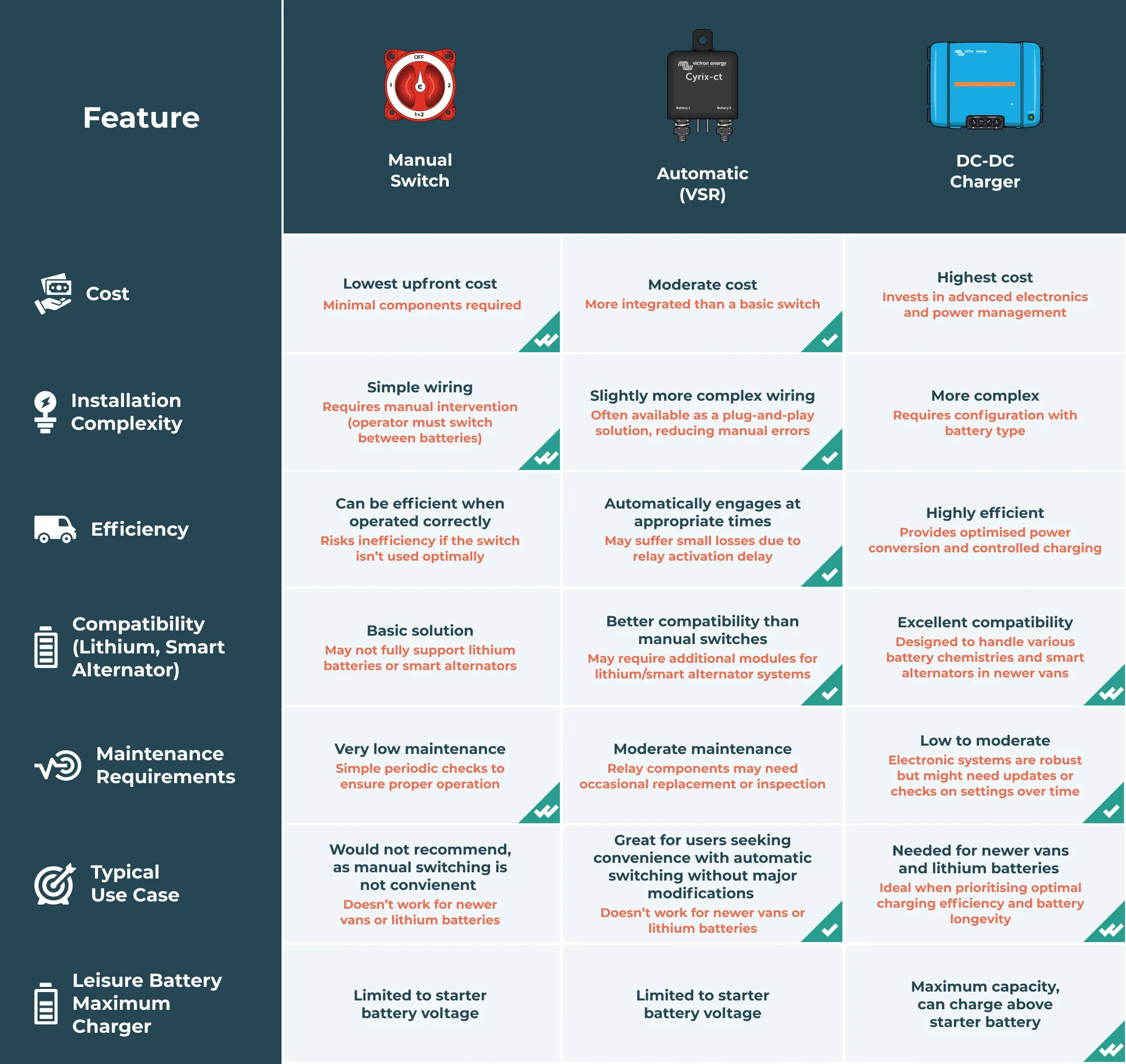
Split charging systems vary widely in complexity and functionality. Here’s a rundown of the main types you’ll see on the market today:
Automatic relay systems
These are what is generally referred to when people say split charge relay or voltage sensitive relay (VSR). These systems use relays which engage automatically based on certain conditions, such as a certain detected battery voltage or the engine turning on.
Your alternator will still charge your regular starter battery, but once full the relay engages. With the relay engaged, the alternator then charges your leisure battery until it’s full or the engine is turned off.
Many modern systems are also dual-sensing. This means voltage drops on either the starter battery side or the leisure battery side while driving allowing the relay to switch between the two as and when needed.
You’ll also find some split charge relays with an emergency start feature. This allows power from the leisure battery to be used to crank the engine over in an emergency when the starter battery is drained.
VSRs also simplify the wiring process compared to older split charge relays. This is because an automatic relay doesn’t need a trigger wire running from the relay to the alternator itself to tell the relay when to engage and charge the leisure batteries.
While VSRs are a cost-effective means to charge while driving, they still charge less efficiently than DC-DC (or battery-battery) chargers. They’re also less safe and aren’t compatible with lithium batteries or smart chargers.
Advantages
- Convenient operation
- Generally affordable
- Relatively easy to install
- Dual sensing options
- Emergency start options
Disadvantages
- Relays can wear out over time
- Less efficient versus advanced systems
Manual switch systems
Manual switch systems are less common nowadays but offer the simplest form of split charging. Instead of using a relay to control charging, you need to manually control the connection between the starter and leisure battery with a high current switch.
This involves wiring the positive terminals of the starter battery to the positive terminals of the leisure battery, with the switch in the middle and a fuse on either end.
While this is cheap and reliable, it means that human error can cause either battery to not charge. It also means that batteries can become drained if you forget to turn the switch off when parking up.
Advantages
- Low cost
- Easy to install
- Robust and reliable
Disadvantages
- Requires manual operation
- Prone to human error
- Potential battery drain
Smart charging systems
A smart charging system, sometimes called a DC-DC charger or B2B (battery to battery) charger is the most advanced way to charge a leisure battery while driving.
These not only maintain the charge of both batteries but can monitor the battery’s condition and adjust the charging process to optimize battery health and performance.
Since a smart leisure battery charger can modulate charging, they also have fast charge capabilities as well as built-in protection against overheating. They’re also the only option if your campervan uses lithium ion leisure batteries or is fitted with a smart alternator.
As a general rule, if your vehicle complies with Euro 5 or Euro 6 emissions regulations, you’ll have a smart charger. This usually applies for vans from 2015 onwards so be sure to check before investing in a split charge relay or split charging system.
Advantages:
- Intelligent charging
- Built-in protection
- Compatible with smart alternators
- Works with lithium leisure batteries
Disadvantages:
- Higher initial cost
- Slightly complex installation
DC to DC charger vs split relay
In general, battery-to-battery chargers (B2B chargers) are the best way to charge a leisure battery. While they’re more expensive upfront, you get more efficient charging, better battery life, and a higher degree of safety over traditional split charging systems. They’re also compatible with all alternator and battery types.
For a full overview of the different types of split charging systems available, check out our article on how to charge a leisure battery while driving.
Components of a split charge system
A modern split charge system is relatively simple, relying on just a few key components outside of your campervan’s existing electrical system. These are:
- Voltage Sensing Relay (VSR): Sometimes called the charge unit. Connects the leisure battery to the charging circuit and automatically engages when your starter battery is charged up to a certain voltage.
- Trigger wire: In non-VSR systems, this wire runs from the alternator to the relay to activate it. This ensures the leisure battery only charges when the alternator is producing enough power (i.e., not charging the starter battery).
- Isolator switch: This lets you manually disconnect the leisure battery from the starter battery for safe maintenance or in an emergency.
- Leisure battery: This is the secondary 12v battery in your split charging system, used to power auxiliary electrical systems like campervan lighting, fridges, or other accessories.
- Starter battery: This is the standard battery that comes with your campervan. It’s used to start the engine and power core systems like ignition and fuel pumps.
- Alternator: This is the mechanical part of your engine that generates electricity to recharge batteries while the engine is running.
- Earth cables: This prevents electrical surges and faults by providing a safe return path for electrical current to the ground.
- Fuses: This protects the split charging system from overcurrent by breaking the circuit if there’s an electrical overload.
Choosing the right size for your split charging relay
‘Size’ in this case refers to the charging capacity of your split charging unit, measured in amperage (A). This controls how quickly the relay can charge your leisure battery, with a higher amperage allowing for faster charging times but requiring thicker cables.
It’s important to choose the right size for your set-up to ensure efficient charging without overloading the system or putting unnecessary strain on your alternator.
To keep your alternator safe, it’s a good rule of thumb to avoid drawing more than 40% of its maximum output. This means that for a 140A alternator, the split charging unit you choose should not exceed 56A.
If you’re using a split charging relay it means you’ll have AGM or Gel batteries. These are less demanding on an electrical system and usually use a smaller alternator compared to more modern vehicles. Be sure to check the output rating for your vehicle's alternator before choosing a split charging system.
Cable sizes
Cable sizing is complex and it’s easy to get your wires crossed. Essentially, your cables need to be rated to handle the maximum current output of the alternator without any significant voltage drop.
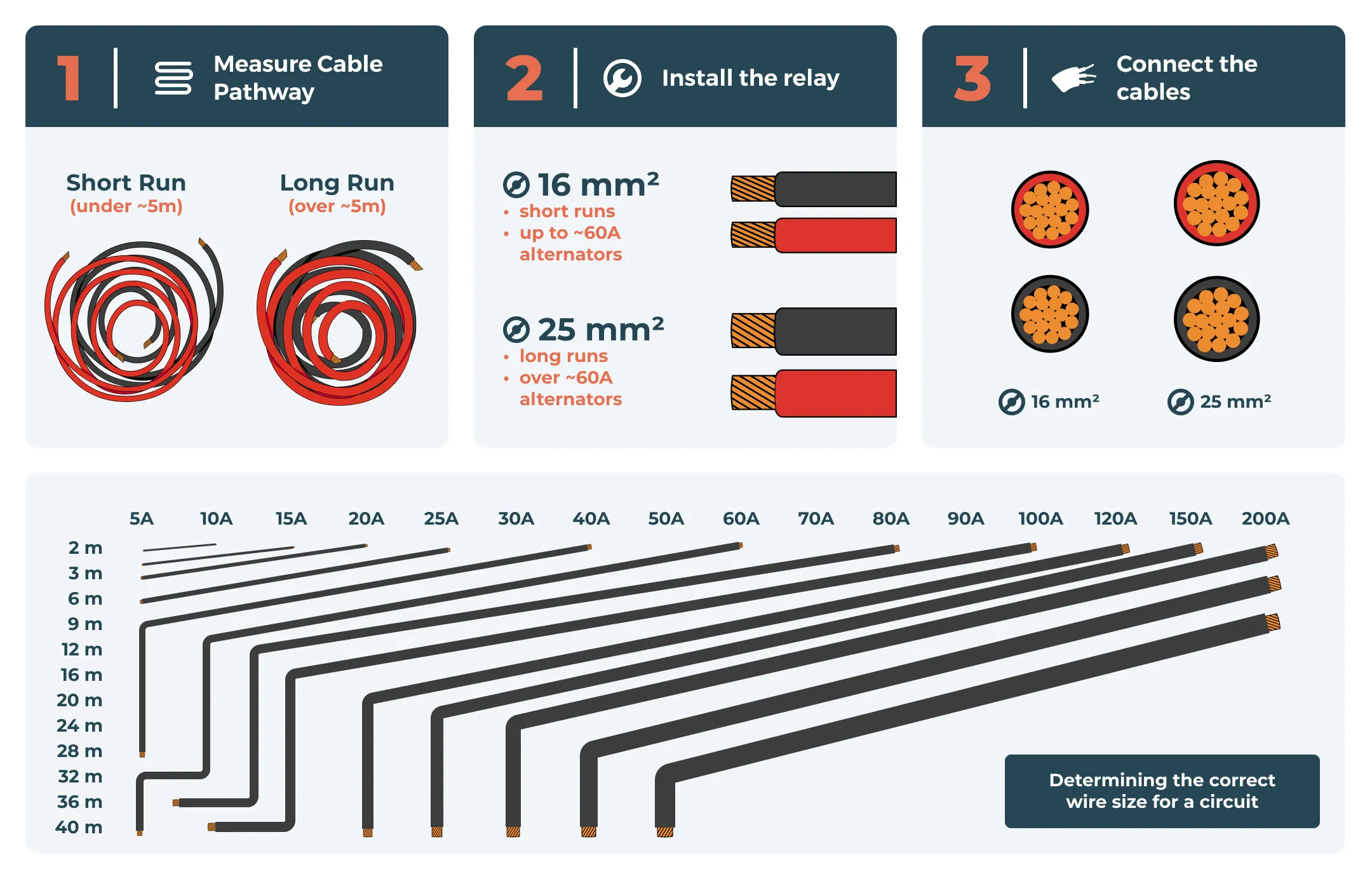
Size them too small and you’ll be liable to inefficient charging and potential safety hazards like fires or system failures due to heat build-up.
For this reason, it’s a good idea to err on the side of caution and oversize. As an example, an alternator rated to 60A would use cables with a cross-section of at least 16mm², or rated to 110A over short distances.
It’s also important to remember that cable length is also a factor. Using the above example, a 60A alternator would need cables with a cross-section of 25 mm² when running longer than 3 metres. To reduce voltage drop and maximise safety, keep your cables short and thick.
How to install a split charge relay
Installing a split charge relay is relatively straightforward. Essentially, you’re simply connecting the starter and leisure batteries through the relay with the right fuses and cables. Here’s how:
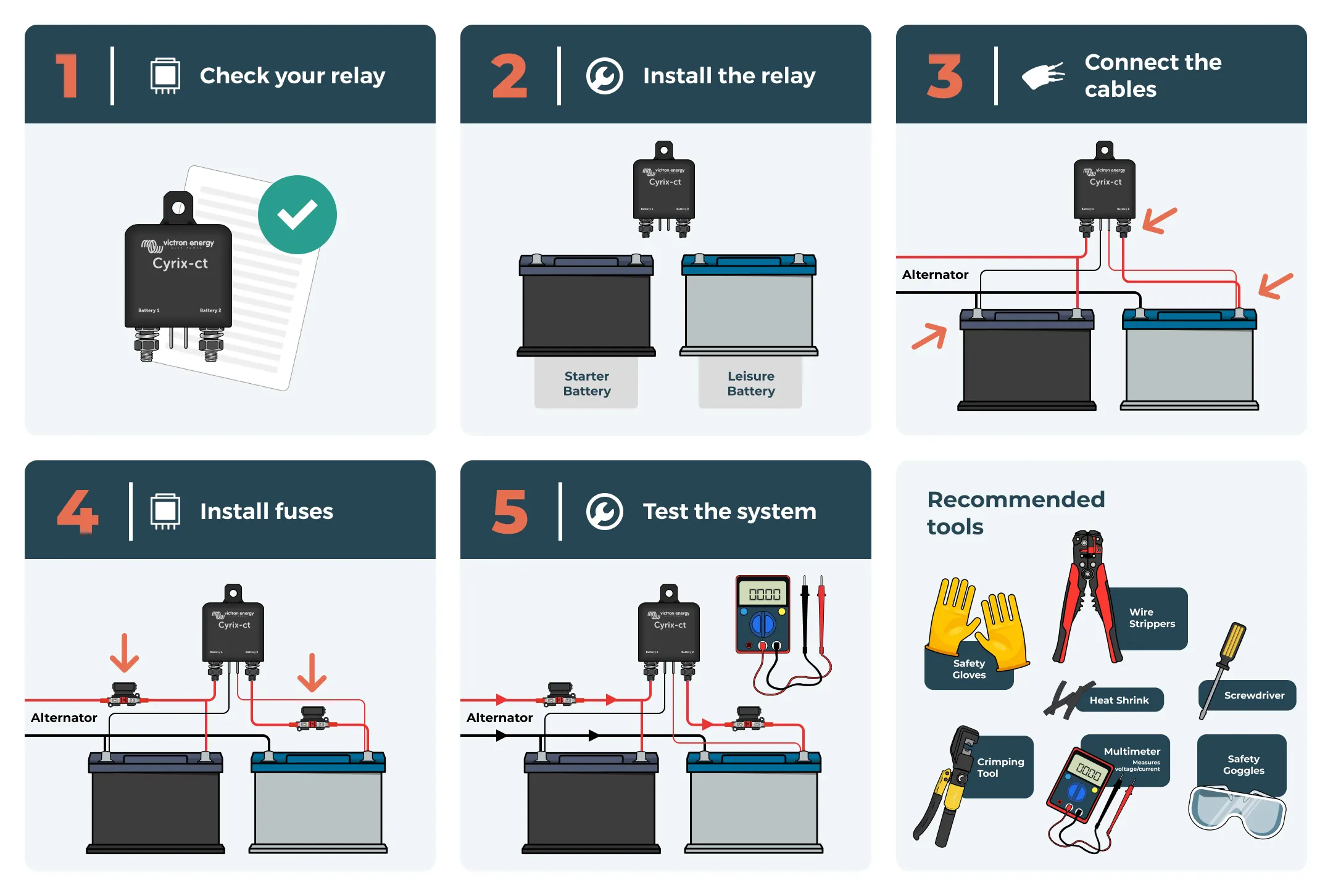
- Check your relay. Double-check that your relay is compatible with your alternator output rating and battery specifications.
- Install the relay. Mount the relay in a suitable location, close enough to your batteries to keep cables short but with plenty of space and ventilation to avoid heat build-up.
- Connect the cables. Connect your cables between the starter battery, leisure battery, and relay according to the above wiring diagram. Ensure connections are secure and protected. Make sure cables won’t rub on metal components and are well protected.
- Install fuses. Place fuses on both ends of each cable to protect against overcurrent or short circuits from issues like wires rubbing.
- Test the system. Start the engine and see if the relay engages. If so, go for a drive and use a battery monitor to check leisure battery charge levels. If you don’t have a battery monitor, use a digital multimeter when stationary.
If you’ve installed your system correctly, your leisure batteries should match the voltage produced by your alternator, usually around 13.8V-14.8V.
Balancing and protecting your split charging system
Since different cable lengths can handle different capacities, it’s a good idea to use equal cable lengths for connections from each component to the relay.
We also recommend using fuses as close to batteries as possible to protect against electrical faults.
If you have a bank of multiple leisure batteries together, follow these tips for safety and equal charging:
- Use equal-length cables from the split charge relay to each battery.
- Keep cable lengths as short as physically possible.
- Ensure cables are rated for the current present considering their length.
- Ensure the earth cable from every battery is short and of equal length and size.
- Keep battery-to-battery connecting cables as short as possible.
- Use batteries of the same type, size, and age to level charge-holding capacity.
- Discharge your batteries equally to ensure they age at the same rate.
It’s also a good idea to install a manual isolation switch between the starter battery and the leisure battery for quick disconnection during an emergency.
Legal and safety guidelines
Before beginning any install it’s important to ensure all components are rated correctly for your intended use. It’s also important to follow automotive electrical regulations like BS7671 to ensure your split charge system is safely installed.
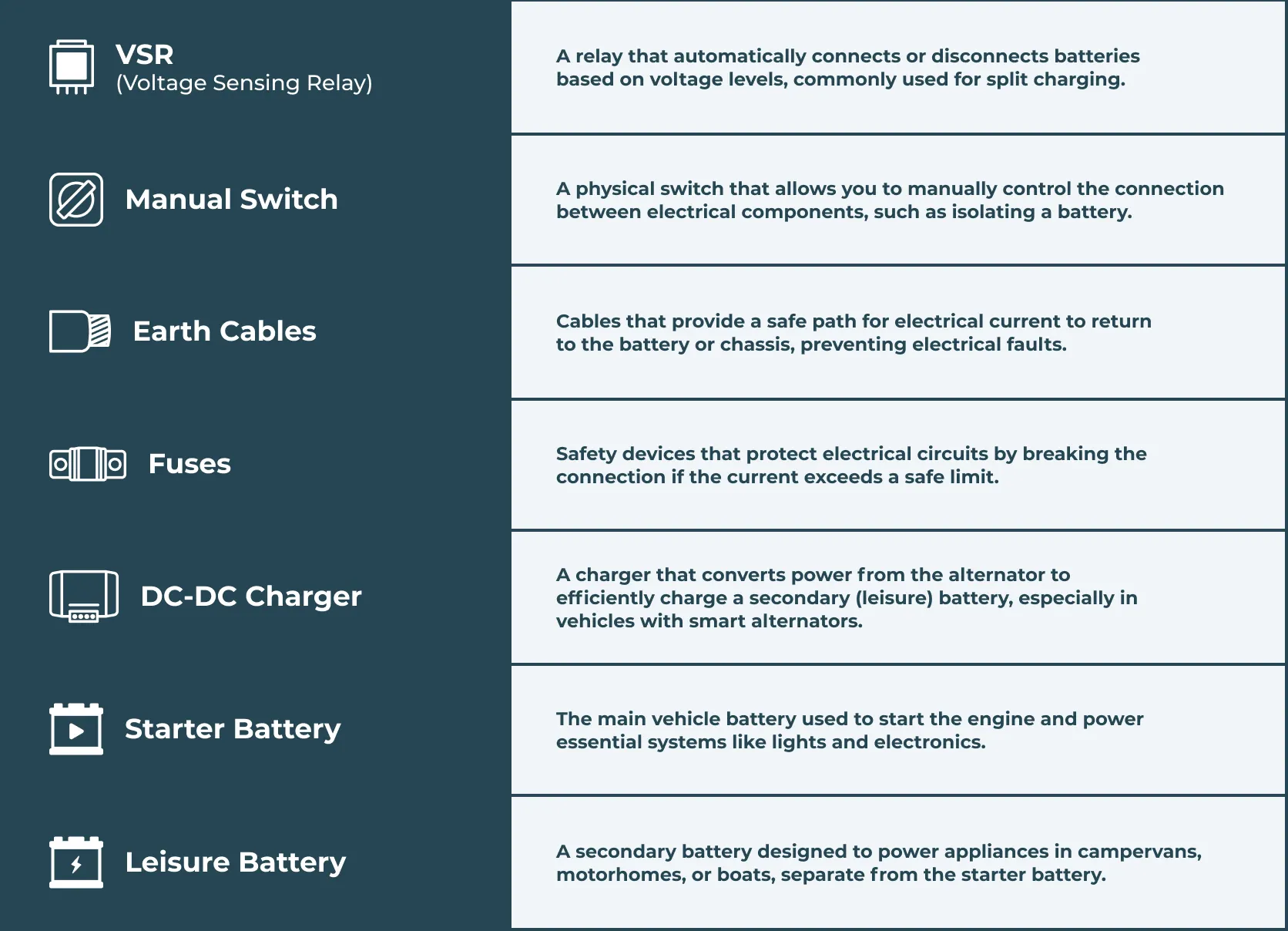
The following considerations are a good place to start:
- Cables. Always install in a way that prevents mechanical damage from rubbing and exposure to unnecessary heat. Ensure split charging cables are fully protected in conduit or sheathing, especially when passing through metal parts of the chassis or around other components.
- Earthing. All metal parts including the leisure battery, alternator, and any bus bars need to be grounded to your vehicle's chassis to provide a low-resistance path for currents in case of a fault. Remember these earths need to be connected to a patch of bare metal and not a painted surface.
- Fuses. All cables need to be protected by an appropriately rated fuse to prevent electrical fires. Each battery connected to the relay device should also have a fuse installed as close to its positive terminal as possible.
- Manual isolation switch. This isn’t absolutely necessary but highly recommended to let you disconnect the batteries for maintenance or in an emergency.
- Heat management. Chargers, alternators, and relays all generate heat. This is especially true under high loads. Mount your split charge relay in an area with plenty of space around it and as far away as feasible from heat-generating components. Exceeding the 40% rule of load limit for your alternator can also cause excess heat build-up.
Maintenance and troubleshooting
Regular maintenance will keep your split charge system working properly for years to come. Routinely inspect connections, cables, and the relay itself for any signs of wear or damage. Common issues and fixes include:
- Relay malfunction. Check for loose connections and blown fuses. If none exist, contact the supplier to replace the relay if it still fails to engage.
- Undercharging. Inspect cable connections for security and test the voltage of the alternator with a multimeter to ensure it is working properly. Its output should be 13.8V - 14.8V.
- Voltage drop. Ensuring your cable lengths aren’t too long and you have used wire of suitable thickness. Voltage drop causes cumulative electrical resistance which stops your leisure battery from fully charging.
Choosing the right split charging system for your vehicle
Follow the instructions in this guide and you should have no problem understanding, sizing, and safely installing a split charging system.
If you’re looking to build a complete electrical system for your van, including split charging, why not use Vunked’s Electrical System Builder? It’s an easy tool that lets you easily configure every part of your campervan’s electrical system.
When you're done, we’ll send you the full system in kit form, with wiring diagrams, detailed instructions, and every component you need to get up and running in no time! We can also supply a standalone split charge relay kit using an industry-leading Victron split charge relay.
Frequently asked questions
Should a split charge relay light stay on?
Yes, this is completely normal and your indicator light should stay on while the relay is engaged. This indicates the batteries are connected for charging.
Can you use a split charge relay with a smart alternator?
No. Smart alternators work completely differently from regular alternators and aren’t suitable for use with split charge relays. Smart alternators run at low voltage which spikes to around 17V when engine RPM rises. This means that you need to use a DC-DC charger (AKA a B2B charger) to charge while driving as it can regulate variable voltage input.
Can you use a split charge relay with a lithium leisure battery?
Lithium leisure batteries are lighter and have better deep discharge capacity than regular AGM or Gel options. However, they’re vulnerable to overcharging and need a precise multistage charging profile that split charge relays can’t provide. We recommend a DC-DC charger like the Victron Orion which is designed for lithium batteries.
What is the difference between a DC to DC charger and a split charge relay?
A DC-DC charger offers much more advanced charging control than a split charge relay. They’re also suitable for multiple battery types, including AGM, Gel, and critically, Lithium. Unlike basic split charge relays they also allow for variable charging and can work with smart alternators. DC-DC.