
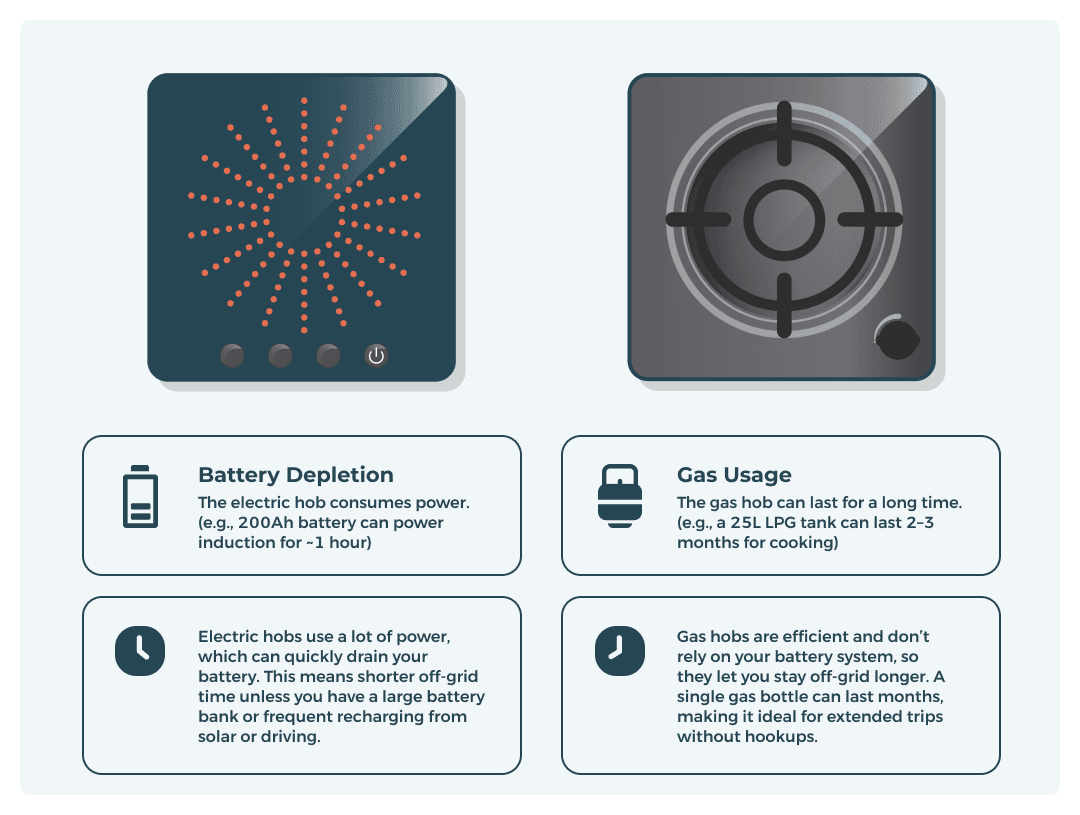
Van Conversion
By Ross Deacon12 min read
While gas hobs have been the de facto standard for campervans for years, induction hobs are all the rage at the moment, leaving many wondering which is right for their set-up.
Induction vs gas is about more than cooking practicality, and you'll need to consider power consumption, cost, practicality, and off-grid capability to make the right choice.
There are also instances where one option is objectively impractical, and installing a system that isn't aligned with your intended use case can be both expensive upfront and massively frustrating down the line.
In this guide, we'll break down exactly how each option works, look at their respective advantages, and evaluate which is better for your off-grid culinary adventures!
How induction hobs work
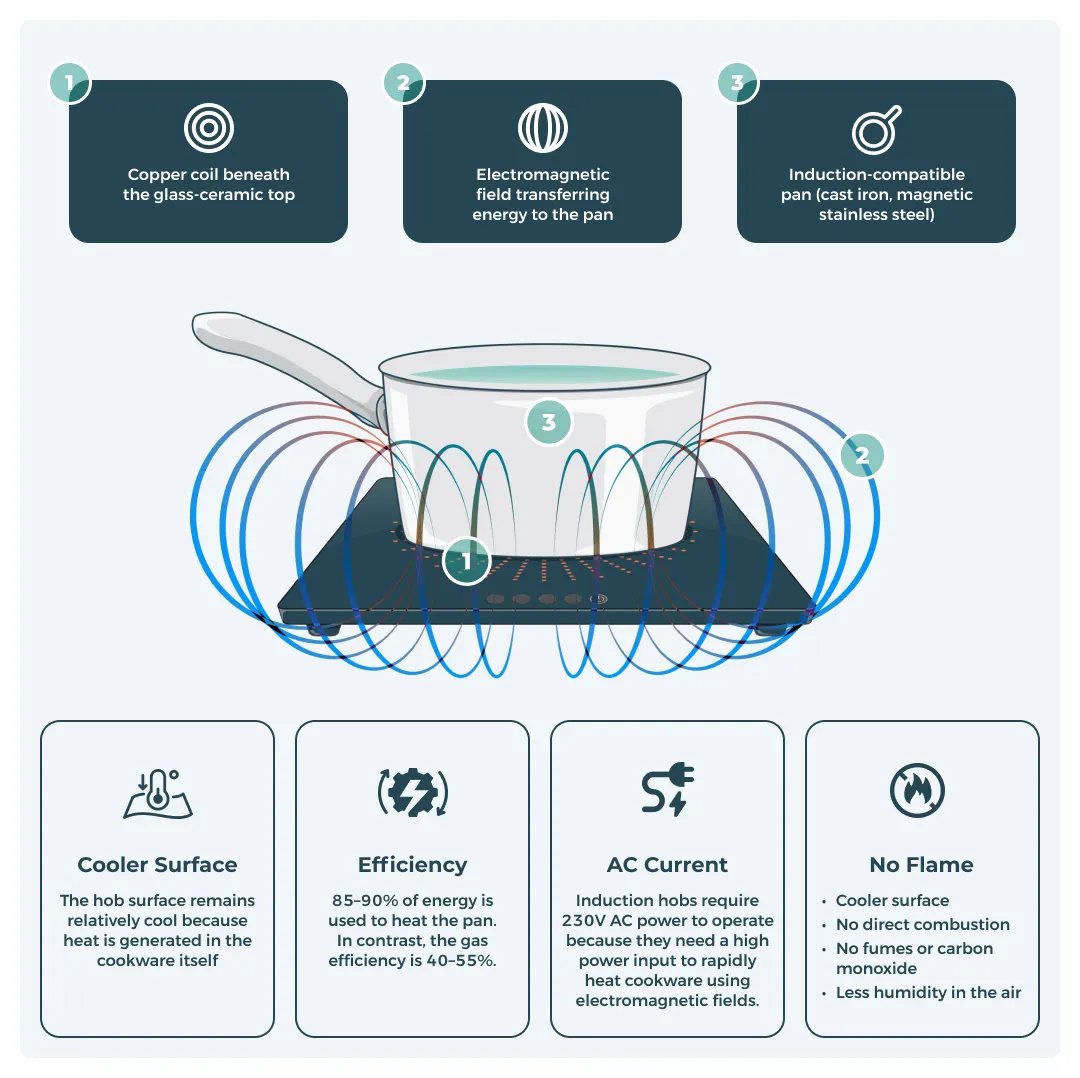
Induction hobs work by using an electromagnetic field to generate heat directly within the pan instead of heating the hob surface itself.
Essentially, there's a copper coil just below the glass-ceramic cooking surface that produces an alternating current to create an electromagnetic field. This field induces an electrical current in the pan, which produces heat through resistance.
Since this relies on electromagnetism, your cookware needs to be ferrous. This just means iron-based, so cast iron or magnetic stainless steels, such as ferritic stainless steel.
Aluminium and copper won't work unless they have a specific induction-compatible base. With how popular induction hobs are becoming for home use, this isn't an issue, and you'll find compatible cookware at any big supermarket or homeware shop.
Since there's no open flame or large surface to heat, induction cooking is highly efficient, with about 85-90% of the energy being transferred directly into the food. With a gas hob, this figure is closer to 40-55% as heat is lost to the surrounding air.
However, this measure of “efficiency” only refers to the technical scientific meaning based on wasted energy. As we'll cover, it doesn't mean that an induction hob doesn't use a lot of energy in the first place.
What it does mean is that induction hobs heat up quickly, boil water faster, and offer more precise temperature control than conventional cooking, which makes for efficient cooking and can finish some tasks in half the time compared with conventional electric hobs.
There's also less risk of burning yourself or accidental fires since the hob surface itself isn't as hot as gas or traditional electric hobs. Since there's no flame, there are also built-in safety features and no fumes or condensation issues to worry about.
However, unlike a simple gas cooking set-up, induction hobs will require a full electrical system, including an inverter and shore power charging to run. You'll also need a bigger bank of modern lithium leisure batteries and a good solar system to even consider going off-grid, so it’s worth understanding the basics of campervan electrics before committing to induction.
How gas hobs work
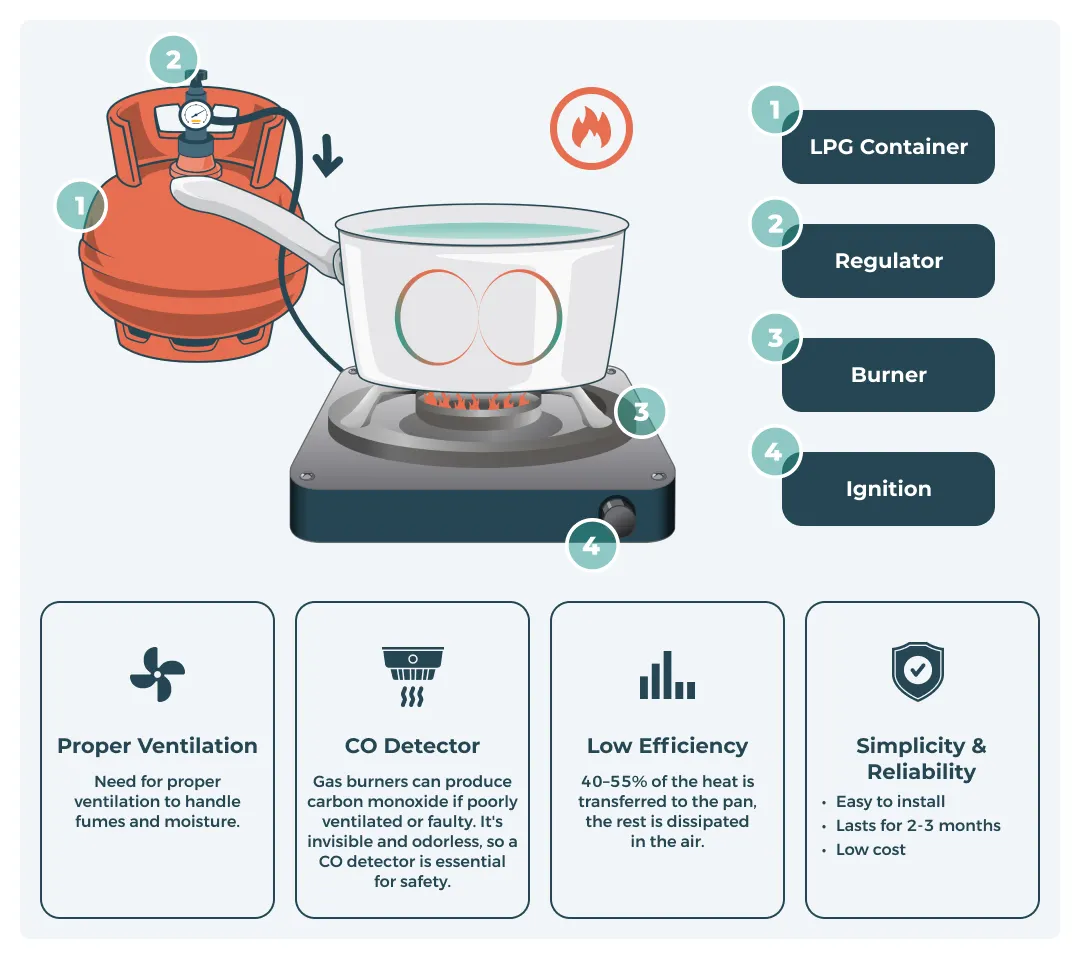
Campervan gas hobs burn LPG (liquefied petroleum gas) as part of your campervan's lpg system, typically using propane or butane to create heat for cooking. The gas flows through a regulator from a pressurised container and is ignited by a spark or flame to create a controlled fire underneath your pan, just like how mains gas fuels your oven at home.
One of the biggest advantages of gas hobs is their simplicity. There are no electrical parts that could become damaged, and even self-igniting models can be started with a lighter or spark. This makes them incredibly reliable and ideal for off-grid set-ups where a reliable electrical supply might not be a guarantee.
Gas hobs also produce instant heat, though they don't tend to heat cookware up quite as fast as induction can. They make up for this with intuitive temperature control that can be manually adjusted and visually measured, as opposed to numbered markings on a dial. This is ideal for more careful jobs like simmering or high-heat searing.
However, gas hobs are less energy efficient than induction, with a large percentage of the total heat produced escaping around the pan rather than actively cooking. Again, this is “efficiency” in a scientific sense, and in reality, gas hobs can last for ages on a single small LPG bottle.
Another consideration when cooking with a gas hob is ventilation. Burning LPG produces carbon dioxide (C02) and water vapour.
This increases humidity in the air and can lead to condensation inside your campervan without proper ventilation. The result can be mould growth in your camper insulation and air quality issues, so you'll need adequate ventilation when cooking on gas.
This doesn't have to be anything crazy, and your camper should be well-ventilated anyway, as air quality and condensation issues aren't exclusively caused by gas cooking.
What is specific to gas cooking is the risk of carbon monoxide buildup. This isn't anything to worry about, and only happens when the flame doesn't burn cleanly and you have inadequate ventilation.
Even though modern LPG gas cooking is extremely safe, it's still a good idea to pick up a carbon monoxide detector for extra peace of mind when cooking in confined spaces.
Portable gas bottles and underslung tanks can both work well, but the right choice often comes down to how much gas tank capacity you want and how easy or affordable refills are for your setup.
On a final note, it's also worth bearing in mind that gas hobs integrate particularly well if you're already running other LPG-fed appliances, such as hot water, a diesel heater backup, or campervan heaters.
If you already have systems like these installed or plan to, gas hobs are a convenient and cost-effective way of cooking without adding extra electrical complexity.
Choosing between induction and gas
So, both options have their own pros and cons, but which is right for you? The answer will come down to multiple factors, including power availability, off-grid plans, and cost. Here's the key differences at a glance:
Feature | Induction hob | Gas hob |
|---|---|---|
Power source | Requires a high-capacity battery and inverter | Uses LPG (propane or butane) |
Energy efficiency | 85-90% efficient, minimal heat loss | 40-55% efficient, significant heat loss |
Cooking speed | Very fast, precise temperature control | Slightly slower, flame-based control |
Safety | No open flames, no CO risk, requires proper electrical setup | Requires ventilation, CO detector, and careful gas handling |
Moisture production | None | Produces water vapour, increasing condensation risk |
Installation cost | Higher (Well over £5,000 factoring in full electrical system) | Lower (£800 - £1,000 for full gas setup) |
Running cost | Free when using solar, but high battery drain | Affordable, (£15 per 25L refill lasting months) |
Off-grid suitability | Limited without a large battery bank, solar, or shore power | Excellent, long-lasting fuel supply, works year-round |
Environmental impact | Cleaner if powered by solar, but requires large batteries | Burns fossil fuels, emits CO2, but lasts longer per refill |
Best for | Campsite stays, hybrid electric setups | Full-time off-grid living, winter vanlife |
Power, battery capacity, and electrical system considerations
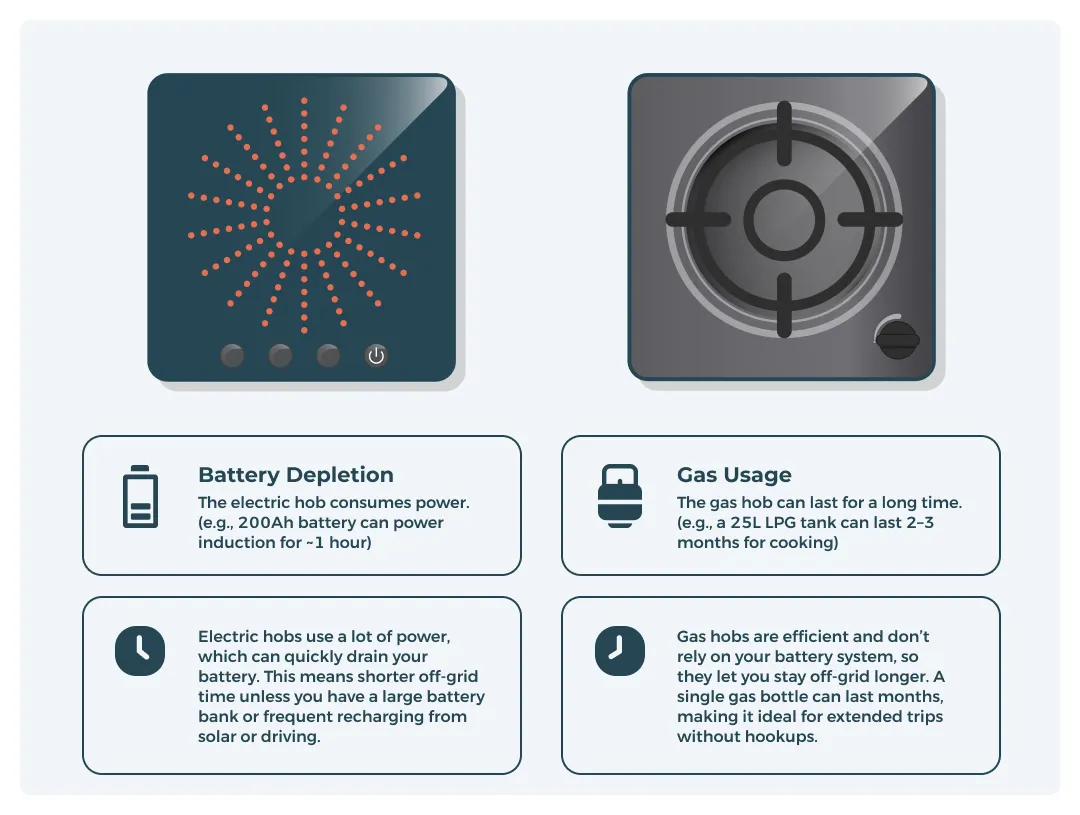
We'll start with power because it's going to be the biggest deciding factor for many people. In practice, if you're asking how much power a campervan induction hob uses, most models draw between 1500W and 2500W per burner, with that headline figure being the maximum power rather than a constant real-world draw.
This makes them completely impractical for budget builds relying on a small leisure battery unless directly connected to shore power at a campsite.
If you're planning to run an induction hob off-grid, you'll ideally need high-capacity battery banks (think 300Ah-500Ah) using lithium batteries, paired with a quality inverter and multiple reliable ways to recharge the whole system, because lithium handles high discharge current far better.
Something like the 3000W Victron Multiplus inverter/charger and 370W solar panels found in our Overland Explorer kit would be ideal here, offering both charging while driving and reliable solar power on sunny days. You also need to check the inverter's rated power so it can supply full power continuously.
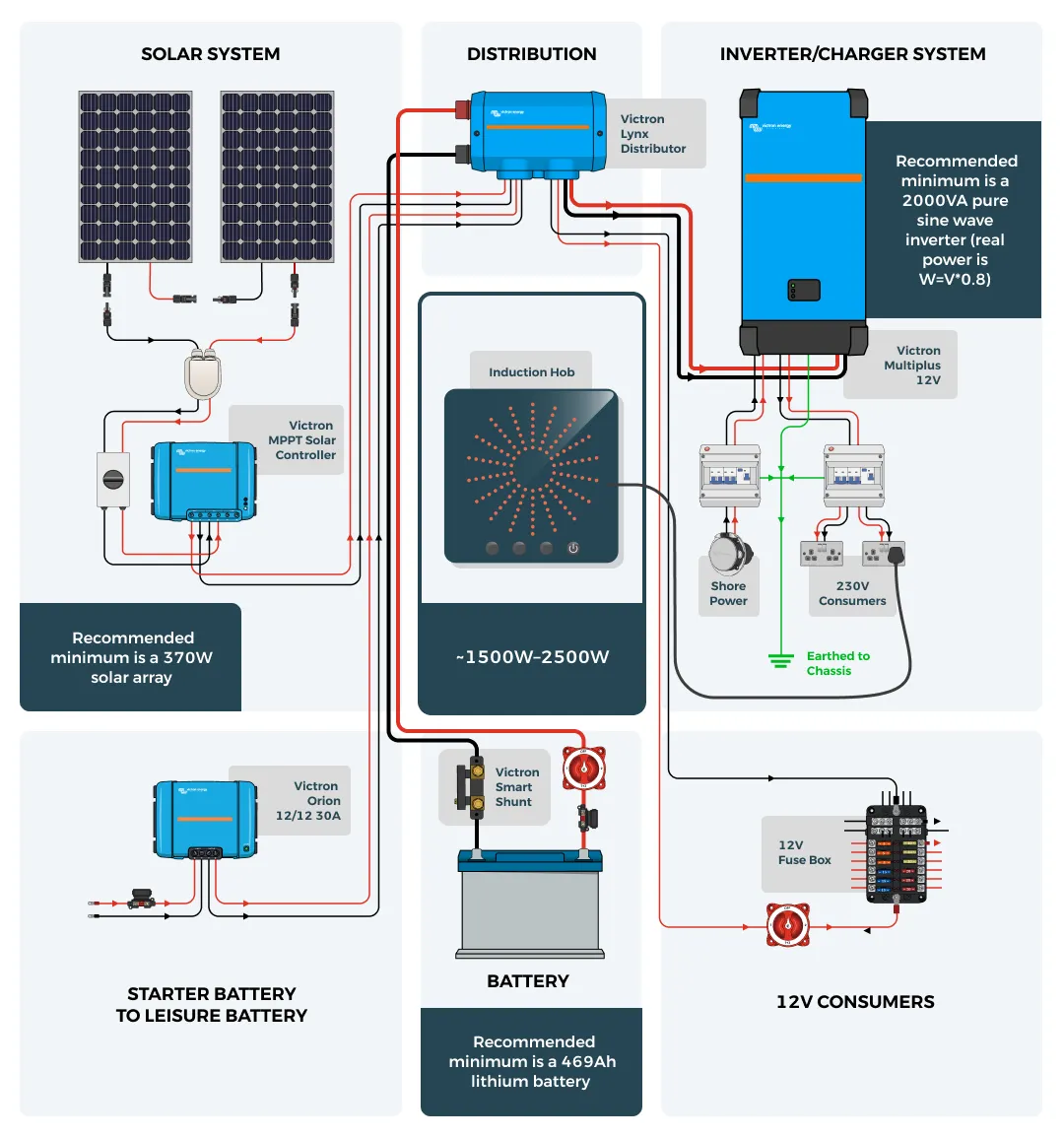
Without this sort of set-up, you're likely to be relegated to strictly campsite use with shore power through mains hook-up, and even with a beefy electrical system like this, you'll still need to be extremely careful with your power management.
In contrast, gas hobs require virtually no electrical power other than ignition (which can be done manually with a lighter if need be), so even a simple 12V campervan wiring layout is usually enough to support them safely.
It's also worth noting that induction hobs aren't ideal for AGM batteries, as the Peukert Effect hits AGM harder under high power draw and high discharge current, reducing usable capacity more than with Lithium.
Gas storage and refuelling
So, gas hobs don't need to rely on electricity when off-grid. What they do need is a steady supply of fuel. LPG can be stored in both portable gas bottles as well as gas tanks underslung beneath your van's chassis, and the right choice ties into the overall campervan electrical system you build and how long you plan to stay off-grid.
Portable bottles are easy to swap out, but you'll need to allocate some vital internal storage space. You'll also need to get these manually refilled or buy new, depending on where you're travelling to. Underslung tanks are permanently mounted and can be refilled at LPG stations, but you'll need to pay more upfront to install these.
Just be sure to research the availability of LPG refilling stations, as it varies from country to country. In Europe, LPG is widely accessible, and you should have very few problems buying bottles or refilling tanks at stations.
Regardless of how you store it, LPG ends up being very convenient, considering just how long LPG lasts when used for cooking. For example, a 25L LPG tank can last for around two to three months of cooking, whereas a fully charged 500Ah battery bank might only give you a few days of induction cooking before being depleted.
Campervan induction hob vs gas: Cost comparison
Gas hobs are fairly cheap to install, with a complete gas system, including a hob, gas lines, and a storage solution, coming in between £800 and £1,000 for off-the-shelf kits.
On top of this, you'll also require regular LPG refills, costing around £15 per 25L tank. This can last for months, so you would be hard-pressed to spend more than £150 per year on gas.
The initial price of induction hobs is also affordable, with a portable induction hob or compact single ring induction hob from brands such as Sterling Power often coming in at anywhere between £100 - £300; choosing a low wattage model can also ease system demands in a compact campervan kitchen. However, the cost of running induction extends beyond the initial purchase price.
As we've mentioned, a full induction set-up will require a high-capacity lithium battery system, a large inverter, and a robust recharging method. If you're planning to explore off-grid, this charging method will invariably be solar, so you’ll want to follow a solid campervan electrics planning checklist to size everything correctly.
This significantly increases the investment required to run induction, and a complete system can cost anywhere between £1500 and £3000, with the price creeping up even further when each component needs to be sourced individually.
That said, it's worth noting that an electrical system is a core requirement for comfortable living, even if you're planning to run a gas hob, and using a complete campervan electrical system kit can make the design and installation far simpler.
Cooking experience and practicality
From a user experience perspective, both gas and induction have their advantages in a compact campervan kitchen, especially when you're thinking about space, cleaning, and day-to-day use.
Most people are probably familiar with gas cooking. You can use whatever pans you like, you turn a dial, and you get a bigger flame. It's simple, reliable, and intuitive. In a small van, a compact single-ring setup can help keep cooking simple.
Induction, on the other hand, is objectively cleaner and safer as there are no open flames or fumes to worry about. It's also faster, with high efficiency in real use because more heat goes into the pan, and cleaning the heat-proof glass surface of most induction hobs is easier than cleaning the grates on gas stoves.
However, where impracticality does rear its head is in power management.
With a gas hob, you know if you've got gas, you're good to go. With induction hobs, you will need to keep power in mind, keeping an eye on battery monitoring systems or trying to be mindful of power draw during use; some users make electric cooking more practical by choosing a hob specifically designed for mobile use or opting for a lower wattage model.
It's also worth noting on a practical level that induction hobs might not be ideal for certain weather conditions off-grid.
While the hobs work in any environment, if you're planning to be out in the sticks during winter, you might not be able to rely on solar recharging to refill depleted leisure batteries after induction cooking.
For many users, this isn't an issue, so be honest with yourself about what you intend to use your van for and where.
If you already have a large battery bank and electrical system and predominantly stay around campsites, then induction is a perfectly practical modern option.
If you need complete off-grid flexibility and want to minimise reliance on solar or shore power, gas is your best choice for long-term self-sustainability.
Safety
Safety-wise, both options are nothing to worry about as long as you use common sense and are aware of the inherent potential risks.
Gas hobs use an open flame; this will always present a fire hazard in a confined space if not operated properly. However, this is no more dangerous than cooking in a small kitchen at home, and most people won't have any issues.
Accidental gas leaks can be a problem if the system hasn't been installed properly; you should also avoid flammable materials near the burner and unattended cooking.
Induction hobs circumvent these issues, with no open flame and a much cooler hob surface than traditional electric or gas burners.
However, there is still a risk of overheating, particularly if the induction hob is running on an undersized electrical system, leading to potential overloads causing excessive heat in cables, blown fuses, or even electrical fires. This makes having your electrical system sized correctly especially important when using an induction hob, along with choosing equipment with the right voltage protection and built-in safeguards such as over-current cut-offs.
There are also fumes to manage with gas, so ensure you have adequate ventilation and good airflow. As we mentioned earlier, you can fit a carbon monoxide detector for extra peace of mind here.
Even with induction, you'll still want ventilation and airflow, as food odours, steam, and grease particles can all still accumulate inside the van without them. To learn more about ventilation options, you can check out our full 12v air conditioning guide.
Environmental impact
The environmental impact of your cooking setup depends on your energy source. LPG is a fossil fuel which emits carbon dioxide when burned. This does, in a very minute way, contribute to greenhouse gas emissions.
However, small amounts of LPG can last for months, reducing the need to make dedicated journeys for refills and reducing your overall environmental footprint.
When powered by renewables like solar, induction hobs are inherently completely sustainable during their operation. However, like all consumer electronics, they will incur a carbon footprint and affect ecosystems throughout the manufacturing and distribution process.
If you're using them extensively at campsites through shore power, the electrical supply powering them might also have been generated by traditional fossil fuels. In winter, this is likely to be the case due to the significant decrease in solar availability.
Ultimately, neither option is particularly damaging to the environment, and there are hundreds of intangibles at play when you consider the full lifecycle of the product, including whether you rely more on solar, alternator charging, the campsite hook-up focused electrical system you build around it, and the battery weight that comes with a larger electric cooking setup.
However, if you're planning a large solar set-up or have an electric vehicle with a massive battery bank, then technically, induction cooking is the more sustainable option at the individual user level, and it may be worth contacting us about your electrical design to make sure the rest of your system is specced to match.
Which cooking setup is right for you?
The right choice for you is going to depend on your travel style, electrical system, and personal preferences. For campsite stays with reliable shore power or weekend trips to the wilderness with a strong electrical set-up, induction is a completely viable option.
Where there is a clear winner in our eyes, however, is in extended off-grid use. To illustrate this, let's imagine your set-up has the following electrical appliances, plus other high wattage appliances that many vans end up carrying:
- Lights
- USB sockets
- Fridge
- Roof fan
- Water pump
- Laptop
Even something like a hairdryer can push battery sizing and overall system cost up further.
With a 200Ah battery, 200W of solar panels, and a 30A DC-DC charger pulling charge from the starter battery while you drive, you could stay off-grid indefinitely during the summer using these appliances with a well-matched Victron-based campervan electrical system. Your battery charger strategy also matters if you want reliable top-ups between stops.
However, adding an induction hob to this set-up would reduce your off-grid time to just two days, depending on how much energy your cooking actually uses in practice, as the high power draw rapidly depletes your battery.
For those looking to live off-grid for extended periods of time, this is simply not workable, especially for winter travel. Gas, on the other hand, can sustain your cooking for months with one cheap and widely available refill. It's also cheaper to initially set up.
The bottom line from Vunked: We might supply complete electrical systems, but if you want to be off-grid in the winter, you will 100% need gas. There's simply not enough sun to power an induction hob in the winter. Cooking is critical when you're off-grid, and induction hobs drain batteries fast.
For a rock-solid set-up that's matched perfectly to your power needs, you can also check out our custom electrical system builder tool. Simply choose the systems and appliances you want to run, and we'll send you the whole kit and caboodle ready to install, much like the step-by-step build your own campervan electrical kit tool we use to size components accurately.
You'll receive every wiring diagram, component, and instruction needed for a clean self-install and years of reliable power anywhere in the world, and if you’re unsure on the details you can always book a free campervan electrics consultation for extra guidance!
FAQs
Are induction hobs good for campervans?
Yes, induction hobs can be great if you have a well-designed electrical system, high battery capacity, and don't plan on being off-grid for too long. However, for full-time off-grid living, we still recommend gas.
Can I use an induction hob on a campsite?
Yes, most campsites with electric hookups provide a 16A supply, which is more than enough to power an induction hob. Just be aware of any power draw limits at modern campsites, and check that the hookup’s power rating can support the hob’s rated power to avoid overloading the circuit; using a lower setting may reduce demand, but cooking will take longer, and in practice running on medium heat is often more realistic than assuming the hob sits at full power continuously.
Can you run an induction hob on 12V?
No, you'll need high-wattage AC power. That means you'll need an inverter to convert the 12V from your battery to the 240V that your household sockets provide.
Can I plug an induction hob into a 13-amp socket?
Yes, as long as the hob's power rating does not exceed 3000W. Most portable induction hobs are fine on a standard 13A UK socket, but check the rated power and whether the unit is a lower wattage model if your supply is limited, as some low-wattage versions are specifically designed for campervan use to help save power and stay compatible with household and campsite power supplies.