
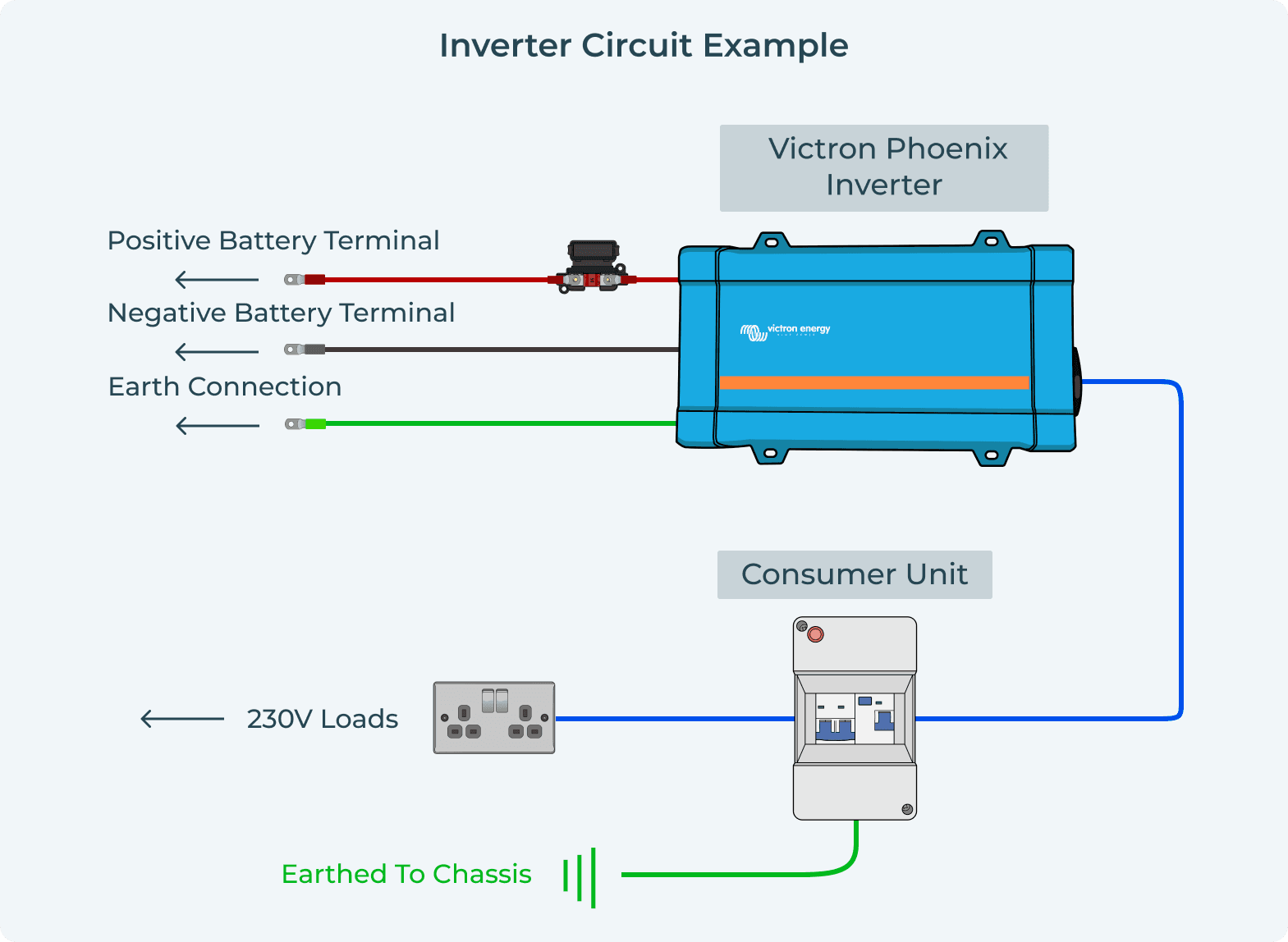
If you’re looking into campervan electrics you’ll undoubtedly have come across the term inverter when researching modern vanlife and how to power household devices when travelling off-grid.
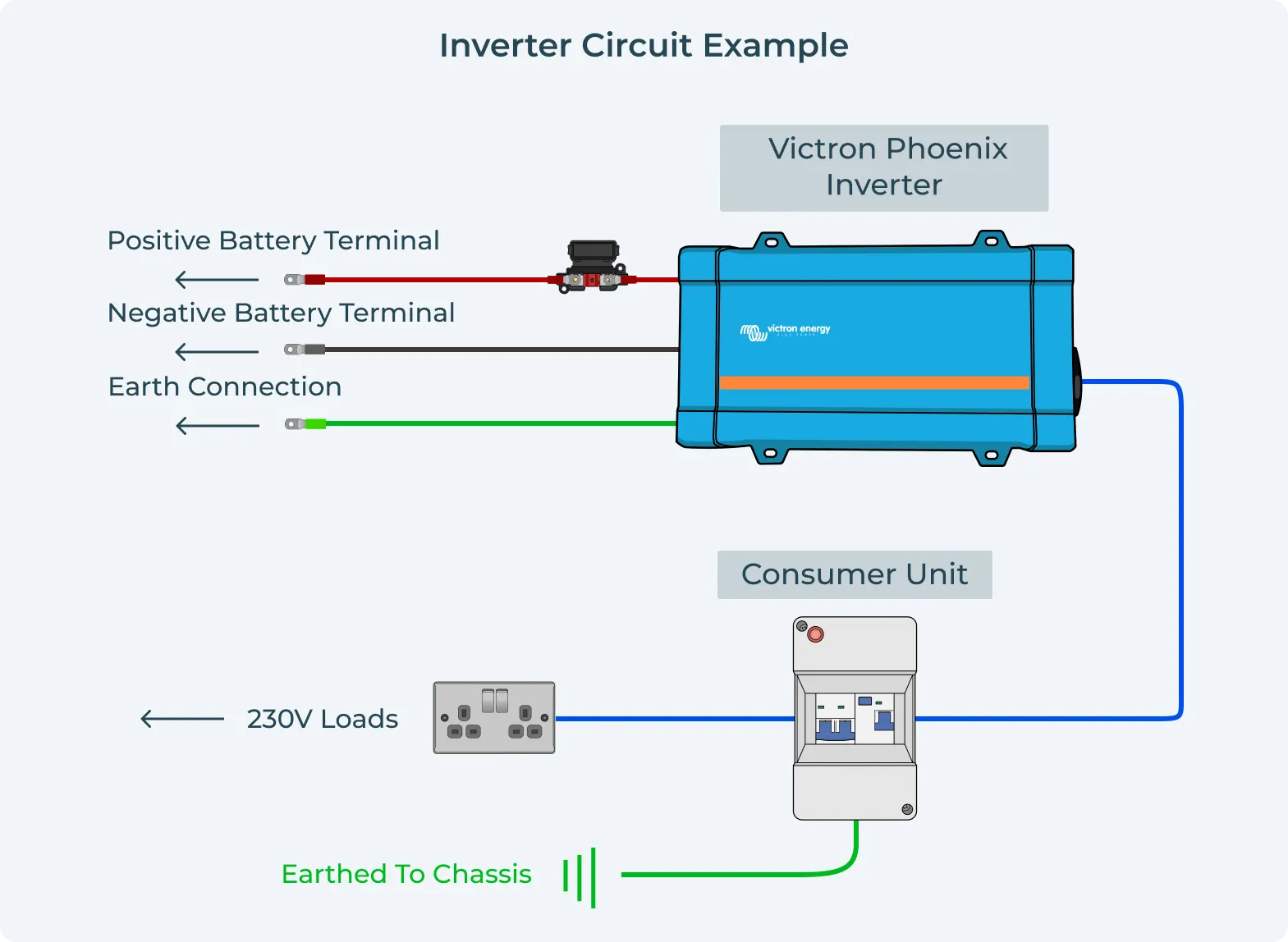
But what actually is an inverter? How do they work? And most importantly —do you actually need one? In this guide, we’ll give you a complete rundown of everything you need to know.
We’ll show you the science behind inverters, look at the common types available today, and help you decide what kind of setup is right for the adventures you want to go on!
What does an inverter do?
An inverter's core purpose is to convert the low-voltage direct current (12V DC) from your campervan’s leisure battery into the same high-voltage alternating current (230V AC) that comes from the plug sockets in your house.
This allows you to use regular home appliances while you’re off-grid, meaning you can plug in things like laptops, hairdryers, or induction hobs.
What is DC to AC conversion?
Your campervan leisure batteries chemically store energy in DC form, meaning electricity flows in a single, continuous direction. However, most household appliances require AC power, so they need electricity that reverses direction, or polarity, in a specific waveform.
An inverter takes the steady DC supply from the battery and transforms it into an AC signal, usually at 50Hz for the UK. This means 50 cycles of the waveform changing direction per second, just as it does in your household sockets.
In addition to changing the waveform to AC, an inverter also boosts the voltage. 12V is fine for things like simple LED lights or the electrics in your van, but standard household appliances require 230V to work. These include:
- Laptops and desktop computers
- Blenders, coffee machines, and kettles
- Induction hobs and microwaves
- Power tools and workshop equipment
- Hairdryers, straighteners, and electric razors
- Large-screen TVs and gaming consoles
How does an inverter work?
So, an inverter takes a low-voltage DC input and transforms it into a stable, high-voltage AC output like the sockets in your home, but how does it actually do this?
Before modern solid-state inverters, early AC power conversion used mechanical rotary converters. These were essentially motor generators that transformed DC to AC through the mechanical movement of magnets and copper to create a rotating magnetic field. They were inefficient, noisy, and prone to mechanical wear over time.
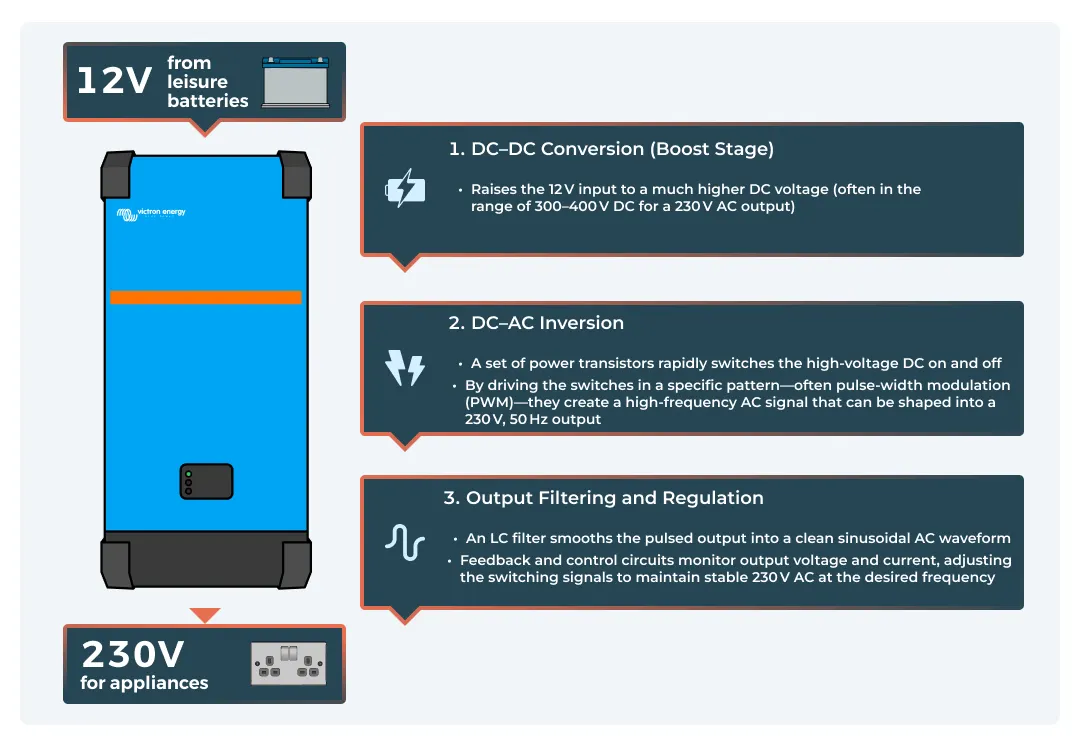
Modern electronic inverters use solid-state components such as transformers, transistors, and pulse-width modulation (PWM) circuits to transform DC to AC with efficiency, reliability, and compactness.
This works in three parts:
- Transistors convert the steady DC into a rapidly switching pulsed DC.
- Transformers step up the low-voltage 12V to 240V.
- PWM Circuits Turn the pulsed DC into a simulated AC waveform.
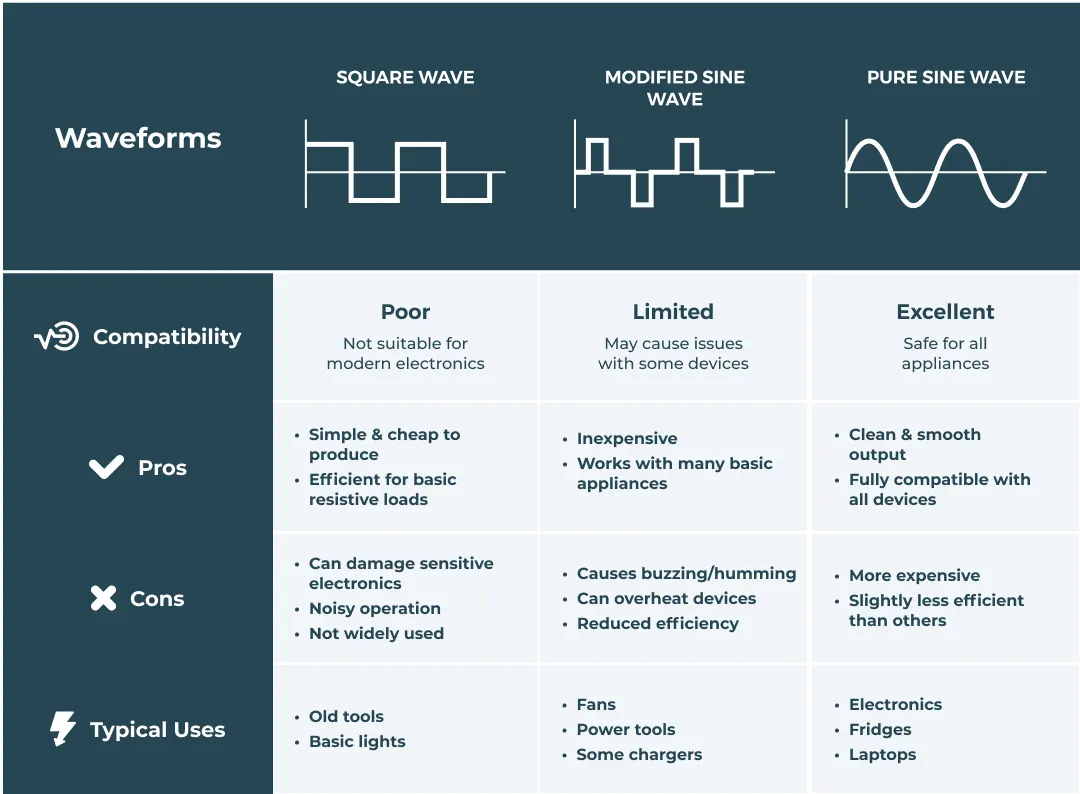
The type of simulated AC waveform produced by the PWM circuit essentially dictates the quality of the simulated AC current provided to your sockets. These waveforms come in three types.
Square wave
Square wave inverters are the simplest and cheapest type of inverter to produce from a component perspective. The square wave they produce is an abrupt, blocky waveform instead of a smooth AC curve. This is fine for basic resistive loads like incandescent bulbs or some power tools but it’s not compatible with modern electronics, causing humming, overheating, and even device damage.
Modified sine wave
This is the type of sine wave produced by many basic budget inverters. It’s better than a square wave, using stepped approximations to more closely mimic an AC sine wave. This means they can work fine for some appliances like kettles, hairdryers, and simpler electronic chargers. However, there can still be issues with more sensitive electronics like laptops, audio equipment, or medical devices.
Pure sine wave
A pure sine wave is identical to the AC waveform produced by mains electricity. It can power all appliances, including delicate electronics like laptops, CPAP machines, and variable-speed motors. The trade-off is that inverters producing pure sine waves may be more expensive, however, they’re unarguably the best for full-time vanlife.
What is the difference between W and VA?
So, we’ve covered the kind of electricity that an inverter produces, but what about how much electricity it actually supplies?
An Inverter’s power, or ‘size’ as it’s often colloquially referred to, is usually measured in Watts (W). This figure represents the total amount of usable power the inverter can supply under ideal conditions.
Each household device you use will also have a rating in Watts, in this case the wattage instead refers to how much power the device draws when operating.
To make this easy, let’s imagine three common household devices: A hair dryer (200W), a blender (500W), and a laptop charger (100W).
200W + 500W + 100W = 800W, so you would need an inverter rated higher than this to comfortably power all devices at once. I.e, a 1000W inverter to give yourself some wiggle room.
If you plan to strictly run one device at a time, you could also take the highest-rated appliance and add a 20% buffer. In this case, the blender, so: 500W + 20% = 600W.
This means a 600W inverter could comfortably power the blender, but you would blow a fuse if you tried to power the other devices all at once.
Inverters come in a range of sizes, and you can check out our full guide on inverter size for a comprehensive look at sizing an inverter based on your power needs.
What is the difference between W and VA?
You might also see some inverters listed by their output in Volt-Amperes (VA) instead of Watts (W).
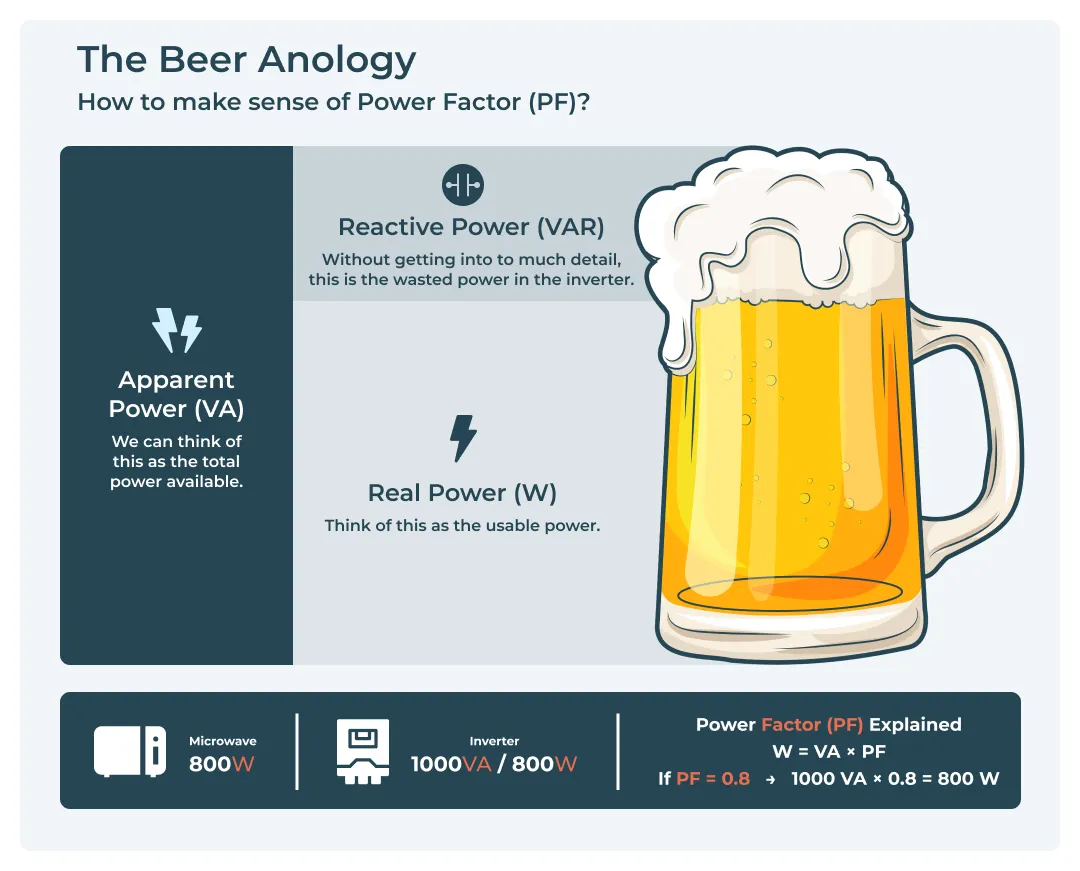
Rating an inverter in VA is simply a manufacturer choice and nothing to worry about. Instead of real-world usable power, this is simply the ‘on paper’ power without accounting for natural losses.
To account for real-world losses, we normally use a power factor of 0.8 when dealing with modern consumer electronics. That means that you can calculate the wattage of an inverter by subtracting 20% from its Volt-Ampere rating.
You can also calculate this using the formula: W = VA × Power Factor. For example, a 1000VA inverter can be considered as having 800W of usable power, since 800 = 1000 × 0.8.
Do you need an inverter?
Without an inverter, you would be limited to 12v appliances when off-grid. For casual weekend trips, this might not be the end of the world, but it isn’t ideal for full-time vanlife.
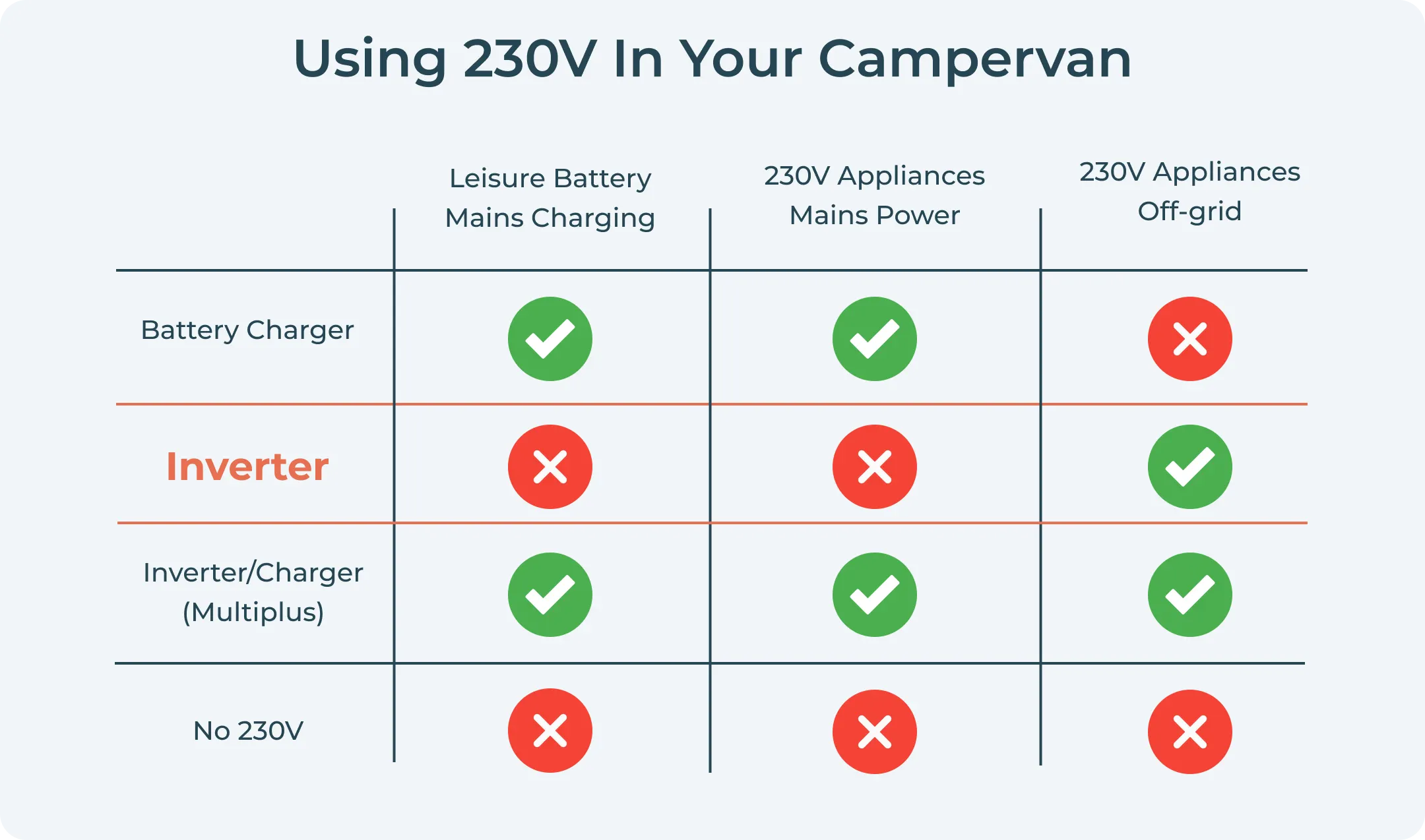
You can also access 230V AC power through what’s called mains hook-up. This is basically plugging a shore power charging kit in your camper into the shore power sockets at a campsite. This allows you to recharge your leisure batteries as well as access unlimited mains power for appliances.
If you’re primarily staying at campsites and don’t plan to venture off-grid too often, this can be a workable solution, but it does mean you’ll be limited to campsites when using regular 230V appliances.
For full-time vanlifers or those who want the most flexible solution and the ability to power anything, an inverter is a must. For a full discussion on this, you can check out our dedicated ‘Do I need 230V Power in My Campervan?’ article.
It’s also worth noting here that you might sometimes see 230V and 240V used interchangeably. Traditionally the UK used 240V, on paper changing to 230V more recently to align with standardised EU voltage. However, many transformers are still set to 240V.
To accommodate this, we say 230V for ease and accept that actual voltage may be +/- 10% of 230V. This means real-world mains voltage can be between 207V and 253V. It’s nothing to worry about and any appliances that are rated for 240V AC work fine with 230V AC and vice versa.
Types of inverters
Inverters are generally categorized based on the type of AC waveform they produce, along with the level of features they offer. Let’s look at the four main types of inverter available today:
Modified Sine Wave Inverters
At the basic end of the spectrum, you’ll find modified sine wave inverters. These approximate a pure sine wave by rapidly switching the polarity of the DC input to create a stair-step-shaped waveform that alternates between positive and negative polarity.
This doesn’t have the smooth curves of a true sine wave, and the abrupt transitions between polarity can cause electromagnetic interference. This can affect the performance of more sensitive electronics such as televisions or medical equipment.
Audio equipment can also be affected, producing a noticeable hum due to the irregular power supply. Similarly, other sensitive devices that aren’t specifically designed for modified sine wave power might overheat or have a shorter lifespan due to inefficient operation.
Pure Sine Wave Inverters
Pure sine wave inverters are the gold standard and use advanced electronics to create a smooth, continuous waveform that matches the AC power from mains electricity.
That means you can use any kind of appliance you like with zero disruption or interference such as noise in audio equipment.
It’s also more efficient than modified sine wave inverters, generating less heat and preserving the longevity of both the inverter and the appliances you use.
Smart Inverters
In a nutshell, modern smart inverters combine the high performance of pure sine wave output with extra features designed to make them easier to use and manage.
For example, the Victron smart series comes with features like Bluetooth connectivity, allowing you to monitor your energy usage in real-time and configure different parameters within a handy mobile app.
Modern smart inverters are also easier to integrate with your wider campervan electrical system, such as solar charge controllers or battery monitors for cohesive power management.
Inverter/chargers
Inverters like the Victron Multiplus take smart inverters a step further, combining the function of a sine wave inverter with a shore power charging solution. Where previously you would need a separate hook-up kit and inverter, inverter/chargers combine these functions so you can recharge your leisure batteries at a campsite.
While they’re doing this, mains power runs from the camp's shore power to your van’s sockets. As you leave the camp, the inverter switches the power source automatically to your now fully charged batteries.
This switch can take as little as 20 milliseconds, meaning if there’s a power outage at the campsite you can seamlessly switch to battery power without interrupting any connected devices.
There are also other additional premium features in inverter/charger units such as intelligent charging profiles for different leisure battery chemistries, extra layers of safety features, and the ability to use multiple units in parallel to achieve higher output capacity.
These modern units are the best of the best and ideal for modern vanlifers who want the most convenient way to use electronic devices both at camps and off-grid.
Inverter brands: Victron vs Renogy
When you’re shopping around for an inverter, you’ll invariably hear about the two main brands supplying the UK: Victron and Renogy. Both make great products, but they’re aimed at different users. Let’s look at the key differences:
Feature | Victron Energy | Renogy |
Waveform | Pure sine wave | Pure sine wave |
Build quality | High-quality components with robust construction | Decent build quality, suitable for budget-conscious users |
Efficiency | High efficiency with low idle power consumption | Moderate efficiency with higher idle power consumption |
Size and weight | Slightly larger and heavier due to transformer-based design | Can be more compact and lightweight due to MOSFET technology |
Connectivity | Most models feature Bluetooth connectivity with comprehensive app-based monitoring and configuration | Limited connectivity features, some models may require additional modules for monitoring |
Price | Higher price point reflecting premium features and field-proven durability | More affordable, offering basic functionality |
Warranty/support | Strong customer support with extensive warranty coverage | Adequate support with decent warranty terms |
The Vunked bottom line: Our complete electrical kits use Victron Energy inverter/charger units because we think they’re the best solution on the market. They’re the most popular choice for a reason, and thousands of users are thrilled with their unrivaled performance and durability.
How to choose the right inverter for your campervan?
Choosing the right inverter for your campervan will depend on a few factors, including power needs, battery capacity, and the types of appliances you plan to run.
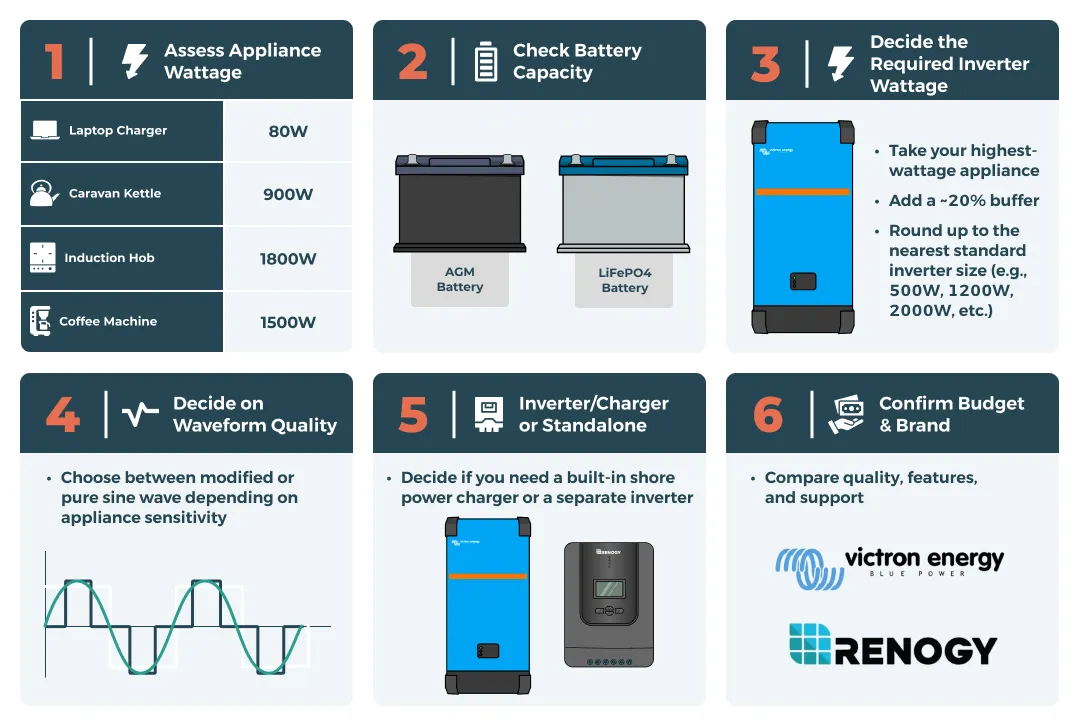
As we’ve covered, modern inverter/charger units like Victron Multiplus are the best option available on the market today. They combine two core functions that you would need to buy separate devices to achieve, and they also don’t need manual intervention and switching every time you change power source from shore power to battery power.
You’ll also need to work out your power requirements. This is basically how much electricity the inverter can physically supply, measured in watts. Each appliance you plug in will draw a certain amount of wattage, so you’ll need to work out what’s realistic for your use case.
For example, a 500w inverter/charger like the one in our Weekend Wanderer kit is absolutely fine for charging phones and laptops or powering small kitchen appliances like blenders.
However, if your power needs go beyond this and you want to use a wider range of household appliances, something like the 1200w inverter/charger in our Adventure Seeker kit is more suitable.
For full-time vanlife using the highest drawing appliances like induction hobs, you might even need more than this. In these cases, you’re probably looking at something closer to the 3000W Multiplus inverter/charger found in our premium Overlander Explorer kit.
You’ll also need to make sure your leisure battery/batteries are capable of providing enough power for your inverter’s output (We recommend modern lithium-ion batteries for their deeper discharge rates and greater efficiency).
To make sizing your inverter easy, you can use Vunked’s electrical system builder. It’s an easy online tool that lets you highlight the appliances you want to run and the features you want from the system.
We’ll size the correct inverter for your needs and send you the full campervan electrical system ready to install in kit form with every instruction, diagram, and component you could possibly need.
Installation considerations
Installing an inverter isn’t as scary as it sounds and with decent DIY skills should be entirely possible for a self-build campervan project.
Every kit we supply comes with full wiring diagrams and instructions, and you can also check out our article on ‘Wiring a campervan inverter’ for a more comprehensive overview of the process.
Keep your devices powered anywhere in the world
We hope you’ve found this guide useful. Inverters are a fantastic technology and an absolute must for modern adventurers who want to take the comforts of home to the wilderness with a modern electrical set-up.
If you need any extra help or advice on choosing the right inverter for your setup, feel free to get in touch and one of our electrical wizards will get back to you in no time!
FAQs
Can I run an induction hob on an inverter?
Yes, but you’ll need a high-wattage pure sine wave inverter that’s 2000W+. Induction hobs have high start up power surge, so you’ll need to make sure your inverter can handle the peak loads. You’ll also need a large battery bank with a reliable recharging system.
What’s the difference between 12v and 24v inverters?
12V inverters are designed for the standard type of leisure batteries found in most campervans. 24V inverters require a 24V battery system. These are less common but can be more suited for higher power loads like induction hobs or large air conditioning units.
Do inverters drain a battery when not in use?
Yes, most inverters will use a small amount of standby power even if you don’t have anything plugged in. To prevent unnecessary battery drain, many modern models come with low standby draw and you can also turn off the inverter when it’s not in use.
Can I use an inverter while driving?
Yes, plenty of users use inverters while driving to charge things like laptops and phones. If you’re using a battery to battery charger this is ideal as it will drain the leisure batteries less as they’re being constantly topped up by the alternator. Just ensure your alternator and battery system can support the load.