
Choosing the right fridge for your house is as simple as popping into Curry’s, giggling that somebody decided to call a manufacturer Smeg, and walking out with something which looks vaguely sophisticated.
If only it were as simple for campervans. 12V fridge vs 230V? Compressor vs absorption? Front-loading vs chest? What size do you even need? The options are endless.
In this comprehensive guide, we’ll break down everything you need to know, including which type of campervan fridge is best based on your travel style, what size to go for, and some top picks for 2025.
Why choosing the right 12V campervan fridge matters
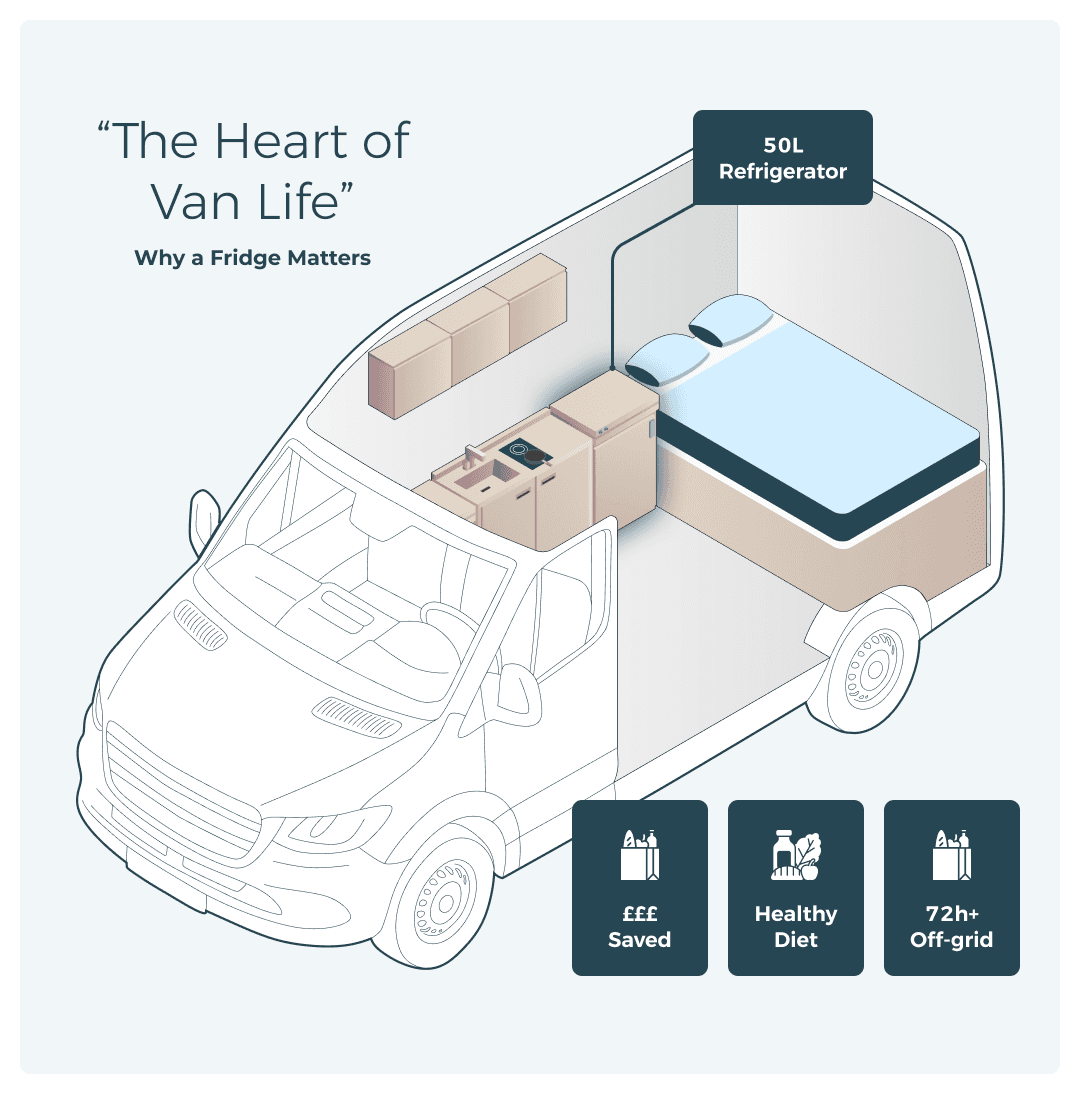
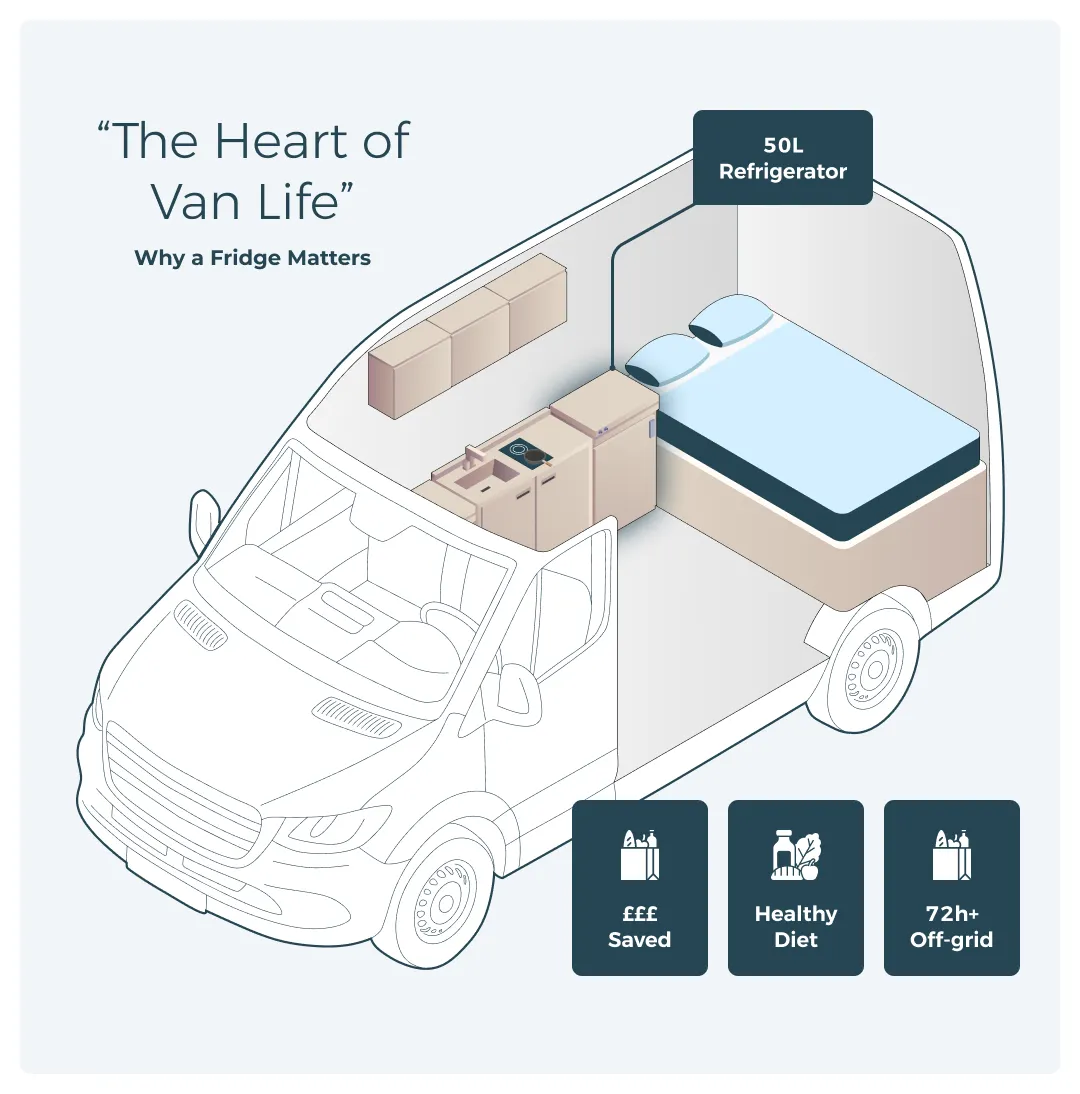
It’s surprising how quickly the cost of roadside snacks adds up. Ditto for daily shopping trips where there’s more chance of throwing in unnecessary snacks in your basket and then wondering why it’s £25 at the checkout.
Sure, there are canned and long-life foods, but it’s 2025, not the Blitz, and with modern technology, there’s no reason not to have a fridge in a modern campervan.
Having a properly functioning fridge not only side-steps these issues but also extends the amount of time you can comfortably venture off-grid and away from civilization.
However, while saving money long-term and having access to a healthier diet of fresh food is game-changing, it’s crucial that the fridge you choose is compatible with both your electrical system and the way you intend to travel.
Running a power-hungry fridge on an undersized electrical system quickly makes power management stressful and limits off-grid freedom, while overinvesting in something bigger than you need costs more up-front and limits valuable interior space.
Some types are also more or less ideal depending on the kind of climate you want to travel in, meaning what works for a weekend in Scotland might be wholly inadequate for a summer getaway to Spain.
How different campervan fridges work
Most campervan fridges work much like their household counterparts, removing heat from inside the unit and dispersing it outside to keep your food cold and fresh.
However, not all technologies work the same, and not all of them are suitable for every kind of travel. In general, there are four main types of campervan fridges, along with alternative methods such as passive cooling.
Type | Cooling tech | Power source | Efficiency | Best for |
12V Compressor | Compressor cycle | 12V DC (Leisure battery) | Excellent | Off-grid, full-time vanlife |
230V Compressor | Compressor cycle | 230V AC (via mains hookup or leisure batteries through an inverter) | High (Irrelevant when on hookup) | Campsite based travel, modern off-grid electrical systems |
Absorbtion (3-way) | Heat absorbtion | 12V DC / 230V AC / LPG gas | Low on electric, good on gas | Long-term off-grid, existing gas users |
Thermoelectric | Peltier effect | 12V DC | Low | Ocassional trips, cool climates |
Passive cooler | No active cooling | N/A | N/A | Day trips, ice storage |
12V compressor fridge
Generally considered the gold standard in campervan fridges, 12V compressor fridges use a refrigerant fluid that cycles through compression and evaporation phases. This works just like your fridge at home, only they’re designed to run from the 12V DC supplied by your leisure battery instead of 230V AC mains power.
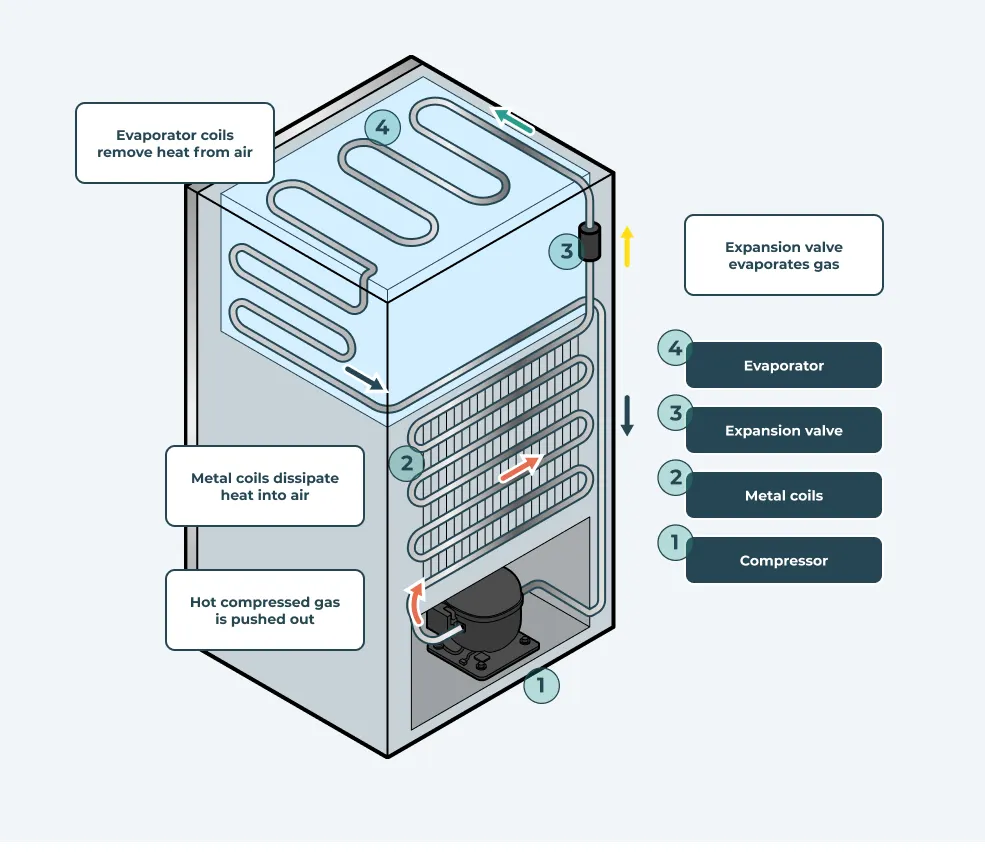
Essentially, that means a small 12V compressor pump compresses gas, turning it into a cold liquid, then forces it through coils inside the fridge to absorb heat from the air inside the unit and your food.
The heated gas then moves into an external coil (the wavy bit on the back of your fridge at home) and releases its heat into the surrounding air. This cycle continues until the air drops to a set temperature, starting again when temperatures start to rise to maintain the cold built up inside.
As you might expect, this means that how hot the outside ambient temperature is determines how hard the fridge needs to work. It also means that a compressor fridge doesn’t need to draw high amounts of electricity every second of the day, which is ideal for preserving leisure battery charge.
For example, in cool weather, a well-insulated compressor fridge might run just 25-30% of the time. In hotter climates, that cycle ratio might rise to 50% or more, increasing the power consumption accordingly.
Even on these hotter days, 12V compressor fridges are extremely robust and efficient, able to maintain consistent cooling even when temperatures climb to 35°C or higher.
While they can be expensive upfront and do require a solid electrical system to run off-grid, this makes them a great choice for full-time vanlife and year-round travel, especially if you plan on venturing further afield to hotter climates.
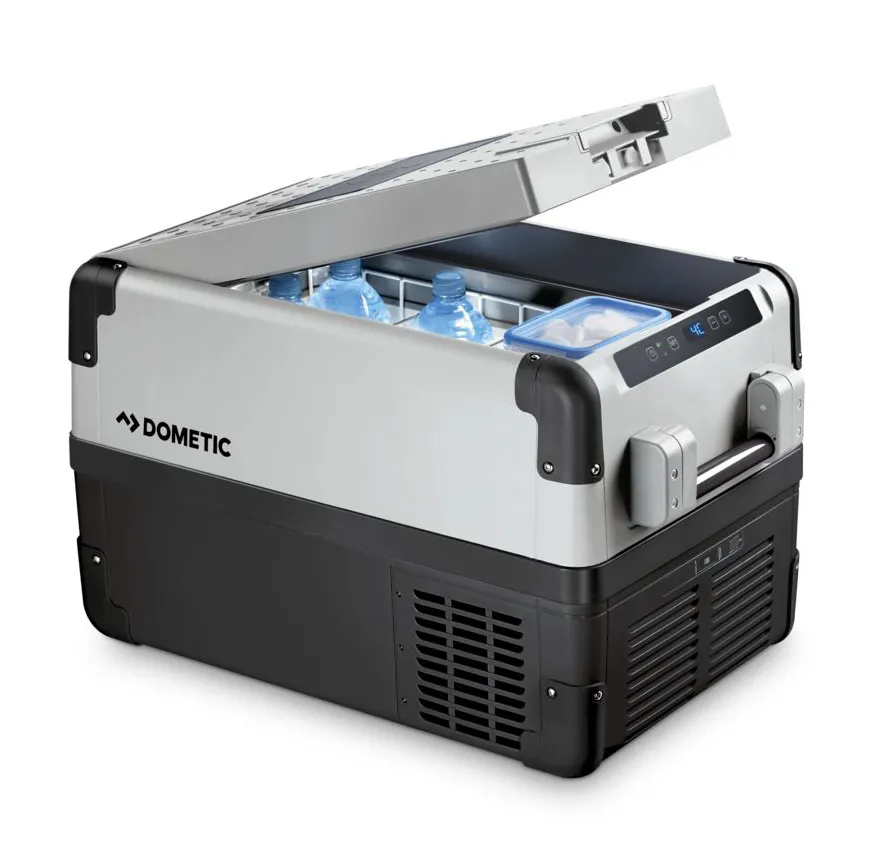
The Dometic CFX series is generally considered the gold standard here, coming in sizes ranging from 25L all the way up to a whopping 99L.
230V Compressor fridge
There are also 230V compressor models, which are extremely similar to the models used in houses with 230V AC mains electricity. The refrigeration cycle works the same here, only the fridge requires mains power to operate.
This can be achieved in two ways. First, through mains hook-up at a campsite when you have access to shore power. The second is to use the power from your 12V DC leisure batteries, only run through an inverter to transform it into 230V AC.
However, household 230V models aren’t designed to be run from batteries and draw excessive amounts of power from your leisure batteries. There are also small conversion losses when running one through an inverter, as well as spikes in power consumption during the compressor's start-up cycle.
If you have a suitably large inverter such as the 3000W Victron Multiplus found in our Overland Explorer kit, this isn’t an issue, and modern camper-specific 230V units can be close in efficiency to 12V units. It does, however, mean you’ll be leaving your inverter switched on permanently when off-grid.
If you plan to do this anyway and have a decent solar setup and large battery bank to cover for the losses, no problem. If you plan on exclusively staying at campsites, you can even repurpose an old household unit to save some cash here.
However, if you’re after the most efficient option and want to stay off-grid for extended periods without constantly running the inverter, we would probably still recommend a modern high-efficiency 12V option.
There are also now electric options from leading brands like Dometic, which can run on both 12V DC and 230V AC for ultimate versatility.
Absorption (3-way) fridge
Absorbtion fridges (sometimes called 3-way fridges) are another reliable option and have been a staple in motorhomes for decades, especially before low-draw 12V compressor-based refrigeration really caught on.
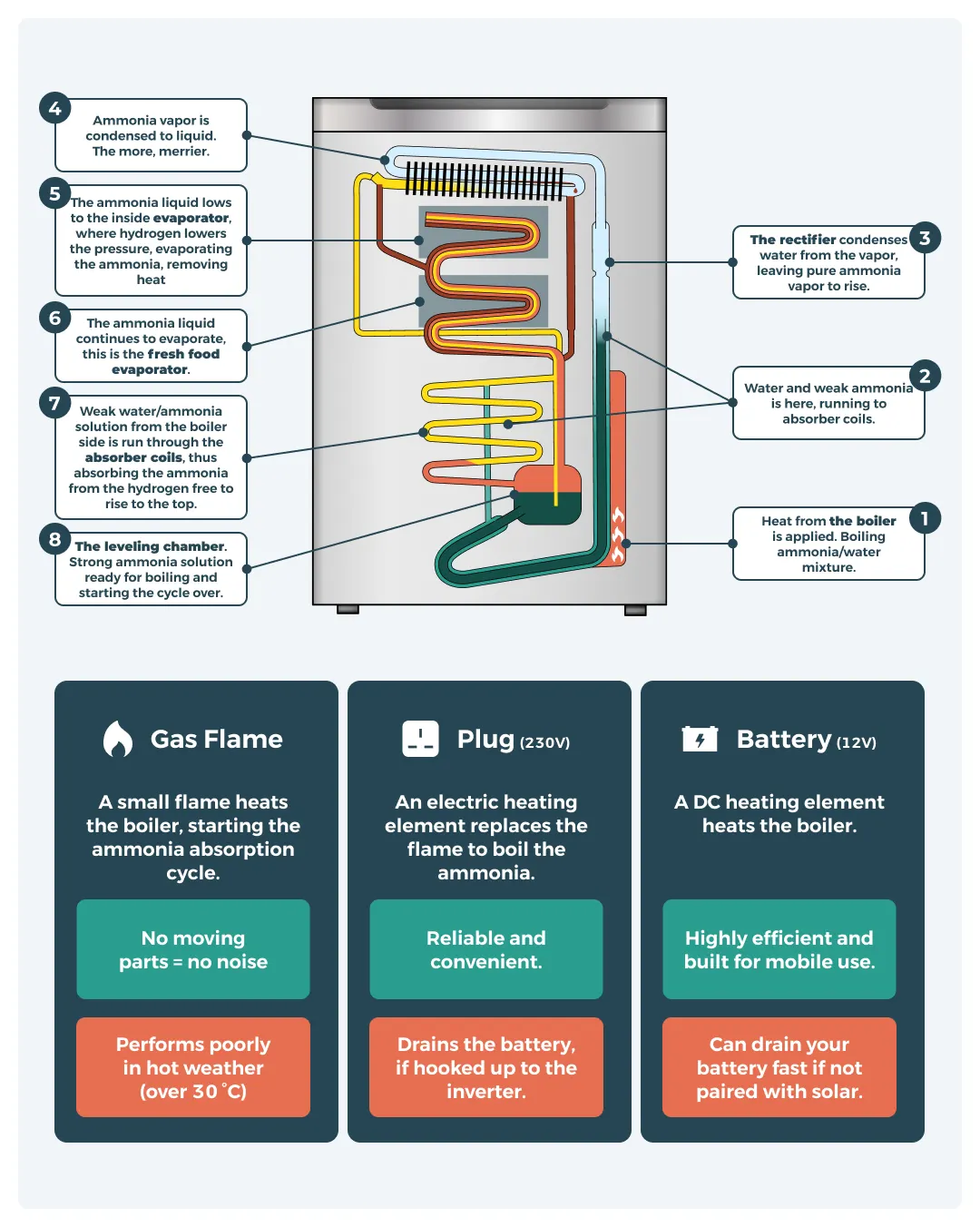
These models use heat, rather than a compressor, to drive a chemical process that moves refrigerant around the system and cools your food.
The big selling point here, though, is power versatility. Absorption-based campervan fridges can run on 12V DC while driving, switch to 230V AC on a campsite hookup, or even operate completely off-grid solely on LPG gas.
However, when they’re run on purely electricity, they’re far less efficient than on gas, drawing a fairly heavy continuous stream of power in 12V mode, which can quickly flatten battery banks.
They also struggle in hot climates as their cooling capacity drops significantly as external temperatures rise, making them less than ideal for summer travel or European trips.
However, if you already use LPG for other things, such as your campervan’s interior heating, then an absorption model can be an extremely viable option for temperate travel, especially for long-term off-grid trips without things like solar.
Thermoelectric coolboxes
The fourth and final way to keep your food cold using a form of actual active cooling is to use a thermoelectric cooler. Instead of traditional compressor-based refrigeration, these leverage the Peltier effect, where electricity is passed through a special semiconductor to create a temperature difference. This absorbs heat on one side (the food side) and releases it onto the other (outside the box).
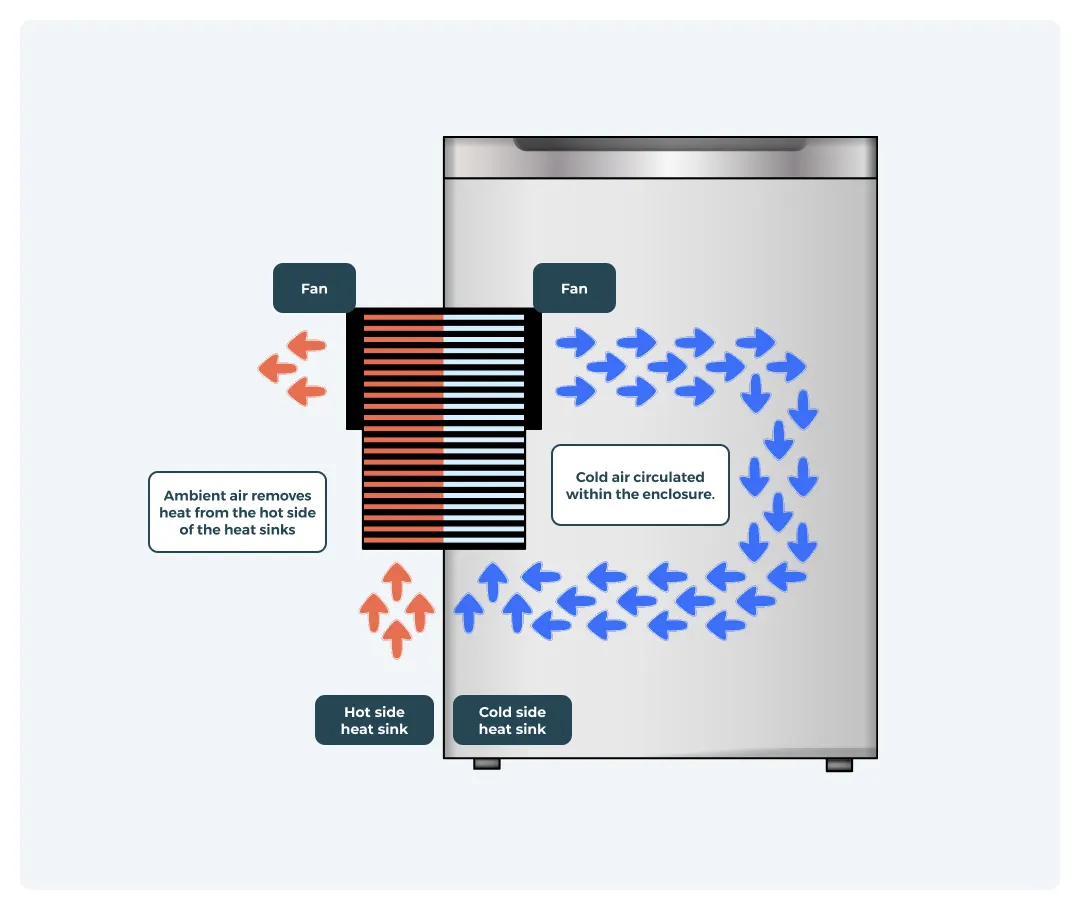
While cheap and simple to connect to a 12V source of electricity, it’s worth noting that thermoelectric coolers are only at their most effective in mild weather. This is because rather than cool their internals to a set temperature, they generally cool to about 20°C below ambient temperature (outside).
That means in hotter climates, food safety can become an issue long term, and they also run continuously, which draws more energy over time than compressor-based models, which use on-off cycles.
However, they are often cheaper, and if you’ll be doing lots of driving on your trip and have a decent B2B charger to top up your leisure batteries, they can be fine for shorter getaways.
Alternatives
Not every campervan needs a fridge. For minimalists or those solely using their van for day trips, there are alternatives in the form of passive coolers and ice boxes.
High-end rotomolded coolers like Dometic’s Patrol series or Yeti feature thick and efficient insulation, which can keep ice frozen for several days. While they do require ice top-ups to function ideally, they consume no power and are completely silent.
These types of passive coolers work best if you don’t need constant refrigeration and just want to store perishables for a few days at a time on a road trip. They’re also a good option for small micro-campers that don’t have a proper electrical setup.
However, ice management is a hassle on longer trips and limits how far you can venture from shops. Food capacity is also not usually amazing since they need space for ice.
Ultimately, these are a cheap, no-frills solution, but for full-time vanlife, longer trips, and off-grid adventures, it’s better to invest in a campervan fridge with proper active cooling.
Power usage explained
It’s crucial to understand how much power the fridge you're looking at uses, as it will often be the single biggest consistent draw on your electrical system. This energy isn’t fixed and fluctuates massively depending on fridge type, size, ambient temperature, and use habits.
There are obviously hundreds of models available, and each works slightly differently, so we’re talking in broad terms here for each general type. Let’s start with 12V compressor fridges since they’re the most popular.
Compressor fridges operate in what’s called duty cycles, switching on to cool, then turning off when a target temperature is reached. How often they actually spend running will depend on how much cooling they need to do, dictated by ambient temperature, how often you open the door, and how well the fridge is insulated.
For a typical mid-sized unit of 40-60L, you're usually looking at around 30Ah to 50Ah under normal use cases on a sunny UK day (15-20°C ambient temperature).
In hotter climates or during a UK heatwave when temperatures can hit 30°C, the fridge needs to work harder and daily draw can rise to 60Ah or more. This is because the compressor cycles more when it’s hot.
Larger 80L+ fridges or dual-zone units with a freezer capability will naturally use more power, potentially drawing 50- 70Ah daily, especially if there’s a freezer working hard to stay cool in hot weather.
If you’re going with a 230V fridge and an inverter set-up, expect power draw to be slightly higher across the board due to efficiency losses during the conversion, and the 12V to 230V inverter needs to be able to handle the start-up current for the fridge compressor.
Look for something with a high peak current rating like the aforementioned 3000W Victron Multiplus Inverter/Charger found in our Overland Explorer kit, which has a 6000W and 120-amp peak rating.
Absorption fridges running on 12V through an inverter are much less efficient, drawing a continuous trickle of power that quickly adds up. Normally, this is about 10A, which equates to 240Ah a day if run non-stop on battery power.
Usually, you’ll want to avoid this and run them on gas (LPG) when off-grid, switching to 12V battery power only when driving to save your gas bottles. Just ensure you have a strong DC-DC charger and an alternator that can keep up with the total demand.
Thermoelectric coolers are also continuous draw devices, pulling about 4- 6A constantly, over 24 hours, that can amount to 96- 144Ah daily. This is not only extremely high for many campervan systems but isn’t reflective of their pretty average performance, especially in hot weather.
Because of these figures, it’s essential to size your system correctly, especially if you want to venture off-grid. For example, let’s say a modern 12V compressor fridge uses 40Ah daily in average conditions. You would need a battery bank that can comfortably supply that plus the other loads in your van (lights, A/C, chargers, etc.).
In this case, at a minimum, you would be looking at something like 100Ah of lithium battery capacity (due to lithium’s deep cycling capability) or 200Ah+ with old-fashioned AGM/lead acid.
In terms of keeping this system charged up, a general rule of thumb is that 200W of solar in sunny UK conditions should easily power a mid-sized compressor fridge. Since you’ll have other devices to consider too, something like the 370W panels in our mid-upper range Adventure Seeker kit would be ideal.
Whichever option you go for fridge-wise, just be sure to match your real-world power consumption to both your battery and charging capacity. Undersize your system, and you’ll constantly be draining batteries. Get the balance right and you can exist off-grid completely energy-neutral with a beefy enough electrical/solar system.
Remember, insulation is also important, and two fridges using the same compressor will use massively varying electricity if one has significantly better insulation. Similarly, ventilation around the back is equally important, since without airflow, the heat can’t escape, causing the fridge to work harder than it needs to.
Finally, thermal mass also plays a part. In short, this is how much cold-stored material is inside the fridge. A cold item of food loses heat much more slowly than air (empty space), so a fully stocked fridge will run more efficiently since it doesn’t need to work extra hard to drop the temperature when it’s been opened.
What size campervan fridge do you need?
Sizing your campervan fridge is super personal and something of a balancing act between storage capacity, available space, and power consumption. Go too small and you’ll be forced to do daily food shopping, which can turn into a massive faff.
Go too big and you’ll consume unnecessary battery power while sacrificing valuable interior space. As a general guide:
- Solo travellers on short trips should be fine with 30–40 litre units. This is enough for 2–3 days of fresh food, along with some drinks and snacks.
- Couples travelling both part-time and full-time should look at 40–60 litre models. This can fit 4–5 days of groceries, making longer stints between shops more feasible.
- Families or those doing extended off-grid trips will be more in the 60–100 litre range, or even dual-zone models that combine fridge and freezer space.
Remember, raw litres aren't everything, and you’ll also need to think about style. If your van’s layout allows for a top-loading chest fridge, they retain cold air better since cold air sinks downwards. That means if you’re frequently opening it, a front-loading fridge would need to work harder (and use more electricity) than a comparably sized top-loader.
That said, they can be difficult to fit into a regular campervan layout and might need more floor space and more awkward installation. Either option works fine, and it’s nothing to worry about, but it’s worth mentioning.
The Vunked bottom line: Think about the length of your usual trip, how often you actually cook fresh vs eat out on the road, and whether you need to store frozen goods (since that will push you into 60L+ dual zone territory). Along with the practicalities of your layout, this should give you a solid indication of the right size and style for you.
Best brands and our top picks
We don’t sell fridges, nor do we have any affiliation with any particular brands, so these are our unbiased top picks for 2025.
Among traditional compressor fridges, both Vitrifrigo and Dometic (formerly Waeco) are extremely popular and widely used, with Dometic in particular emerging as the gold standard in recent years.
Their popular CRX range includes multiple 12V compressor options in a range of sizes, with their front-loading CRX50 and CRX80 being popular sizes that cater to a wide range of uses.
They’ve also recently released the new NRX line, which not only offers more premium fit, finish, and features (including smartphone temperature control) but also increases efficiency even further.
For example, their new NRX 80C (75 Litres) claims to use as little as 1.05A/hr over 24 hours. With built-in freezer functionality, this is extremely impressive. It can also run from both 12V and 230V for ultimate versatility, as can a fair few models in Dometic’s range.
There’s also their CFX series if you prefer a top-loading chest-style fridge that’s rugged while still offering premium features and high efficiency, and they also offer the CF series, which is a line of more budget-friendly thermoelectric coolboxes.
Alpicool is another brand who have emerged as a reliable budget option, particularly in the portable chest fridge category. Models like their Alpicool C50 offer compressor cooling at an affordable price, though they fall short of Dometic in areas like insulation and build quality.
Whichever model you choose, 12V compressor fridges perform exceptionally well in all climates and are a super reliable, well-proven choice for vanlifers.
For absorption-based models, Thetford and Dometic dominate the space, with models like the Dometic RM5310 and Thetford’s N4000 series being particularly popular in the motorhome space, where most people run an LPG-based setup.
These are ideal if you already have an LPG campervan heater or water heater system, and want to venture off-grid in mild weather.
Whichever brand and model you go with, we would always recommend sticking with a reputable name brand. You get what you pay for, and while a cheap thermoelectric cooler might work okay for a year, premium brands should deliver 8-10 years of reliable use.
The Vunked bottom line: Buy-once-cry-once. While they can be a bit more expensive up front, for most people, we think a modern 12V compressor fridge from a premium brand like Dometic is ideal. Especially when newer options can be run on both 12V and 230V. Absorption is viable for electric-free off-grid travel, especially if you don’t have solar panels, but even then, only in mild climates. Cool boxes and thermo-electric options aren’t in the same league.
Choosing the perfect fridge for your adventures
Picking the right fridge for your van isn’t about choosing the biggest, the most expensive, or even the one with the best reviews. It’s about matching it properly to your space, travel style, and available power.
Even the most efficient modern 12V compressor fridges need a solid electrical infrastructure to power them while off-grid. That’s where we can help.
Vunked supplies complete electrical system kits designed for everything from short weekend trips with an electric cooler to long-term off-grid stays with large compressor fridges and other household appliances.
If you can’t find the perfect setup for your needs, there’s also our electrical system builder tool, which lets you put together a bespoke kit based on the appliances you want to use.
Whichever route you choose, we send you the whole set-up ready to install, along with every component needed. We also include detailed installation instructions and complete wiring diagrams for an easy self-install.
FAQs
How long will a 100Ah battery run a 12V fridge?
A 100Ah battery should be able to run a mid-sized 12V compressor fridge for about 1 to 2 days off-grid, depending on weather and the efficiency of the unit. This can decrease in hot weather.
How long will a 12V fridge last?
A quality 12V compressor fridge should usually last about 8 to 10 years with normal use and recommended maintenance. Budget brands might have a shorter life of around 3 to 5 years.
What are the disadvantages of a 12V fridge?
12V fridges are extremely efficient but do require a well-sized battery and charging system to effectively run off-grid. Up-front cost will also be higher compared to older absorption options.