

If you're building a UK campervan house bank, lithium is the right choice for almost everyone. AGM still belongs in the leisure-battery world and a few older, awkward installs, but it's no longer the default leisure choice.
AGM batteries are the old standard because they were the sensible sealed lead-acid option for years. That's changed. In modern off-grid van builds, the question isn't whether AGM works, it's whether you've got a real reason not to move on.
Table of Contents
- Why AGM Is Now the Legacy Choice for Most Builds
- How an Automotive AGM Battery Is Actually Built
- AGM vs Lithium Head-to-Head for Campervan Use
- Charging Profiles, Equalisation and Temperature Compensation
- Lifespan, Depth of Discharge and Real-World Cycling
- Where AGM Still Earns Its Place in a UK Build
- The Decision Rule for Your Next Battery
Why AGM Is Now the Legacy Choice for Most Builds
AGM remains in use because motorhome makers still fit it on builds aimed at campsite use, not serious off-grid living. That is the situation. DIY builders, especially the ones who want to run fridges, lighting, charging and an inverter without babysitting the system, have moved to lithium because it delivers more usable power in less space.
The old case for AGM has collapsed
The strongest argument for AGM used to be convenience. It was sealed, didn't need topping up, and worked well enough for basic 12V use. It still does those things, but lithium now does them with a much better weight-to-capacity ratio, and that matters the moment you start caring about payload and cabinet space.
A 100Ah AGM battery is commonly limited to about 50% depth of discharge, so you're usually only leaning on about 50Ah of routine use. A 100Ah LiFePO4 battery is commonly run at 80–90% depth of discharge, so you're getting 80–90Ah of usable capacity from the same nominal size (UK campervan battery guidance). That's why a lithium battery can replace a much larger AGM bank in practical use.
Practical rule: if you're building for weekends, off-grid stops, or anything with real overnight electrical demand, start with lithium and only move away from it if there's a specific technical reason.
Why the price argument is weaker now
People still talk as if AGM is the cheaper option by default. In practice, that has become a sloppy oversimplification. Lithium costs more in some setups, but in many modern installs the gap is narrow enough that the actual decision is about usable capacity, mass, and system design rather than the sticker alone.
There is also the warranty and service-life angle. Many lithium batteries now come with 10-year warranties, including the ones sold by Fogstar. That matters because even if lithium costs a bit more up front, it will usually last much longer than an AGM battery in real campervan use, so the long-term value is often better.
The other shift is visibility. More lithium batteries now ship with app-based monitoring and built-in Bluetooth, which makes state-of-charge tracking much easier for owners who want simple, honest information instead of guessing from a resting voltage reading. AGM doesn't give you that same clarity unless you add separate monitoring.
If you want a general maintenance reference for RV electrical systems, keep your RV road-ready is a useful broad checklist, but for a van build the battery chemistry choice matters more than roadside habits.
How an Automotive AGM Battery Is Actually Built
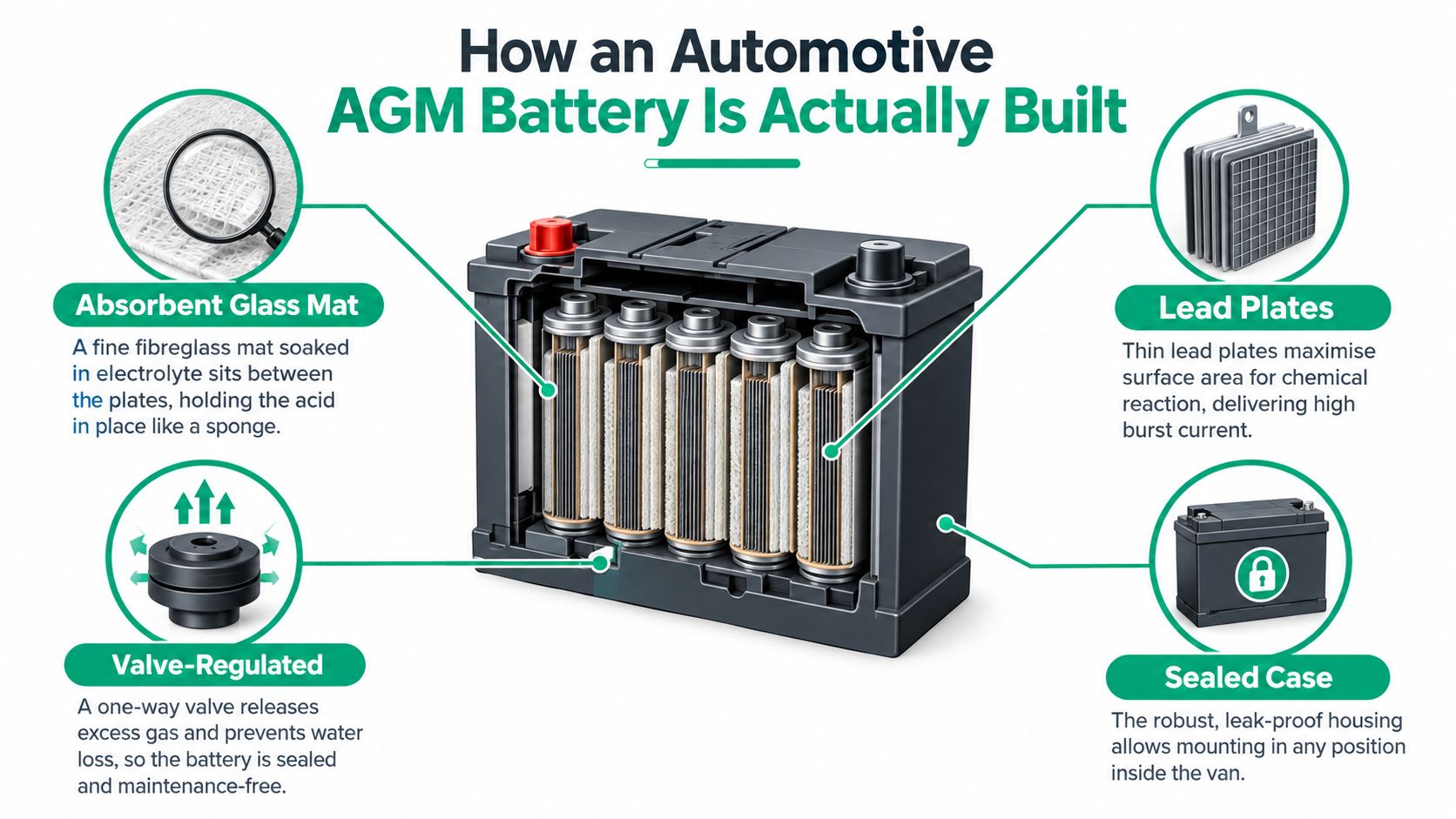
An automotive AGM battery is still a lead-acid battery, just built in a neater way. The electrolyte is not free to slosh around like it does in a flooded battery. Instead, it is held in absorbent glass fibre separators pressed against the plates, which keeps the acid where it belongs and cuts movement inside the case (AGM construction overview).
What that construction changes
The absorbent mat keeps the electrolyte tight against the plates, so the battery can give strong burst current without the same slosh, stratification, or spillage worries you get with a flooded unit. The internal compression also helps keep the active material in place, which is why AGM handles vibration better than older wet batteries.
The case is valve regulated, so it recombines gases during normal charging and stays sealed in ordinary use. That is why AGM turns up so often in vehicle starting roles and why it suits batteries that have to live inside a van rather than out in the open.
What the builder actually cares about
You need three things from it. Strong starting performance. Better cycling than a basic flooded starter battery. Proper charging control, because the sealed design that keeps it tidy also makes it less forgiving if you charge it badly.
AGM is a better-behaved lead-acid battery, not a magic battery. It still follows lead-acid chemistry, so the cycling limits covered later in this guide still apply. At end of life, it should be treated as part of the regulated automotive battery system, as set out in UK waste battery rules.
AGM vs Lithium Head-to-Head for Campervan Use
For a campervan house bank, AGM is the compromise choice. It is heavier, gives you less usable energy for the same box, and leaves you with less headroom if you run lights, heating controls, charging, and a fridge overnight. Lithium gives you more usable power in less space, so the whole van is easier to live with.
AGM vs LiFePO4 for UK campervan house banks
| Attribute | 100Ah AGM | 100Ah LiFePO4 |
|---|---|---|
| Usable capacity | About 50Ah at roughly 50% depth of discharge | About 80–90Ah at roughly 80–90% depth of discharge |
| Typical battery mass | About 25–30kg (Roamworthy) | About 10–13kg (Roamworthy) |
| Charge efficiency | Lower than lithium, with more energy lost as heat and incomplete acceptance | Higher than AGM, so more of what you put in is stored |
| Typical charging approach | Multi-stage AGM profile | Lithium profile with BMS-aware settings |
| Cold charging caution | More forgiving in cold conditions | Charging below 0°C must be blocked or protected (Victron lithium guidance) |
| Practical fit | Starter or limited-duty leisure use | Proper off-grid house bank |
The weight gap is only part of the story. A lithium bank can deliver broadly similar usable energy to a much larger AGM setup, which is why builders keep moving away from lead-acid. In a van, kilograms and cubic centimetres are both real costs.
AGM can still work, but only if the system is built around its limits. That means correct charge settings, sensible cable sizing, and no expectation that it will behave like a modern lithium bank. If you want the rest of the van kept serviceable while you sort the electrical side, keep your RV road-ready and do the battery job properly.
My view: if you are building a new house bank from scratch, AGM only makes sense when you are accepting more weight and less usable capacity for a reason you can defend.
Charging Profiles, Equalisation and Temperature Compensation
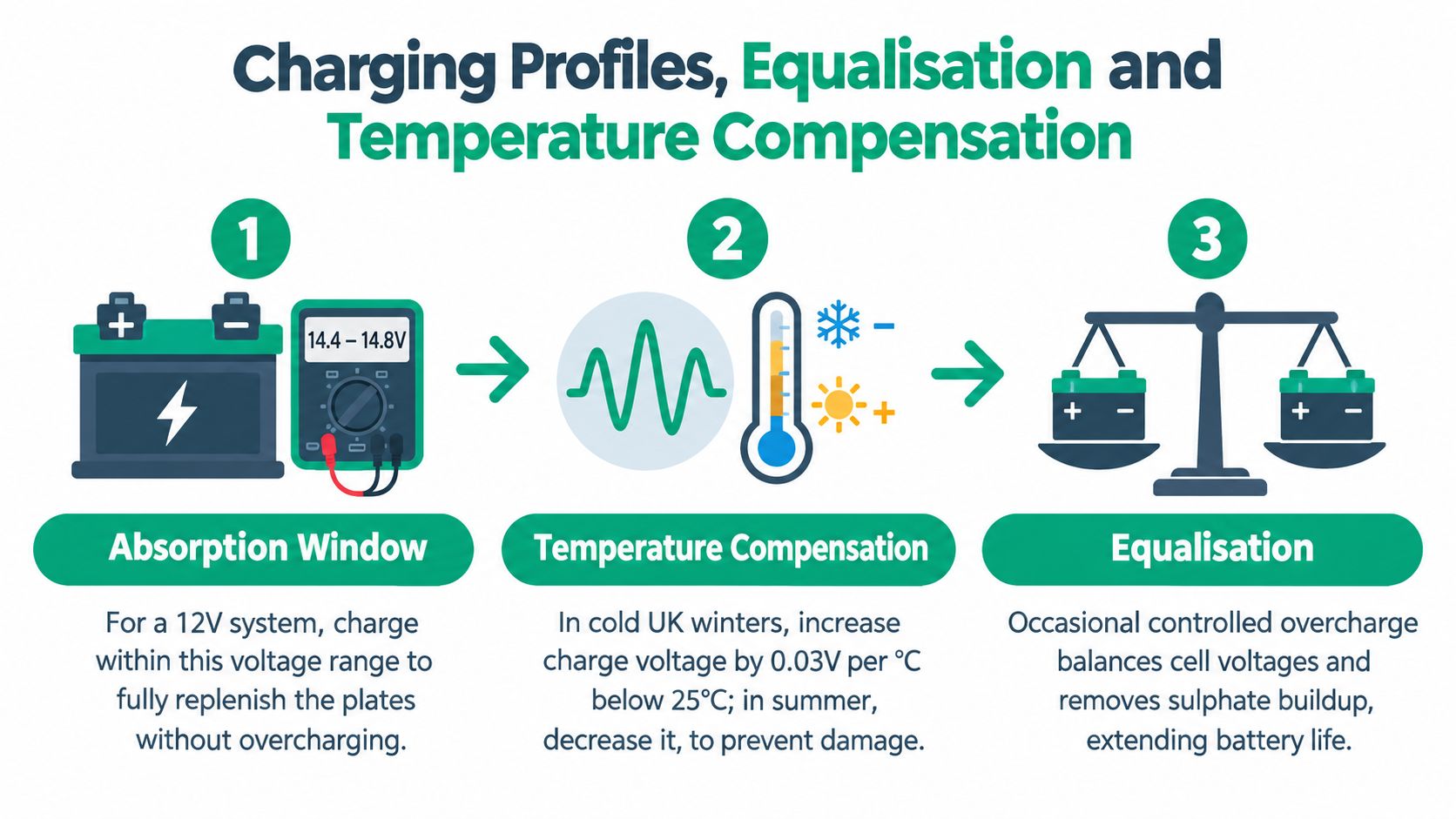
AGM batteries are picky in a different way from lithium. They do not need constant attention, but they do need the charger set up properly. A practical AGM charge-voltage window is about 14.4–14.8V on a 12V system, and that matters because low voltage leaves the battery undercharged, while high voltage pushes gassing, drying and damage (AGM charging guidance).
What to set on the charger
Use an explicit AGM profile, not a vague lead-acid setting. If you are charging from mains hook-up, a DC-DC charger, or a smart alternator setup, the charger needs to recognise AGM so it can hold the right absorption stage and then float properly instead of forcing in a crude charge. If you're charging from mains hook-up, the complete mains charging guide walks through the settings step by step.
Mixed systems need more care. An AGM starter battery can sit alongside a lithium house bank, but they should not be treated as if they want the same charging behaviour. Lithium needs different absorption settings, and Victron's lithium charging documentation says temperature compensation should be disabled, with low-temperature charging blocked below 0°C.
Equalisation is where people get careless
Do not assume AGM wants flooded-battery equalisation. It does not, unless the battery maker specifically allows a controlled conditioning cycle. A standard equalisation voltage can damage AGM by driving unnecessary gassing and drying. If you are guessing, you are doing it wrong.
Temperature compensation is not something to improvise either. Follow the battery maker's voltage-temperature spec. In practice, that means cold-weather charging should be deliberate and documented, not copied from a forum post written for a different battery type.
The right charger settings matter more than a flashy spec sheet. Get them wrong and you shorten the battery's useful life.
Lifespan, Depth of Discharge and Real-World Cycling
Battery life isn't about the label on the case. It's about how often you keep pulling it down, how often you recharge it properly, and whether the system spends days sitting half-full. For AGM, the depth-of-discharge habit matters a lot because lead-acid chemistry punishes abuse far faster than lithium.
What the cycle numbers mean in a van
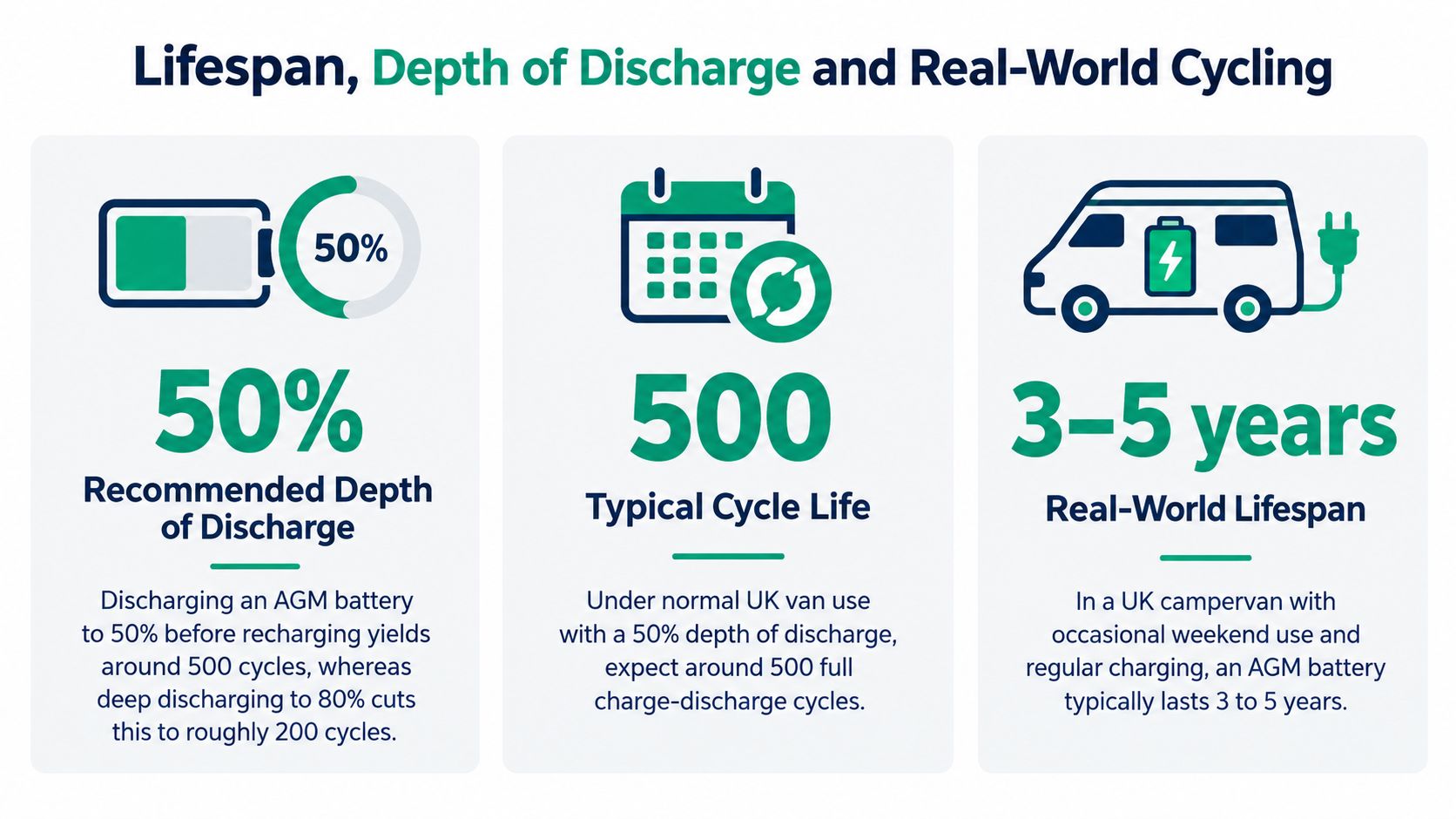
A battery store comparison for campervan and motorhome use shows the practical difference clearly. A 100Ah AGM battery is commonly treated as a 50% depth-of-discharge battery, while a 100Ah lithium battery is usually run at 80–90% depth of discharge (Battery Store). That's why lithium often feels so much bigger in the same physical box.
The problem with AGM is not that it can't work. The problem is that it gives you less room for error. Keep it partially charged, drain it hard, or let it sit through winter without proper maintenance charging, and it will age quickly.
If you want a broader discussion of depth-of-discharge habits, HighFlow Energy's DoD insights are a decent technical primer to compare against your own use pattern.
Real failure patterns in campervans
The most common mistakes are boring, and they're repeated constantly.
Chronic undercharge: The battery never gets fully recovered after short trips.
Partial state of charge: The battery lives in that awkward middle zone for too long.
Inverter abuse: Big AC loads get dumped onto a battery that wasn't sized for them.
Winter neglect: The van sits, the battery self-discharges, and nobody puts it on a proper maintenance charge.
Practical rule: if you want AGM to live a decent life, don't treat it like a deep-cycle lithium bank. Keep the discharge shallow, recharge it fully, and don't let it idle in a half-flat state.
For a longer service-life reference, how long leisure batteries last is useful alongside the hard numbers, but the discipline matters more than the theory.
Where AGM Still Earns Its Place in a UK Build
AGM still has a place. I'm not pretending otherwise. It just doesn't have the broad leisure-battery job it used to have.
The legitimate AGM use cases
The clearest one is as an engine starter battery in vehicles with stop-start and regenerative braking, because AGM's higher cycling durability and vibration resistance are exactly why the chemistry is specified for that job (Yuasa technical guidance). If the vehicle came with AGM from the factory, replacing it with the same chemistry is usually the sensible move.
The second case is older motorhomes where the charging system is basic, the wiring is already built around lead-acid, and changing the whole setup isn't worth the cost or hassle. In that situation, AGM can be a tidy, known quantity. It's sealed, it's familiar, and it doesn't force a full rework.
The third case is when you deliberately want the extra weight. That's uncommon, but it does happen in vehicle balancing and some installation layouts where mass distribution matters more than saving every kilo.
Older AGM batteries may also need venting, so the compartment matters. Don't assume every sealed battery is automatically carefree in every location. A van cupboard, under-seat box, or engine bay each raises different practical questions.
When AGM is still the better call
Factory-spec replacement: Match what the vehicle maker already designed around.
Simple maintenance expectations: If the owner wants a known lead-acid setup and nothing else.
Legacy charging hardware: If the system isn't realistic to modernise.
Starter use, not house-bank use: Keep AGM in the role it does best.
That's also why you should not confuse “AGM still works” with “AGM is the right leisure battery”. Those are different decisions. The battery in the engine bay and the battery feeding your living space don't have the same job, even though they both get called a battery.
The Decision Rule for Your Next Battery
For a DIY off-grid campervan house bank, choose lithium unless you have a clear reason to stay with lead-acid. That is the straight answer. You get more usable capacity, less weight, easier packaging, and a system that suits how modern vans are used.
AGM still has a place, but it is a fallback, not the default. Use it for a starter battery, for a factory lead-acid setup you are keeping as-is, or for an older vehicle you do not want to redesign. In those cases, AGM is a sensible, known option.
Before you buy, check the charger profile, confirm what your DC-DC or solar controller is set to do, and make sure the battery goes through the proper automotive collection route, not general waste. If the battery is leaving a vehicle, treat it as regulated automotive kit.
Before you commit, work through how to choose a campervan leisure battery so the bank matches your real loads instead of your guesswork.
If you want the system planned properly, Vunked designs campervan and off-grid electrical layouts, including battery choice, charging setup, and wiring diagrams. Visit Vunked if you want the battery decision made cleanly before you start buying parts.
Composed with the Outrank app