
10 min read
Found the right battery? Our campervan leisure battery kits bundle the battery with correctly-sized charging and protection — or design the whole system in minutes with the free builder.
Understanding Campervan Leisure Batteries
The best leisure battery for a campervan depends on how you use it: lithium is usually the best choice for high-spec vans and regular off-grid use because it lasts longer, charges faster and delivers more usable capacity, while AGM often suits smaller, lower-budget builds that spend less time away from hook-up. The most critical part of any campervan electrical system is the leisure battery, so getting the battery type right matters if you want reliable, safe power for your appliances without paying for capacity you do not need or replacing a battery too soon.
This guide is written for DIY campervan and motorhome owners in the UK and EU, especially first-time and intermediate converters who want a dependable off-grid setup and clear guidance before buying. It runs through the main campervan battery types, lithium vs AGM, capacity and depth of discharge, lifespan and charging, weight and size, cost differences, recommended brands, and the tools available to help design a custom campervan electrical system. If you're not much of a fan of reading,skip to our summary.
What is a Campervan Leisure Battery?
Before we go any further, it's worth noting that leisure battery is a term used to describe the battery that will power the appliances in your van conversion. This is in comparison to the starter battery, or vehicle battery, which is part of your van already and used to start the van when you turn the key in the ignition. If you're completely new to this topic, our introduction to campervan electrics walks through how the leisure battery fits into the wider system.
How A Campervan Leisure Battery Works
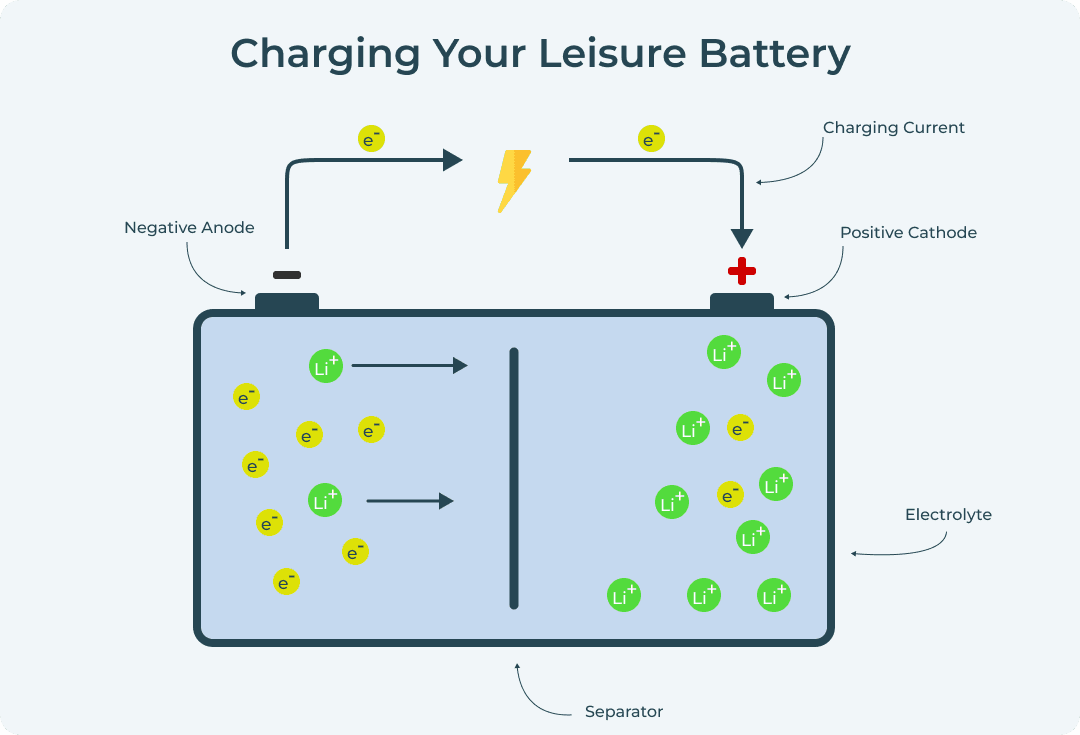
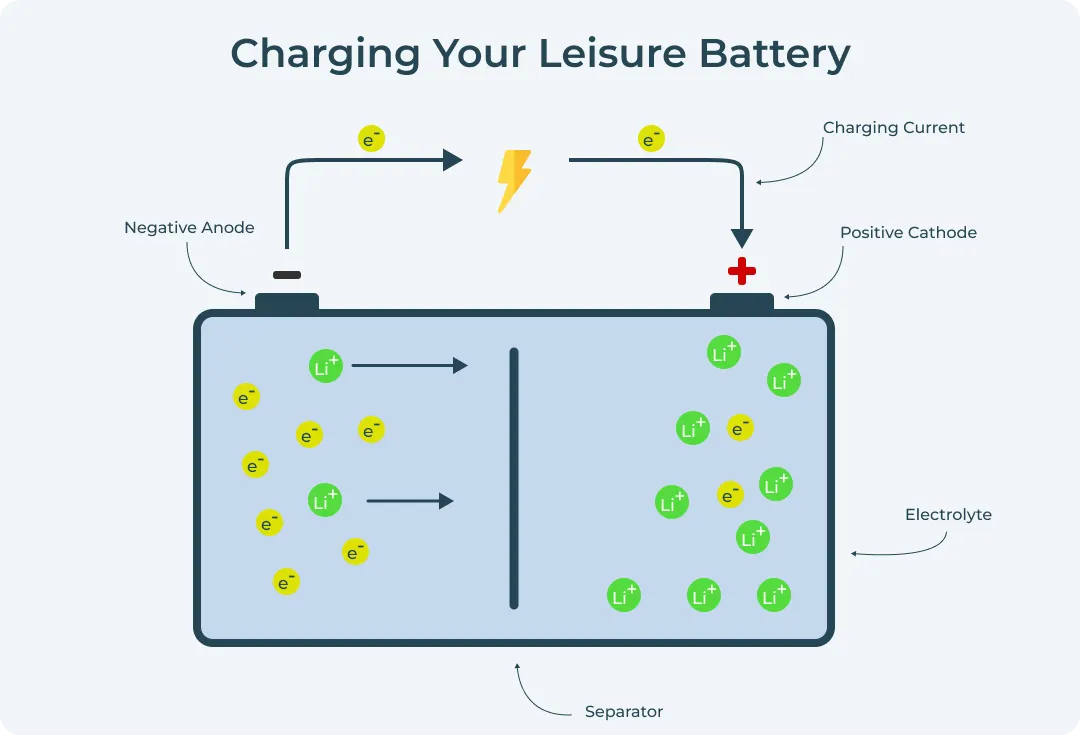
Campervan leisure batteries work by storing electrical energy as chemical energy, the same as any other type of battery. This electrical energy can come from your solar panels, your battery-to-battery charger, or mains electricity via electric hook-ups - your batteries won't even know the difference. Once charged, these sources help provide power to your appliances.
Here is a breakdown to explain more:
- All batteries work by creating a potential difference (i.e. Voltage) between 2 terminals, a positive and, you guessed it, a negative.
- When the battery is charging, charged particles (or ions if you want to get all sciencey) move from the positive terminal to the negative terminal.
- Then, when you switch on an appliance, electrons will flow through your electrical system from the negative battery terminal, through the appliance and back to the positive battery terminal, where they're ready to be charged back up again and the battery supplies power to connected devices.
Leisure Battery Capacity
Explaining Amp-hours (Ah)
We describe how much energy a battery can store by using the unit Amp-hours (Ah) which is a current flow of 1A for 1 hour. So a battery with a 100Ah capacity could sustain a current flow of 100A for 1 hour, 1A for 100 hours, or 5A for 20 hours - you get the idea.
How much capacity will I need?
What leisure battery capacity you need will be dictated by how much power you need in your van. For example, if you mainly take shorter trips and just need to charge your phone, your capacity needs will be far lower than someone working remotely or running several appliances every day. Our campervan off-grid calculations guide explains how to turn those usage patterns into concrete battery and solar sizing.
This can be pretty tricky to figure out, but luckily for you, our team at Vunked has done the hard work and created a Campervan Electrics System Builder, which can be found below. When using the tool, select the appliances you'd like to use off-grid and then build your system until you have exactly what you're looking for for off grid setups.
The importance of getting the leisure battery capacity right
It's essential to get your battery capacity right as part of choosing a good leisure battery for how you want to use your van. If you don't have enough battery capacity for all the appliances you want to run, you'll likely struggle to get reliable power, regardless of how many solar panels you have or how long you drive.
Leisure Battery Charging Cycle
How does this work?
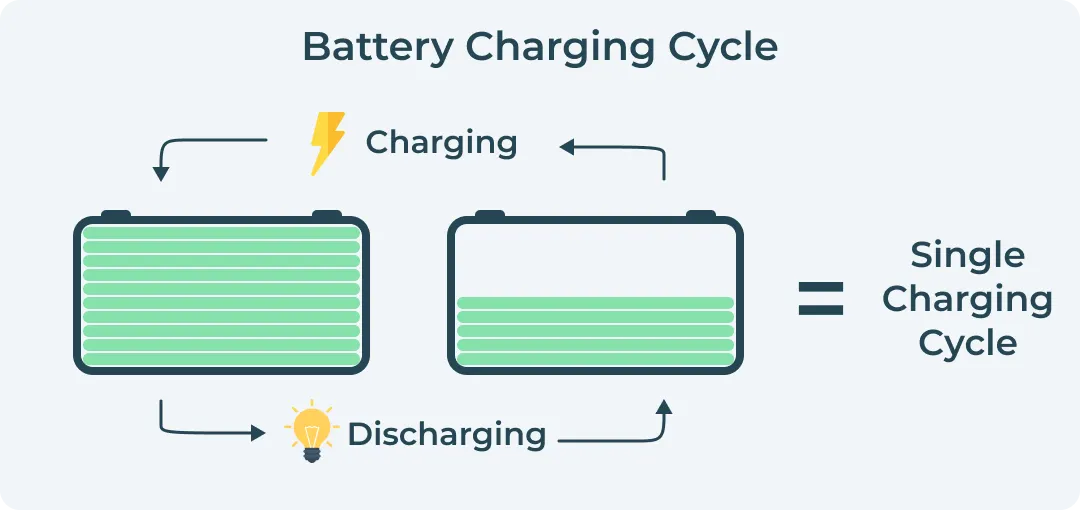
The batteries in your campervan work precisely the same as those in your phone. So when you use your phone throughout the day, whether for a YouTube van conversion binge or to send loving messages to your significant other, this activity will discharge your batteries.
When you get home at night and plug your phone in, the battery will start to recharge, completing what we call one of its recharge cycles. Therefore, when we do this repeatedly, the battery will eventually begin to degrade, and you won't be able to spend half as long scrolling before you need to plug in.
What happens when I reach the maximum 'number of cycles'?
When we buy batteries for a campervan, they all have a lifetime described as the 'number of cycles' before the battery degrades in the same way as your phone! If you’re wondering what that means in real-world years and trips, our breakdown of how long AGM and lithium leisure batteries last digs into cycle life and cost over time.
The good news is that your campervan leisure battery won't just stop working when it reaches this number of cycles, but it will start to degrade and won't hold its charge quite as well as it used to. This will gradually worsen until you're unable to spend time off-grid for long periods away from hook-up power without replacing it.
Leisure Battery Depth Of Discharge
How does this work?
Have you ever had the starter battery on your car run flat and needed a jump start from a friendly stranger? With this in mind, you might have noticed that your battery hasn't held its charge quite as well as before. This is because your battery has been discharged much deeper, and fully discharging it can degrade it!
What to look out for
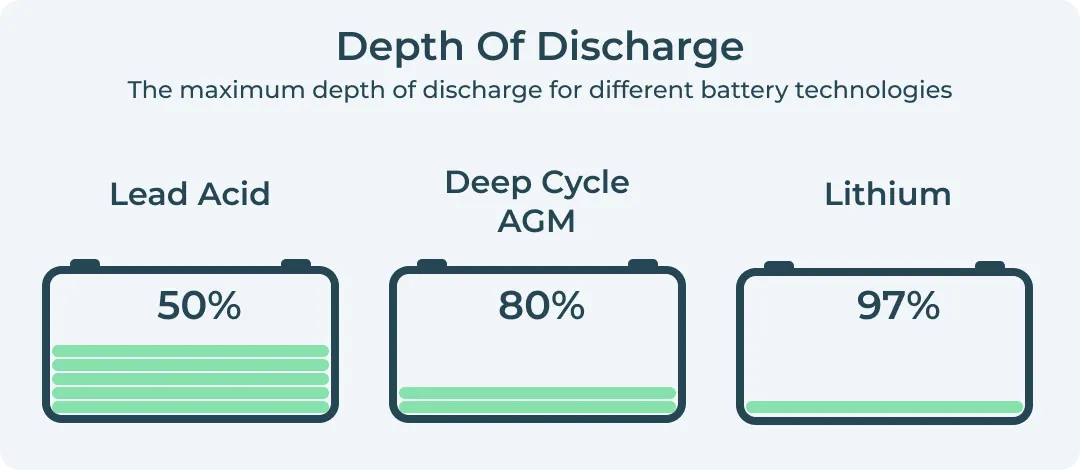
Therefore, depending on the battery technology you opt for, some battery types handle deep discharges better than others, and there may be a recommended limit on how discharged you can allow the campervan leisure batteries to get without doing permanent damage. This is often called the depth of discharge**(DoD)** and is given as a percentage.
As a rule of thumb, lead acid batteries should never be discharged more than 50%, AGM is a sealed battery option with a maximum discharge of 80%, and lithium is a highly efficient deep cycle battery that can be almost 100% fully discharged.
How To Decide What Type Of Leisure Battery You Need?
Ok, so now that we have a basic understanding of the different variables which affect a campervan battery's lifetime, we can put it all together. Most buyers fall into three categories when choosing a battery type, but for this guide we’ll compare the two most recommended types - Lithium and Deep Cycle AGM batteries. If you’d like to see how the battery choice plays out across complete van builds, our guide to the best campervan electrical systems for different lifestyles walks through example setups.
Choosing the best leisure battery kit can simplify this decision and ensure all components work together from the start.
We always recommend the same two battery types when we build a campervan electrical system for campervans and motorhome owners - Deep Cycle AGM and lithium-ion. They work in the same way, but lithium batteries are essentially a newer technology, offering significant benefits but with a heavier price tag. Below are a few things you should know when comparing these battery technologies, with a focus on key features, lifespan, and real-world use.
Top Tip
You might have noticed that we've missed out lead acid batteries.
In our opinion, if you plan on building a quality electrical system built to last, lead acid won't make the cut.
You might save some pennies in the short run, but AGM or lithium will always be more cost-effective over time.
Lithium Batteries (Lifetime)
Lithium batteries are a lithium leisure battery option with a long lifespan, typically offering a lifetime of up to 2,000 - 5,000 cycles, with a degradation rate of around 1% per year. On the other hand, AGM batteries have a lifetime of approximately 500 cycles.
Estimating how many battery cycles you'll use each year is complicated, so we tend to work with a template of rules (as shown below). For example, lithium will offer significant advantages if you have opted for a high-spec electrical system, want to be fully off grid, and plan to spend long periods away from external charging.
We recommend lithium batteries if you're lucky enough to be a full-time van lifer, and they also make sense for serious motorhome users who rely heavily on their vans. These will pay for themselves in the long run, but if you're not convinced, then be sure to check our lifetime price comparison at the bottom of this page.
AGM Batteries
On the other hand, AGM batteries use an absorbent glass mat design, with the electrolyte held in a fibreglass mat rather than as free liquid, and they have a lifetime of around 500 cycles.
This sealed construction makes them a maintenance-free option for many campervan users. AGM charging should generally be capped at 14.4V.
If your system is smaller and cheaper, suits budget builds, and you don't intend to spend as long off-grid or run the van fully off grid for extended stays, AGM batteries will likely offer everything you need.
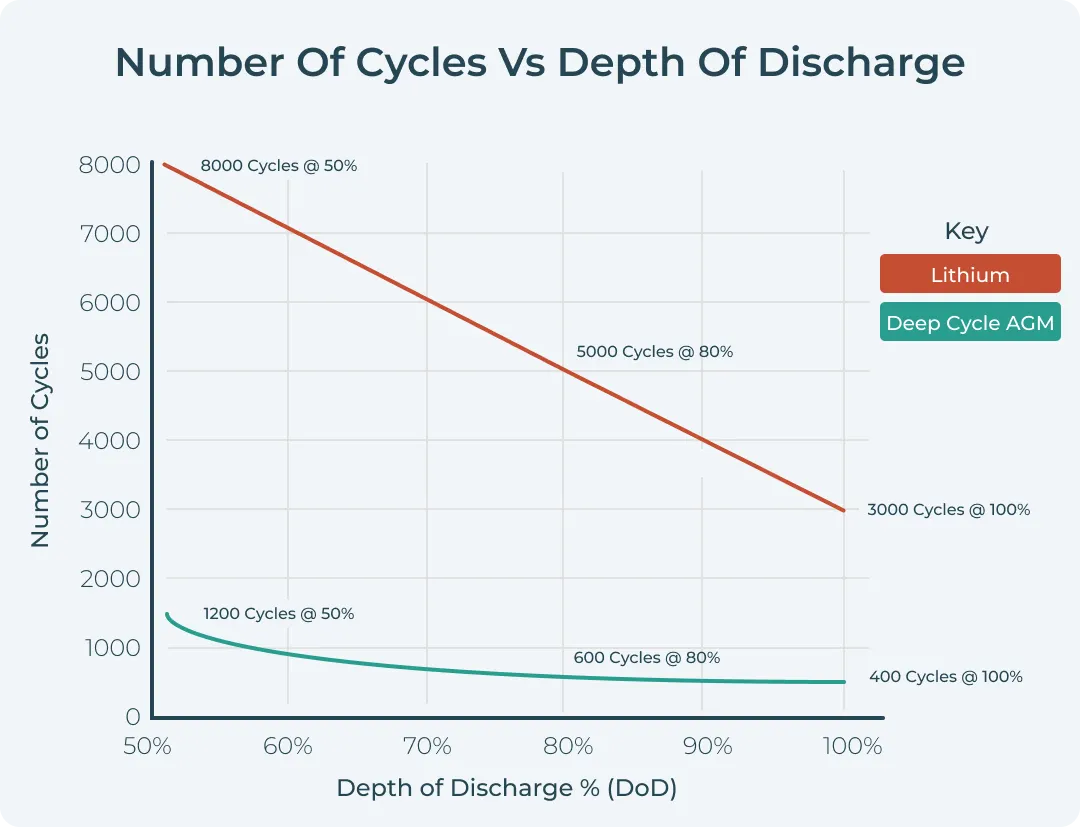
Campervan Battery Capacity & Discharge Depth
AGM vs Lithium Batteries - A few things to keep in mind
It's worth noting that AGM and lithium are different battery types with different usable discharge limits. However, your choice of battery capacity can be upscaled to account for this, meaning that lithium and AGM batteries can offer the same total capacity if your system is designed correctly.
For example, a modern lithium battery can be discharged up to 98% of its total capacity, whereas an AGM equivalent can only be discharged 50-80%. You may need 150Ah of deep-cycle AGM battery capacity to achieve the same performance as a 100Ah lithium equivalent, something you’ll see clearly when you run the numbers in a campervan off‑grid calculator.
It's also worth noting that lithium batteries generally can't be charged below temperatures of around five °C without causing issues, which matters most in cold weather. Doing so can cause permanent damage to your batteries, reducing their capacity. For this reason, if your van life goals include shredding at back-country skiing, we always recommend checking the manufacturer data sheets on any batteries you're considering and following a DIY campervan electrical checklist that covers winter-proofing.
Lithium batteries don't like freezing temperatures
It's also worth noting that lithium batteries generally can't be charged below temperatures of around five °C without causing issues. Doing so can cause permanent damage to your batteries, reducing their capacity. With this in mind, if your van life goals include shredding in the Alps, we always recommend checking the manufacturer data sheets on any campervan leisure batteries you're considering.
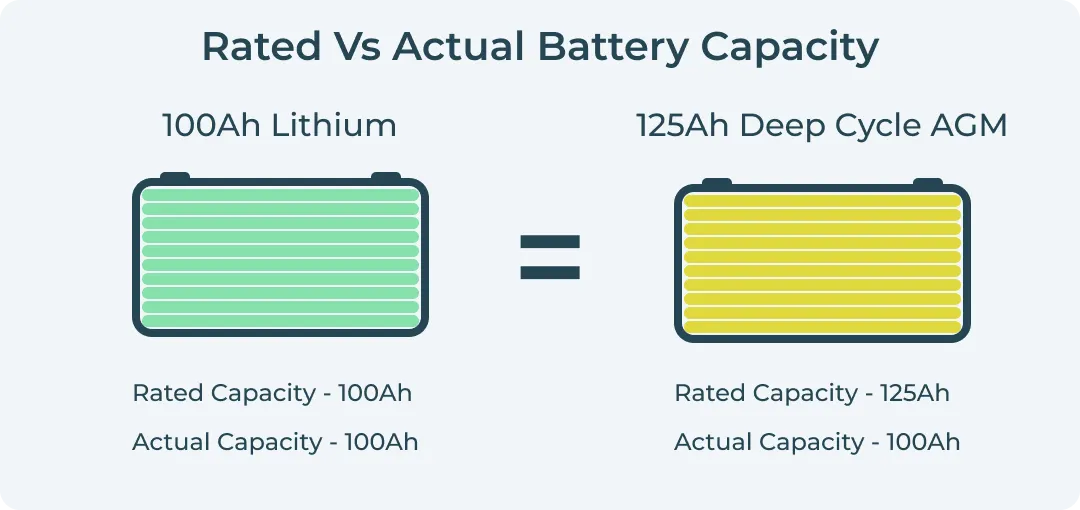
Campervan Leisure Battery Size & Weight
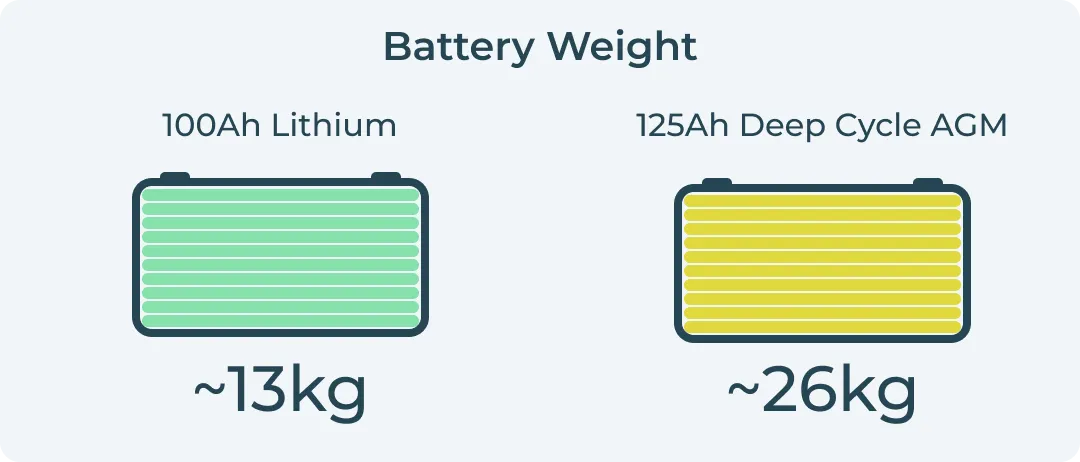
Most van conversions won't need to worry too much about weight. Still, it is worth noting that AGM batteries will be significantly heavier than the lithium equivalent and will likely take up more space in your van, as you may even need twice as many of them. That extra mass and footprint can also influence where and how you mount them, so it’s worth reading up on how to install a leisure battery safely before you commit.
This should be considered seriously if your van is smaller or you're trying to keep weight to a minimum. For example, TN Power's 100Ah lithium offering weighs 13.1kg, whereas their equivalent AGM battery weighs a whopping 26kg.
How Much Do Campervan Leisure Batteries Cost?
Unfortunately, it's difficult to estimate the overall lifetime costs of each type of battery due to the different ways we charge and discharge them - our cycles will not always be exactly 50%, 80% or 100%. However, we'll offer a lifetime cost analysis in a future blog to get deeper into this topic. In the meantime, our guide to choosing a battery and solar panel kit for your campervan puts real prices and system options side by side.
The cost of Lithium batteries
So far, lithium batteries lead on capacity, weight, charging performance and lifespan. So with that in mind, what's the downside?
Yep, you guessed it, cost. Lithium batteries will cost more than their AGM counterparts for the same capacity. For example, TN Power's AGM battery with a usable capacity of 100Ah currently costs £189.99, whereas the lithium equivalent will cost £600.
However, as we've discussed, this cost is not the whole story. Lithium batteries will last roughly ten times as many cycles as their AGM counterparts.
Overall, we recommend lithium batteries if you can afford the upfront cost, because they can still offer excellent value over their lifetime, especially for off grid power use - make sure to check the temperature ratings if you intend to spend your winter à Chamonix.
The cost of AGM batteries
With this in mind, AGM batteries may need to be replaced several times during your van ownership, multiplying the cost of the battery several times (not to mention the hours of stress and confusion you could be facing if you have to replace them once they've been built into your bench seat).
Which Lithium Battery Is The Best? (Updated 2025)
We've scoured brochures, built the systems and tested a range of campervan leisure batteries so that you don't have to. Here is what our team at Vunked recommends. - updated 2025
Best Overall: Fogstar (LiFePO₄)
Fogstar Drift is now our top pick. It delivers excellent performance, robust BMS protection, strong cycle life, and excellent value for lithium leisure use in campervans — a combination that's hard to beat in 2025.
Best for Cold/Extreme Conditions: Roamer
If you're chasing year-round adventures or sub-zero trips, Roamer's cold-rated options (e.g. their XTREME line) are superb. They're designed to handle low-temperature charging and harsher environments with confidence.
Best of the Best (Premium): Victron Energy Smart Lithium
For those with some cash to spare and wanting the truly premium option, Victron Energy is one of the trusted brands buyers often look to when they want premium reliability, and its bluetooth monitoring adds to the appeal. We're huge fans of Victron Energy because their products are top-notch and reliable.
If you want the absolute premium option, go Victron Energy Smart Lithium. Seamless system integration, class-leading reliability, bluetooth connectivity, and top-tier build quality — ideal for complex or mission-critical setups alongside other batteries and components.
Which AGM Battery Is The Best? (2025)
Thanks to the dramatic price drop in lithium over the last couple of years, AGM no longer stacks up on cost-per-usable-Ah, weight, cycle life, or charging performance. AGM is not the only sealed option in the wider market; gel batteries are another maintenance free type that use gel electrolyte instead of liquid battery acid. They also generally should not be charged above 14.2V to avoid damage. Lead crystal batteries are another maintenance-free option known for resilience under high usage. If you're comparing older non-lithium options, you may also come across the National Caravan Council leisure-battery verification categories as a basic quality check before you buy. If you already own AGM and it's working for your use-case, that's fine — but for any new purchase, go lithium.
(Previously recommended AGM options like “deep-cycle AGM” or “Victron Energy AGM” have been superseded by better-value lithium alternatives in 2025.)
Summary
- Making sure your batteries are the suitable capacity for your van life ambitions is super important.
- We recommend using our free Campervan Electrics System Builder to help you build the perfect system. See how changing your battery capacity affects your off-grid calculations.
- Once you've settled on a battery capacity, the next decision is what technology is right for you (Lithium or AGM).
- If you are conscious of size and weight or have a high-spec electrical system, you should consider lithium batteries. However, you will have to pay a premium for them.
- Those with a smaller or cheaper electrical system or are building their conversion on a tighter budget should consider AGM batteries. The good news is that as long as your batteries have enough capacity to power your appliances (see our off-grid calculator above for help with this). The performance will be very similar once everything is plugged in.
Build Your Own Campervan Electrics System
We hope you found this Campervan Leisure Battery blog helpful in kick-starting your van build.
If you want to simplify the process, our campervan battery kit includes everything you need to get started and ensures all components work seamlessly together, built around having the battery installed correctly with matched charging components like a dc dc charger. A split charger can charge both the vehicle and leisure batteries at the same time. For a deeper dive into that side of the system, our guide to DC to DC charger wiring in campervans explains how to connect things safely and efficiently.
We have built thousands of systems for adventurers like you, and, as knowledgeable as we are, it soon became apparent that it's tricky to find the exact match for an electrical system right away. But that's the beauty of campervan electrics - every van build and owner is unique!
With that in mind, we've created a free online tool to help our community to plan out its electrical system in a matter of minutes. It works hand‑in‑hand with our build your own campervan electrical kit walkthrough, which shows how to choose batteries, solar and charging methods. So select your essential appliances like a water pump, and account for high-demand loads such as motor movers when sizing battery capacity and charging, then let us handle the rest, including options for charging your leisure battery while driving.
Keen to try our Campervan Electrics System Builder?