
Campervan Electrics
By Ross Deacon13 min read
Campervan Off-Grid Calculations
Here at Vunked, we design our electrical systems to meet your needs when travelling off-grid, and our leisure battery calculator helps you work out how long you can stay off-grid in your campervan by estimating your daily power use, solar and DC-DC charging, and battery usage. For DIY campervan and van-life builders in the UK and EU, getting these figures right is a key part of sizing a reliable electrical setup.
To do this accurately, we need to figure out your campervan's off-grid calculations, including daily energy consumption, the 12V and 230V appliance types you use, charging and generation from solar and DC-DC, and the days of autonomy you want from your battery system. This is a topic of great debate in the van life community; getting it wrong can be costly and can leave you short of power when you need it most.
To make your life easy, we have built an easy-to-use calculator that takes your daily energy consumption, appliance types, charging inputs, and target days of autonomy to help estimate battery use versus charging and show how many off-grid days your setup can realistically deliver.
Campervan Electrics Off-Grid Calculator
< !– LEFT COLUMN: Appliance Selection --> < h2> < svg xmlns="http://www.w3.org/2000/svg" viewBox="0 0 24 24" fill="none" stroke="currentColor" stroke-width="2" stroke-linecap="round" stroke-linejoin="round"> < path d="M9.663 17h4.673M12 12v5M12 5v2M8.343 14.5 6 17l2.343-2.5a1.552 1.552 0 0 1 2.193 0L12 16l1.464-1.5a1.552 1.552 0 0 1 2.193 0L18 17l-2.343-2.5">< /path> < circle cx="12" cy="12" r="9">< /circle> < /svg> Select Your Off-grid Appliances < /h2> 12V Appliances < button id="reset12v"> < svg xmlns="http://www.w3.org/2000/svg" width="16" height="16" viewBox="0 0 24 24" fill="none" stroke="currentColor" stroke-width="2" stroke-linecap="round" stroke-linejoin="round"> < path d="M3 12a9 9 0 1 0 9-9 9.75 9.75 0 0 0-6.74 2.74L3 8">< /path> < path d="M3 3v5h5">< /path> < /svg> Reset < /button> < button data-consumption="4" type="button"> 💡 LED Lights (4W) < /button> < button data-consumption="18" type="button"> 🔌 USB Sockets (18W) < /button> < button data-consumption="60" type="button"> ❄️ 50L Fridge (60W) < /button> < button data-consumption="30" type="button"> 🌬️ Roof Fan (30W) < /button> < button data-consumption="15" type="button"> 💧 Water Pump (15W) < /button> < button data-consumption="30" type="button"> 🔥 Diesel/Gas Heater (30W) < /button> < button data-consumption="10" type="button"> 🔊 Portable Speaker (10W) < /button> < button data-consumption="40" type="button"> 📺 12V TV (40W) < /button> 230V Appliances < button id="reset230v"> < svg xmlns="http://www.w3.org/2000/svg" width="16" height="16" viewBox="0 0 24 24" fill="none" stroke="currentColor" stroke-width="2" stroke-linecap="round" stroke-linejoin="round"> < path d="M3 12a9 9 0 1 0 9-9 9.75 9.75 0 0 0-6.74 2.74L3 8">< /path> < path d="M3 3v5h5">< /path> < /svg> Reset < /button> < svg xmlns="http://www.w3.org/2000/svg" width="20" height="20" viewBox="0 0 24 24" fill="none" stroke="currentColor" stroke-width="2" stroke-linecap="round" stroke-linejoin="round"> < circle cx="12" cy="12" r="10">< /circle> < line x1="12" y1="8" x2="12" y2="12">< /line> < line x1="12" y1="16" x2="12.01" y2="16">< /line> < /svg> < strong>OFF-GRID 230V APPLIANCES ONLY< /strong> < p>Please only select 230V appliances you plan on using when NOT connected to shore power. These AC loads also pass through an inverter, so allow for around 10%-15% efficiency losses.< /p> < button data-consumption="80" type="button"> 💻 Laptop Charger (80W) < /button> < button data-consumption="900" type="button"> 🫖 Low Wattage Kettle (900W) < /button> < button data-consumption="900" type="button"> 🔥 Microwave (900W) < /button> < button data-consumption="1200" type="button"> 💇 Hair Dryer (1200W) < /button> < button data-consumption="800" type="button"> 🍞 Toaster (800W) < /button> < button data-consumption="1800" type="button"> 🍳 Induction Hob (1800W) < /button> < button data-consumption="55" type="button"> 📺 230V TV (55W) < /button> < button data-consumption="1500" type="button"> ☕ Coffee Machine (1500W) < /button> < button data-consumption="150" type="button"> 🚴 E-bike (150W) < /button> < button data-consumption="1500" type="button"> 🍟 Air Fryer (1500W) < /button> < button data-consumption="700" type="button"> ❄️ Air Conditioner (700W) < /button> < button data-consumption="60" type="button"> 📡 Starlink (60W) < /button> < button data-consumption="200" type="button"> 🎮 Playstation / Xbox (200W) < /button> < button data-consumption="150" type="button"> 💇 Hair Straighteners (150W) < /button> < !– RIGHT COLUMN: System Selection and Results --> < !– System Selection Panel --> < h2> < svg xmlns="http://www.w3.org/2000/svg" viewBox="0 0 24 24" fill="none" stroke="currentColor" stroke-width="2" stroke-linecap="round" stroke-linejoin="round"> < path d="M21 10V8a2 2 0 0 0-1-1.73l-7-4a2 2 0 0 0-2 0l-7 4A2 2 0 0 0 3 8v8a2 2 0 0 0 1 1.73l7 4a2 2 0 0 0 2 0l7-4A2 2 0 0 0 21 16v-2">< /path> < circle cx="12" cy="12" r="4">< /circle> < /svg> Select Your Electrical System Size < /h2> < button type="button" data-system="small"> < strong>⚡ Small< /strong> < /button> < button type="button" data-system="medium"> < strong>⚡⚡ Medium< /strong> < /button> < button type="button" data-system="large"> < strong>⚡⚡⚡ Large< /strong> < /button> < !– Results Panel --> < h2> < svg xmlns="http://www.w3.org/2000/svg" viewBox="0 0 24 24" fill="none" stroke="currentColor" stroke-width="2" stroke-linecap="round" stroke-linejoin="round"> < path d="M12 2v4M12 18v4M4.93 4.93l2.83 2.83M16.24 16.24l2.83 2.83M2 12h4M18 12h4M4.93 19.07l2.83-2.83M16.24 7.76l2.83-2.83">< /path> < /svg> Number of Days Off-grid < /h2> Total Daily Consumption: < strong id="dailyConsumptionValue">0 Wh< /strong> ☀️ Summer Unlimited ❄️ Winter Unlimited < p>Ready for more < b> detailed planning?< /b> Our comprehensive online campervan electric calculator lets you build your complete < b>electrical system< /b>, add custom appliances, get a < b>full parts breakdown < /b>, precise < b>off-grid times< /b>, and detailed < b>pricing< /b>. Check it out below!"
- Assumes 12V battery (12V nominal), ~5 sun hours in summer and ~2.5 in winter. * DC-DC charger is assumed to run 1 hour/day while driving, providing additional battery charge.
< p>If you want to learn the nitty gritty, read on...< /p>< p>No one wants to run out of power when they're hours from home and need to start work in 15 minutes. < /p>< p>So, today we're going to discuss how we < strong>calculate the off-grid times< /strong> for our electrical systems, along with the benefits and drawbacks of our approach.< /p>< p>When we were converting our first van to work remotely, we had no idea how long we'd be able to stay off-grid. After seemingly endless hours of research and making spreadsheets to perform the calculations, we were still clueless!< /p>< p>Since then, we've been able to build electrical systems and test them in the real world. After several iterations, we developed our off-grid calculator.< /p>
< h2>Campervan Off-Grid Calculation Steps< /h2>
< p>Calculating how long you can stay off-grid involves four main steps.< /p>< ol>< li>< strong>Daily Power Consumption -< /strong> Calculate how much energy you'll use daily when in your van.< /li>< li>< strong>Daily Power Generation -< /strong> Combining solar and DC-D charging, we can calculate how much energy will be generated daily.< /li>< li>< strong>Battery Consumption Vs Charging -< /strong> Depending on the size and type of battery we choose will affect how long you can stay off-grid.< /li>< li>< strong>Off-Grid Calculation -< /strong> Bringing it all together, we can calculate how long you can stay off-grid throughout the year.< /li>< /ol>< p>To make it easy to use, we've had to make some assumptions about the appliances you'll use in your campervan. We want to be completely transparent on how we do this so that you can feel confident that our systems suit you. < /p>
< h2>Step 1 - Daily Power Consumption< /h2>
< p>Every time you turn a light on or want a cup of tea, you'll need to consume energy to make that happen. < /p>< p>We're lucky to live in a world where we don't have to worry about these things, and if you get your campervan electrics right, you'll also be able to sleep easy knowing you'll never run out of power.< /p>< p>Below we go through each < strong>12V and 230V appliance< /strong> you may use in your campervan and estimate its < strong>daily power consumption.< /strong> If you're still deciding between sticking with 12V only or adding mains-style AC, our guide on [when you actually need 230V power in a campervan](https://vunked.com/blog/do-i-need-230v-power-in-my-campervan) can help you choose the right mix for your setup.< /p>
< h3>Simple Campervan Energy Calculations< /h3>
< p>Quick maths lesson. A < strong>12V battery< /strong> capacity is measured in < strong>Amp Hours (Ah)< /strong>.< /p>
To make our off-grid calculations easy we'll calculate how many Ah each appliances uses. To do this we'll use the following equation two equations.
Current (A) = Power (W) / Voltage (V)
Sometimes expressed as,
I = P/V
Amp Hours (Ah) = Current (A) X Hours
So all we need to know is the voltage of our battery system (usually 12V) and the wattage (W) of the appliances we're using. This is always stated on the applaince.
From here we can calculate the Current (A) using our I = P/V formula and then multiply this by time it's used each day, measure in hours, to find the total amount of energy charge (Ah)
12V Campervan Appliance Usage
First off, we need to figure out what power you will draw from your batteries while off-grid.
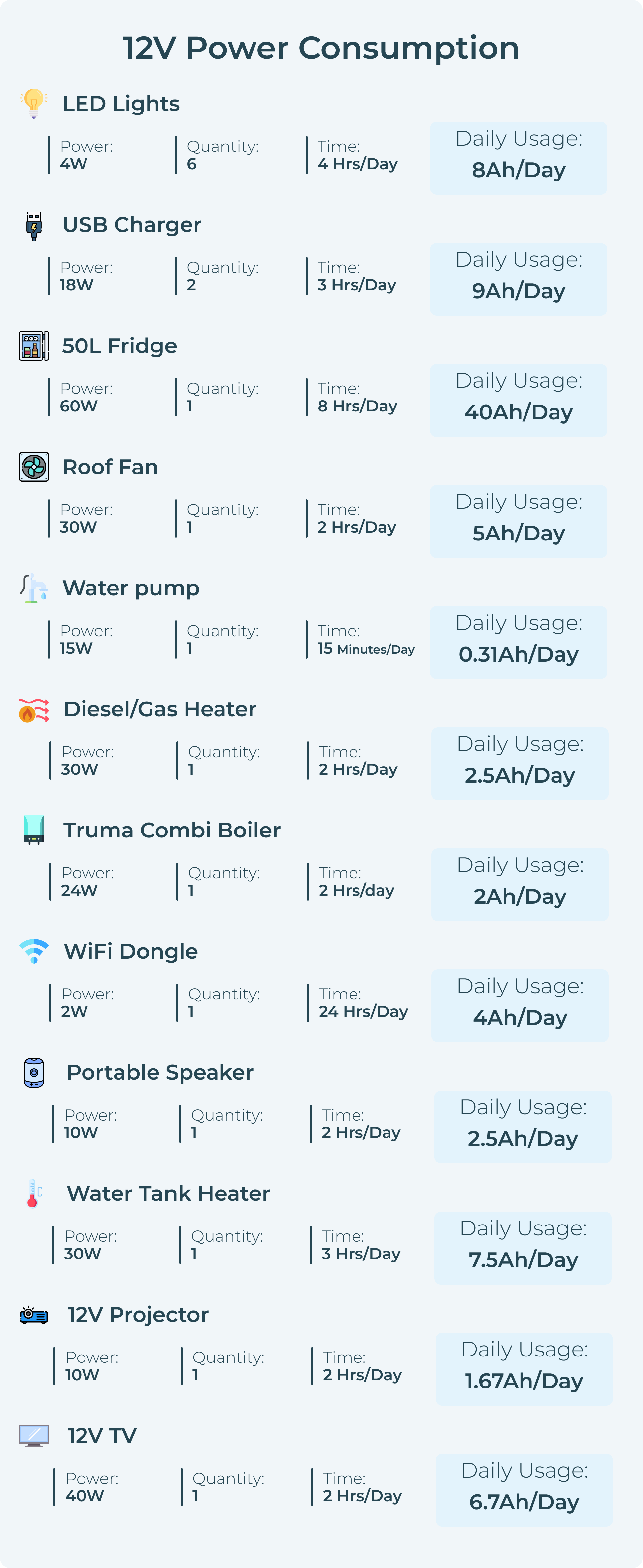
See the table below for all our appliances, the typical power rating and how long we estimate they run for in a day. We'll also include any assumptions we make here and explain our reasoning.
Appliance | Power | Qty | Time per day | Daily usage |
|---|---|---|---|---|
LED lights | 4W | 6 | 4 hours | 8Ah |
USB charger | 18W | 2 | 3 hours | 9Ah |
50L fridge | 60W | 1 | 8 hours | 40Ah |
Roof fan | 30W | 1 | 2 hours | 5Ah |
Water pump | 15W | 1 | 15 minutes | 0.31Ah |
Diesel/gas heater | 30W | 1 | 2 hours | 2.5Ah |
Truma combi boiler | 24W | 1 | 2 hours | 2Ah |
WiFi dongle | 2W | 1 | 24 hours | 4Ah |
Portable speaker | 10W | 1 | 2 hours | 2.5Ah |
Water tank heater | 30W | 1 | 3 hours | 7.5Ah |
12V projector | 10W | 1 | 2 hours | 1.67Ah |
12V TV | 40W | 1 | 2 hours | 6.7Ah |
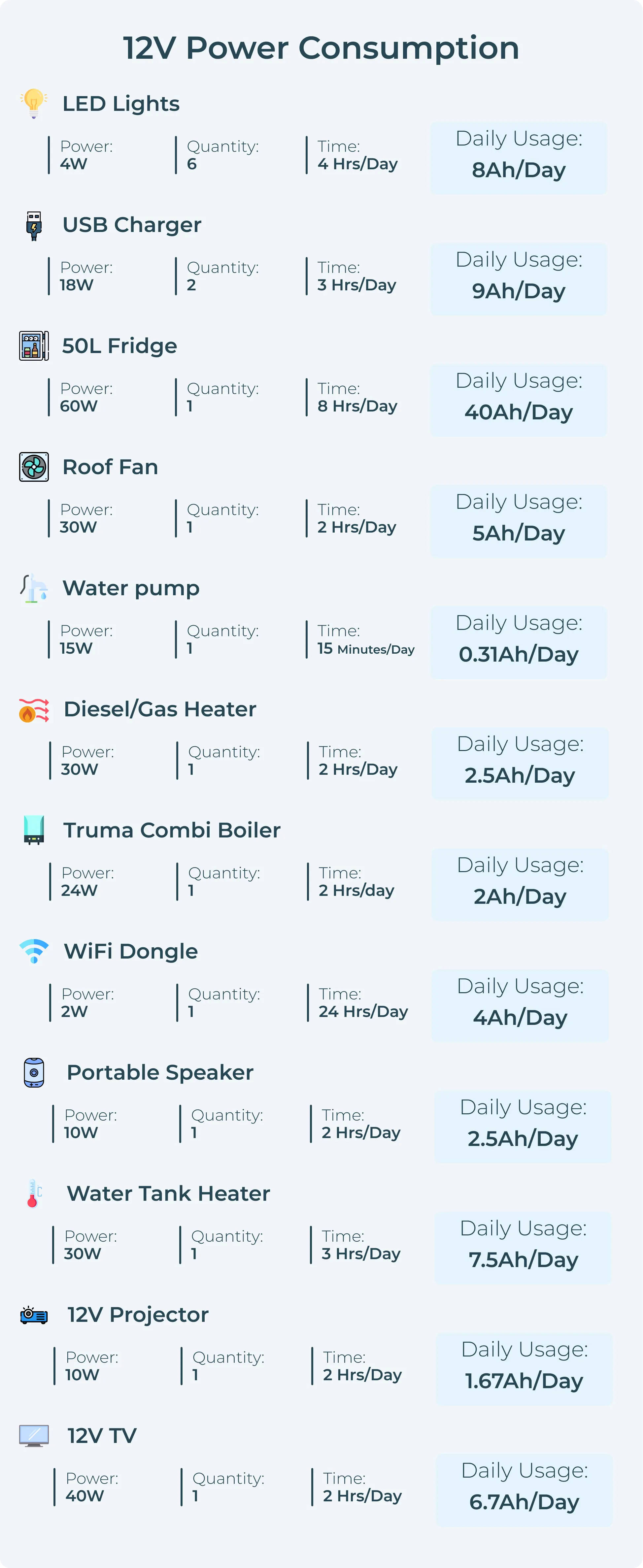
Nobody runs all of these — pick the rows that match your build and add up just those.
12V Campervan Appliance Assumptions
Here we will explain the assumptions we have made for our most popular 12V campervan appliances and what daily energy usage you will draw.
LED Lights (4W) -
Everyone has LED lights in their campervan. In this case we estimate 4W per light with a total of 6 lights in each campervan. We also assume they will all be used 4 hours a day.
USB Sockets (18W) -
If you are charging you phone or camera the most efficient way to do this is to use a 12V USB connection. We assume you'll charge two phones 100% each day for 3 hours.
50L Fridge (60W) -
You've got to keep the beers cold somehow. A 12V fridge is power-hungry but often necessary to stay off-grid for longer. A 50L fridge will consume about 60W. However, the compressor will only run about a third of the time, as the fridge automatically starts cooling itself. Therefore, we assume your fridge is only on for 8 hours daily (1/3 of 24 hours).
Diesel/Gas Heater (30W) — Like the fridge, a heater cycles rather than running flat out. We assume 2 hours of runtime at roughly half duty, giving 2.5Ah a day.
Truma Combi Boiler (24W) — Same principle. The boiler heats to temperature then idles, so we assume 2 hours at roughly half duty.
230V Campervan Appliance Usage
Next, we need to determine what power your 230V appliances will draw from your leisure battery and make sure your inverter is correctly sized using a dedicated campervan inverter size calculator.
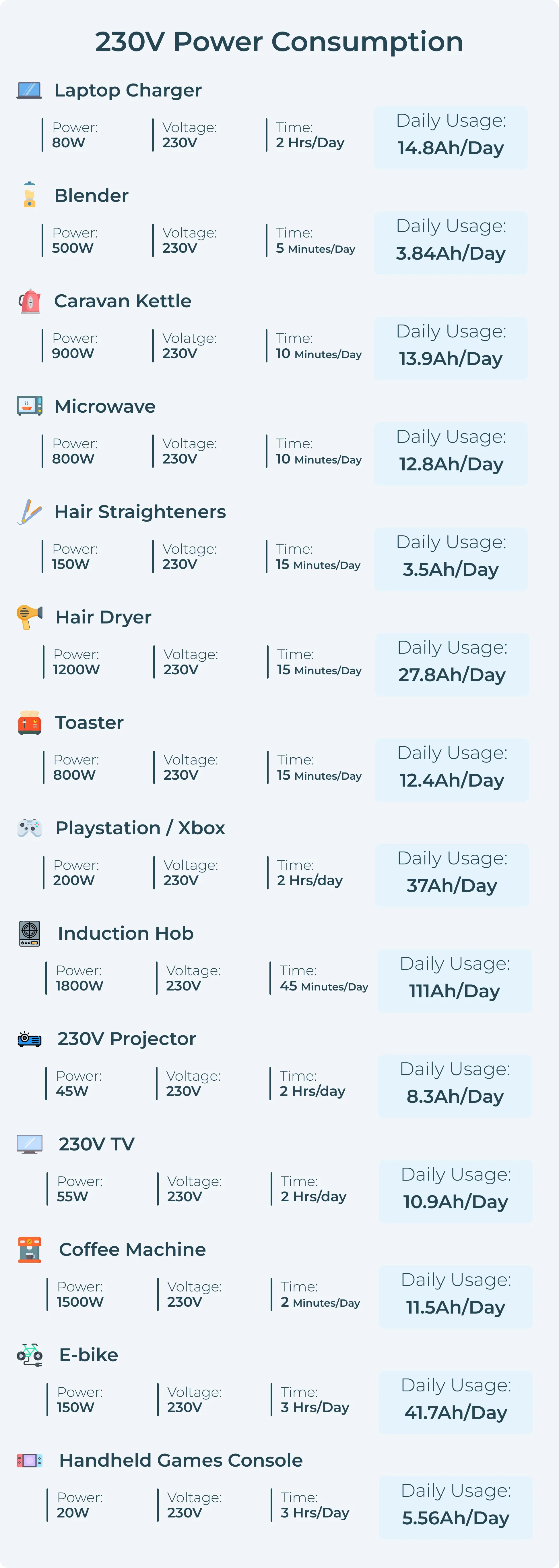
See the list below for all our 230V appliances, the typical power rating and how long we estimate they run for in a day. If you’re still working out the right mix of batteries and solar to support these loads, our overview on choosing a campervan battery and solar kit walks through sizing and setup options.
230V Campervan Appliance Assumptions
Here, for our 230V appliances, we will call out the assumptions we make for our campervan off-grid calculations.
Laptop Charger (80W) -
Laptop chargers can vary between 40 Watts and 120 Watts. Most standard laptops will sit around the 80W mark, whereas your new shiny Apple Macbook Air will be as low as 45 Watts and if you have a big hungry gaming laptop, that will be closer to the 100W end of the spectrum. We assume most people have standard laptops and charge them for two hours a day, which will see them through the working day.
Microwave (800W) -
Have you seen the Watts rating printed on the front of every microwave? Well, that is not how much power (W) it consumes. The rating on the front indicates the power (W) it generates to heat your soup on those cold days. The power it consumes (W) is higher than this. A study on 203 microwaves showed that the average efficiency was 71.29%. Meaning a 600W-rated microwave would draw 842W. We have taken this assumption and rounded it up to 900W. This means you can use your microwave with a 1200VA Inverter.
Hair Dryer (1200W) -
A rule of thumb is that anything that spins or heats requires a lot of power (W). Hair Dyers do both, which is why most standard hairdryers consume over 1000W. If you want that flowing hair, you will want a large Inverter. We assume that you will be using a lightweight or travel hair dryer.
Step 2 - Daily Power Generation
Now that we have calculated the daily usage Ah. Next, we will calculate how much power we generate daily for our campervan off-grid calculations.
Once you've calculated your usage, you'll need a suitable campervan solar panel kit to generate enough energy each day, and our range of Victron-based campervan solar kits shows how this looks in complete, ready-to-build systems.
Power Generation from Solar
Next up, we figure out how much juice your solar panels will provide daily. We have two basic scenarios we base these calculations on - summer and winter. The sunlight changes massively throughout the year, especially as you move further north. So we also have the weather to account for. As a Glasgow-based company, we base our calculations around our fair city.
For our campervan off-grid calculations and solar, we make two main assumptions:
- Hours of daylight
- Solar panel efficiency
These are both explained below...
Hours of Daylight Assumptions
We assume an average of 4 hours of direct sunlight each day in the summer and 1 hour in the winter. This may sound low, but we've found this to be a reasonable average estimate based on Glasgow's weather data.
If you live somewhere sunnier (think south), our solar calculations will likely be a bit conservative. This isn't a bad thing. After all, it's better to be conservative than risk running out of juice!
Solar Panel Efficiency Assumptions
We also assume an efficiency of 70% for all our solar panels. This is because your solar panels will only produce their rated power when the sun is directly overhead. Not all the sunlight is absorbed when the sun hits the solar panels at an angle. When this happens, the solar panels generate slightly less than their rated power. Our efficiency factor considers this.
If you want to learn more about this, you can read up on our
Deep Dive into Campervan Solar
We end up with another amp-hour value that is provided to your batteries each day from your solar panels. This is combined with the DC-DC charging capacity and offset against your daily energy consumption.
Power Generation from DC-DC Charging
The next part of the off-grid calculations jigsaw is how much power is generated through the DC-DC charger while driving, which ultimately depends on the vehicle’s alternator and gives you a useful backup charging source alongside solar when off-grid. This is dependent on two things:
- The size of your DC-DC charger (we currently stock 18A and 30A chargers from Victron)
- How long do you drive for
We assume the DC-DC chargers are 100% efficient and, therefore, constantly provide the 18A or 30A stated while you drive. If you’d rather not piece the charging side together yourself, our Victron campervan electrical systems bundle DC-DC, solar, batteries and protection into matched kits.
Driving Times
We don't assume driving hours, instead, when you fill out our online form, we'll ask how long you expect to drive for each day. We perform our calculations based on various driving scenarios and will give you a feel for how much battery capacity your DC-DC charger is actually providing.
For example, each hour of driving will provide 18Ah of battery capacity using a Victron 18A DC-DC charger.
Step 3 - Battery Consumption Vs Charging
We're finally getting to the good bit - finding out the net change in your battery capacity each day. We offset your solar and DC-DC charging against your starting battery capacity and daily energy consumption to determine how your daily net charge. When working out the right battery size, daily battery consumption calculations also need to consider peak current demands from high-draw appliances, not just total stored energy. This can be done using the equation bellow...
(solar charge) + (DC-DC charge) - (energy consumption) = (net charge)
If you charge your batteries each day more than you consume, you can last as long as you like off-grid, though usable capacity depends on DoD rather than headline capacity alone.
Pair your system with a reliable leisure battery kit to store your energy and maximise your time off-grid, and consider the most popular campervan electrical upgrades vanlifers choose when they outgrow their first setup.
If like most van users, you consume more than you charge, you drain your batteries daily until they run flat. We love when people use examples, so let's finish this off using one.
"We have a campervan electrical system that generates 10Ah from solar and 15Ah from a DC-DC charger. The appliances we use drain 50Ah of battery capacity daily (we have long showers!). Our campervan is fitted with one 100Ah lithium battery, giving about 1.28kWh usable energy before depth of discharge limits are applied."
Walking through this using the above equation...
For example, if you top-up 10Ah from solar and 15Ah from your DC-DC charger, and drain 50Ah of battery capacity each day from your appliances, your required capacity depends on the battery bank you choose and the usable reserve available, so a 100Ah lithium battery will drain in 4 days.
Walking through that using the above equation...
Battery Capacity Change: 10Ah + 15Ah - 50Ah = -25Ah
net charge = -25Ah
We can see that every day we use our van off-grid we lose 25Ah of energy. However, what does that mean? How long can I stay off-grid?
Step 4 - Off-Grid Calculation
Using the same example before we can see that losing 25Ah of energy a day will result in four days off-grid.
Battery Capacity (start of the day) - net charge = Battery Capacity (end of the day)
- Day 1: 100Ah - 25Ah = 75Ah
- Day 2: 75Ah - 25Ah = 50Ah
- Day 3: 50Ah - 25Ah = 25Ah
- Day 4: 25Ah - 25Ah = 0Ah
A quicker method is to divide the total battery capacity by the net charge. Using the same example as before...
Days Off-Grid = Total Battery Capacity / Net Charge
- Days Off-Grid = 100Ah / 25Ah
- Days Off Grid = 4 days
Here you have it, and following these four (almost) simple steps, you can calculate how long you can spend off-grid in your campervan. From there, it’s easier to match one of the best campervan electrical system layouts for different lifestyles to your actual travel plans.
Don't want to worry about going through all the hassle? Our Campervan Electrics Builder Tool takes the guesswork away so you can focus on what's essential - exploring in your van, and our walkthrough on how to use the Build Your Own Campervan Electrical Kit tool shows each step from appliances to final parts list.
Battery Discharge Assumptions
When performing this last part of the calculation, your chosen battery type matters. Popular leisure battery types include LiFePO4 (lithium) and AGM. We assume deep-cycle AGM batteries can be discharged by 80% of their maximum capacity before causing lasting damage, and that a lithium battery can be discharged to 100% of its capacity.
That's why the example above takes a 100Ah lithium battery all the way down to 0Ah. Swap in a 100Ah AGM battery and you'd only have 80Ah to play with, so you'd run flat sooner on exactly the same setup.
One more thing worth knowing: lead-acid batteries, including AGM and flooded types, deliver less usable capacity when you draw power quickly. This is called the Peukert effect, and it means a high-draw appliance takes more out of a lead-acid battery than the maths alone suggests. Lithium is far less affected.
Want More Time Off-Grid?
If you don't like the results of or off-grid calculator, there are three things you can do to get more time off-grid:
- Increase your maximum battery capacity — in many setups, that means choosing a larger battery than the bare minimum so you have headroom for seasonal changes and variable solar input before you need to recharge.
- Increase your charging capacity — one simple way to do that is to add solar.
- Reduce your daily energy consumption
Remember our off-grid calculator is free to use and even provides a wiring diagram and quote for the entire electrical system, including all the bits and pieces you need to install it! You can play around with your system design and see the different ways to achieve the time off-grid you've, or start from a pre-designed Weekender campervan electrical system kit that’s optimised for short trips and light off-grid use. Cold temperatures can reduce battery capacity and affect safe charging, so winter users may need a bit more headroom.
Simplify everything with a complete electrical system designed specifically for your van, or dive into our overview of campervan electrical system kits and design services if you’re still comparing options.
Still a Bit Confused? Want the Perfect Electrical System?
Why not plug your figures into the tool for a starting estimate, then if you’re still unsure we recommend consulting our team about the right size battery or system setup for your van. This is especially useful if your plans range from occasional use to longer off-grid trips, since appliance demands can vary significantly between vans.