
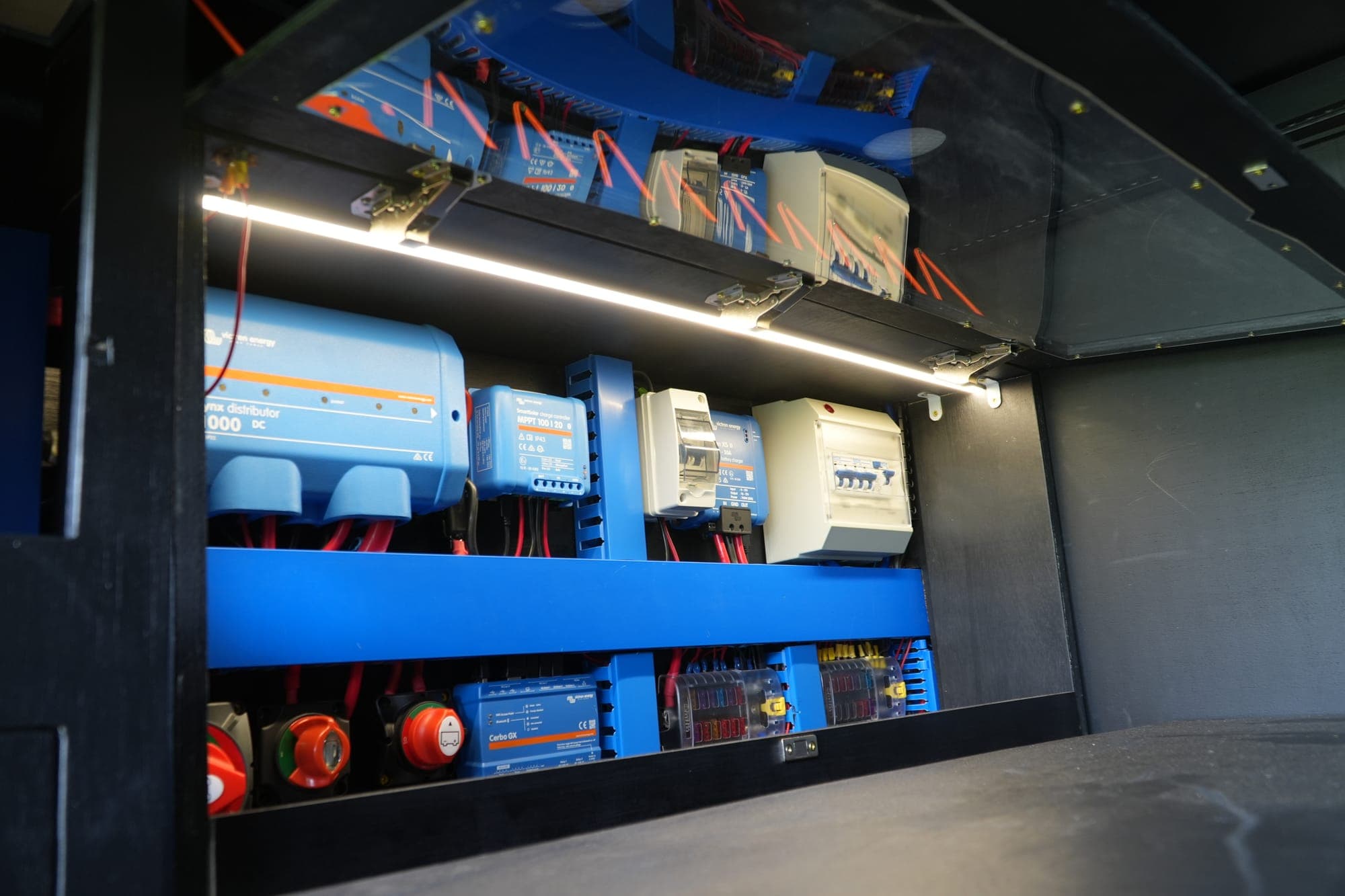
Choosing the right campervan electrical system depends entirely on your lifestyle and preferences. A digital nomad needs consistent off-grid power to work anywhere. A part-time traveller might only need weekend reliability. And if you're retired or work seasonally, you'll want comfort and efficiency without the need for constant maintenance. Your van's power system will largely dictate how you live and travel.
One of the best campervan electrical systemoptions is a bespoke system designed to simplify installation, ensure everything works together seamlessly, and make compatibility easier to manage.
This guide breaks down the best electrical setups for various types of vanlifers, including remote workers, content creators, retirees, and part-timers. Each section includes real-world case studies, clear system priorities, camper van electrical planning, and recommended setups from Vunked that build on our insights into the most popular electrical upgrades for vanlifers
Campervan Electrical System for Remote Workers
If you want to work remotely from a van, having the right electrical system matters more than anything else. You'll need consistent power for a laptop, phone, WiFi, and possibly a monitor. That means planning for charging, storage, and backup, with a dependable power supply for work devices—especially when you're off-grid.
Key priorities:
- Reliable Charging: You must have the ability to charge via solar, alternator, and hookups, ensuring you always have a redundant power source for uninterrupted work.
- Battery capacity: We recommend capacity for at least 2 days of use without charging.
- Inverter: Critical if your devices run on 230V AC.
- System access: You need to know how to reset, fuse, or fix your electrical system—you won't have help when you're off-grid, hours from the nearest town.
A reliable system matters because remote workers may be far from help when something fails.
Full-time remote worker Lucinda Norris (@vanlifewithluci) built this exact electrical system; here's how she did it.
Case study: Luci, the remote worker

Lucinda lives solo in a short-wheelbase Sprinter. She's full-time on the road, mainly in Europe, and works remotely while travelling. She often works off-grid, using Starlink for internet access.
"The system powers everything from my laptop to a Starlink satellite for the internet, enabling me to work remotely from anywhere—even the top of a mountain in Portugal."
Luci built the van herself, fitting every component herself, meaning she can fix or*—at the very least—*locate the problem when things go wrong.
"I love that I know every nut and bolt in my van. I recently had a leak in my shower, and because I installed the plumbing myself, I was able to fix it in a car park in Portugal. That sense of independence is priceless."
Luci's remote work electrical system

Core Setup:
- Power sources: Roof-mounted solar + split charge from alternator.
- Battery bank: DIY install large enough to support remote work, with a lithium setup that includes a battery management system and battery monitoring for campervans for protection and longevity.
- Inverter + 12V access: Enough for laptops, lighting, and charging devices.
Design priorities:
- Redundancy – If solar fails (cloudy weeks in Europe), the alternator covers it.
- Accessibility – She knows every cable route and fuse location because she installed them.
- Scalability – Built around her solo needs but modular enough to upgrade, and a battery monitor helps track charge levels while working remotely.
🔋 Batteries:
- 1 x 460Ah Lithium battery
☀️ Charging:
- 370W solar with Smart MPPT solar charge controller
- 30A DC-DC Charger
🔌 Usage:
- 1600VA Inverter
- 12V Fuse Box
BUILD YOUR REMOTE WORK CAMPERVAN ELECTRICAL SYSTEM
Campervan Electrical System for Content Creators
Creating content on the road is power-hungry. Cameras, drones, phones, laptops, lighting—everything needs charging. If you regularly film, edit, and upload content, you'll need a robust and comprehensive camper van electrical system, ideally planned using a DIY campervan electrical checklist.
Unlike casual vanlifers, content creators can't wait for the sun to shine or a café to open. You need constant, dependable power wherever you are.
Key priorities:
- Reliable Charging: You must have the ability to charge via solar, alternator, and hookups, ensuring you always have a redundant power source for uninterrupted work.
- Aim for 2–3 days of full creative use without charging.
- Pure sine wave inverter: Needed for camera batteries, laptops, and sensitive gear.
- Charge point access: Multiple USB, 12V, and AC points for simultaneous charging, with enough capacity to manage AC loads safely when several chargers and appliances are running at once.
- Fixability: Know your system. If you blow a fuse mid-upload, you need to fix it fast.
Full-time vanlifers and content creators Lauren and Louis built their van's electrical system to meet these needs—without overspending.
Case study: Lauren and Louis, the content creator couple

Lauren and Louis live full-time in their Ford Transit. They're building a brand from the road—filming, editing, posting, and sharing their journey. That means constant power use, especially for phones, cameras, laptops, and a record player.
Their background? Lauren from marketing. Louis is a landscaper. No van build experience—but they figured it out. Lauren and Louis used Vunked's builder tool to design their system and received everything they needed for installation.
"Our van's electrical system is designed for maximum off-grid living. We have a 230-amp lithium battery, 350 watts of solar panels, and a DC-to-DC charger that keeps the battery topped up while driving. For three weeks in Scotland, we didn't need to hook up to power once."
Lauren and Louis's electrical system

Core Setup:
- Power sources: 350 watts of solar panels on the roof, including rigid solar panels, + split charge from the van's alternator. Solar panels can be wired in series or parallel depending on the system layout.
- Battery bank: 230-amp lithium battery for charging cameras, lighting, and a fridge.
- Inverter + 12V access: The inverter supports 230V AC for laptops and creative gear; 12V sockets power lighting and low-draw appliances.
Design Priorities:
- Redundancy – Solar handles most of the charging; the alternator keeps batteries topped up during travel days.
- Budget efficiency – They repurposed materials (like an old dining table for worktops) so they could put more into power and functionality.
- Creative workflow – Multiple charge points and a stable inverter setup allow for uninterrupted content creation, even when off-grid.
Minimal gear (iPhone + one device, such as a camera or drone):
🔋 Batteries:
- 1 x 230 Ah Lithium Battery enough juice to charge your devices; for many uses, a 200Ah LiFePO₄ battery paired with 300–400W of solar power is an effective baseline.
☀️ Charging:
- 185W Solar with Smart MPPT - A smallish solar panel to extend your off-grid times with an mppt solar charge controller
- 18A DC DC Charger - provides an alternative to charging during those cloudy days or winter months
🔌 Usage:
- 500VA Pure Sine Wave Inverter - Keep the inverter small to keep the costs down
- 12V Fuse box for appliances, or a fuse block for grouping and protecting multiple small circuits; fuse boxes and busbars centralize power distribution and protect circuits for multiple electrical components in the van.
Link this system - https://vunked.com/configurator/campervan_12v
Gear-heavy content creators (Multiple devices, like a camera, drone, GoPro, etc. ) :
🔋 Batteries:
- 1 x 460Ah Lithium Battery - A big battery bank so you can be sure your drone, camera, and GoPro never miss a shot!
☀️ Charging:
- 350W Solar with Smart MPPT - or more, fit as much solar on your roof as possible to maximise off-grid times.
- 30A DC-DC Charger - Charges your leisure battery during those long drives between shots.
- Campsite Hook up using the Inverter Charger. You can charge from shore power if you ever get stuck.
🔌 Usage:
- 2000VA Inverter Charger - Enough power to charge the largest of drones (fast!); heavy gauge cables are important to minimize voltage drop on high-current runs.
- 12V fuse box for appliances
BUILD YOUR CONTENT CREATOR CAMPERVAN ELECTRICAL SYSTEM
Campervan Electrical System for Seasonal Workers
Seasonal workers aren't always off-grid, especially when working. But they do need flexible systems. Their electrical setup must support full-time living and frequent travel.
While solar is important for seasonal workers when they're off-grid, having a system optimised for hookups is essential during times they're parked and working, with consumer units helping manage campsite AC safely, much like a dedicated campsite hook up campervan electrical system.
Winter work adds complexity—more heating, more lighting, and more time spent indoors. That means more energy use, not just for comfort but for core functions like showers, cooking, and drying gear, so the major components need sizing around those loads and how long you're indoors.
Key priorities:
- Hybrid charging:Solar for off-grid and hookups when parked for work.
- Temperature control: Diesel heating for cold seasons, ventilation or fans for hot ones. Both impact power use.
- Hot water: Adds convenience and hygiene, especially in winter.
- Insulation: Reduces heating needs and protects equipment in colder seasons.
Maisie and Nik planned their build around doing seasonal work in winter climates—balancing cost, power needs, and comfort. Here's what their system looks like.
Case study: Maisie and Nik, the seasonal workers

Maisie and Nik are a UK-based couple who transitioned from years of backpacking to full-time vanlife. They work seasonally and have built their van to support travel and employment across Europe, including winter seasons in the Alps.
Their lifestyle demands long stretches of self-sufficiency, reliable power in cold climates, and comfort features like hot water and an indoor shower. With Nik's background as an electrician, they tackled the entire build themselves, aiming for a setup that balances practicality, durability, and year-round usability.
"We've got a solid electrical system with two solar panels giving about 350 watts, a Victron 3000 inverter, and a heavy-duty Fogstar drift battery with Bluetooth monitoring and heating capabilities. We also have a DC-to-DC charger and an offshore hookup, and most of our components are Victron. Monitoring our battery consumption has been helpful, especially to see which appliances are draining the most power."
Maisie and Nik's electrical system

Core Setup:
- Power sources:
- 350W solar panel on the roof
- Split-charge relay for alternator charging while driving
- Battery bank:
- 1 608Ah AGM leisure batteries (total 260Ah capacity), a sealed lead acid type, though some vanlifers prefer integrated Victron campervan electrical systems for higher performance and flexibility
- Inverter + 12V access:
- Victron 3000W inverter****charger for limited 230V usage
- Lighting, fridge, water pump, and other essentials run on 12V
- A battery monitor is especially useful here for tracking winter usage and spotting heavy draws.
- Heating + water:
- Diesel heater
- Hot water system connected to both water tanks and heater
- Indoor shower plumbed in and tested before heading to the Alps
Design Priorities:
- Winter functionality: Electrical system designed around life in the Alps, including insulation, hot water, and reliable heating
- Low-maintenance power: Their AGM batteries require no user maintenance and handle cold better than lithium without heating.
- Real-world testing: They ran the system on a summer trip, then finalised it before winter work
Hot summer climates:
🔋 Batteries:
- 1 x 460Ah Lithium Battery
☀️ Charging:
- As much solar as you can fit on your roof, to take advantage of the sun. We recommend a 430W Solar with Smart MPPT.
- 18A DC DC Charger
- Campsite hook up as a backup - you don't want to run out of power if the van is your home!
🔌 Usage:
- 3000VA inverter charger to give you room to run larger 230V appliances
- 12V fuse box for powering basic appliances
Harsh winter climates:
🔋 Batteries:
- 2 x 460Ah Lithium battery - A big battery bank to get you through those cloudy days
☀️ Charging:
- 370W Solar with Smart MPPT - Still a lot of solar but don't need to go crazy
- 50A DC DC Charger - As big a DC DC charger as you can fit, maybe even two, so you can charge while you drive as you will have limited sun in the winter.
- Campsite hook up so you can charge in those winter months and cloudy days
🔌 Usage:
- 3000VA inverter charger, ideally within a Victron Energy setup, so you can run heating appliances and you have the option to plug into a campsite which you will need in the winter months
- 12V Fuse box for your basic appliances
BUILD YOUR CAMPERVAN ELECTRICAL SYSTEM FOR SEASONAL WORK
Campervan Electrical System for Retirees
Retired vanlifers often prioritise reliability, comfort, and simplicity in a camper van setup. They're less likely to rough it and more likely to invest in campervan electrical systems that reduce maintenance and remove hassle.
They may not need extreme off-grid setups, but they do want energy independence—especially when travelling across Europe for weeks or months at a time, making reliable Victron solar kits for campervans an attractive option.
Key priorities:
- Reliable, high-spec components: Systems and parts built to last, with quality components forming the basis for long-term dependability and minimal servicing or user intervention.
- Energy independence & flexibility: Strong solar and battery storage, but still compatible with campsite hookups.
- Comfort features: Induction cooking, heating or cooling, toilet, shower.
Nige and Diane fit this profile perfectly. Here's how they approached their self-converted van build after leaving behind their business and home.
Case study: Nige and Diane, the retiree vanlifers

Nige and Diane converted their van—a retired Scottish ambulance—themselves. Nige's engineering background shaped every detail of the electrical system. Having converted a minibus in the past, they applied those lessons here to build a clean, efficient, and reliable setup.
Their system is 100% electric, designed to eliminate the use of gas. It powers everything from cooking to heating and was built with long-term travel in mind. They raised the floor to add storage and reworked their layout to maximise efficiency and usability.
Nige and Diane's electrical system

Core Setup:
- Power sources:
- Upgraded roof-mounted solar** array** (exact wattage not specified).
- Compatible with campsite hookups for additional charging flexibility.
- Battery system:
- Switched to lithium batteries for faster charging, deeper discharge, lower maintenance, and more reliable usable capacity for an all-electric setup.
- Inverter + appliances:
- Runs an all-electric induction hob and other household comforts. Larger ac loads like an induction hob also need suitable AC protection and distribution.
Design Priorities:
- All-electric simplicity: Eliminating gas reduces complexity and lowers long-term maintenance costs.
- Built for longevity: Every component was selected for durability and ease of use.
- Flexible power use – Able to live off-grid or plug into hookups when needed.
🔋 Batteries:
- 400 - 600 Ah Lithium battery so you can power an induction hob easily
☀️ Charging:
- 200W - 400W Solar with Smart MPPT so you can use power off-grid without fear of running out of electricity
- Campsite hook up by using an inverter charger - If you are spending anytime at a campsite then a hook up is a must
- Option DC DC charger if looking to extend your off-grid times but likely not needed
🔌 Usage:
- 3000VA inverter charger - lets you power your induction hob off grid and at a campsite so you can go gas free
- 12V fuse box for powering your basic appliances - lights, USB, fridge, etc
ELECTRIFY YOUR RETIREMENT WITH THIS CAMPERVAN ELECTRICAL SYSTEM
Campervan Electrical System for Part-Timer Vanlifers
Part-time vanlifers typically use their vans for weekends, holidays, and short trips—often off-grid but not always too far from civilization.
Their electrical systems need to be simple, dependable, and ready to go at a moment's notice, with a straightforward camper van electrical setup that’s easy to live with, similar to a weekender campervan electrical system. Long charge cycles, fragile gear, or complex setups are a liability. These vans might sit unused for weeks, so ease of use and reliability matter more than max capacity.
Key priorities:
- Fast, simple charging: Split-charge systems and compact solar setups with properly sized charge controllers.
- Durable storage: Reliable lithium batteries that tolerate sitting idle.
- Low-draw appliances: Lights, phone chargers, fridge.
Part-time vanlifers Rob and Hannah, along with Chloe, built their vans by balancing comfort and function without going overboard. Here's how they made it work.
Two part-time vanlifer case studies
Rob & Hannah:

Rob and Hannah are a UK couple who transitioned into part-time vanlife after years of feeling stuck in a routine. Their VW Crafter is a self-built project with extended trips used as test runs to refine the setup. Hannah works remotely, so the couple doesn't venture too far off grid as she uses a WiFi hotspot for the internet.
They typically alternate between stretches at home and several months away, often with their dog. The build focuses on comfort, gradual upgrades, and learning through hands-on experience. It's a flexible setup for a lifestyle that doesn't demand full-time off-grid capability—but is ready when needed.
Chloe:

Chloe owns a VW T5 and uses it for flexible travel, short breaks, beach weekends, and time in nature with her dogs. As a surfer and nature lover, Chloe wanted a van that was ready for seaside trips at a moment's notice.
Her build is fully DIY, designed for compact efficiency. The van features solar power and a split-charge system. Her focus was on practicality, low-maintenance power, and a homey feel.
Core Setup (both have similar systems):

- Power sources:
- Roof-mounted solar panel for passive daytime charging, with the van roof often limiting how much panel space you can fit.
- Split-charge relay from the alternator for top-ups while driving.
- Battery bank:
- Leisure batteries, DIY-installed, separate from the starter battery, to handle lights, fridge, and device charging. Use marine-grade tinned copper cables for better durability. Select wire gauge to allow a maximum voltage drop of 3% for critical loads.
- 12V system:
- USB ports, LED lighting, and low-draw appliances.
- Inverter
- Appliances:
- LED lighting.
- Fridge or cooler, water pump, and charging points for phones, laptops, and cameras.
A simple fuse block or bus bars layout makes DIY maintenance easier, and fuses should be sized according to the weakest link in the circuit.
Design Priorities:
- DIY simplicity: Built without technical expertise, using electrical kits and online tutorials, with crimping recommended for making electrical connections and heat shrink connectors useful for waterproof, permanent joins.
- Low maintenance: Reliable without requiring frequent checks or servicing.
- Ready-to-go usability: Minimal setup time, ideal for spontaneous weekend trips or holiday getaways.
- Built for comfort: Prioritises essentials without overspending or over-complicating.
This kind of van conversion also benefits from keeping electrical components easy to access, especially when installing campervan electrics conversion kits for a DIY build.
🔋 Batteries:
- 180 Ah lithium battery - enough to last you a weekend off-grid
☀️ Charging:
- 100W - 300W Solar with Smart MPPT - solar is your best bang for buck energy wise, gives you energy without breaking the bank
- If you will spend most the time at a campsite, a 15A battery charger with campsite hook up is recommended too
🔌 Usage:
- 12V appliances only to keep system cost down
- If looking to run larger appliances, install a 500VA inverter charger, and run anything over 500W at a campsite to save money
VAN ELECTRICS SIMPLIFIED with expert-backed campervan electric consultations
BUILD YOUR CUSTOM CAMPERVAN ELECTRICAL SYSTEM IN MINUTES
Build the Right Electrical System and Solar Panels for Your Vanlife Journey
Every vanlife journey is different—and the right camper van electrical system should match how you use the van day to day, not how someone else does it, as countless stories in our vanlife and campervan electrics blog illustrate. Whether you need to power creative gear, stay warm in winter, or keep your phone charged for a weekend escape, the proper setup makes all the difference.
Ready to electrify your home on wheels? As part of any van conversion, our builder tool will guide you through creating your ultimate campervan electrical system in a few clicks and get everything you need delivered to your doorstep.