
With property prices booming and rent creeping up every year, thousands of people across the UK are looking at full-time UK vanlife as a viable option for living, and over half a million UK citizens now live in vans full-time.
However, it's not as simple as throwing a mattress in the back of a transit and telling your family you'll miss them. How will you get your post? Where will you park? Can you even live in a van legally?
To truly enjoy the freedom of life on four wheels, you'll need to navigate these unique complexities. In this complete guide, we'll give you the rundown on everything you need to know, including laws, where to stay, when to go, and what you'll need to make vanlife truly comfortable!
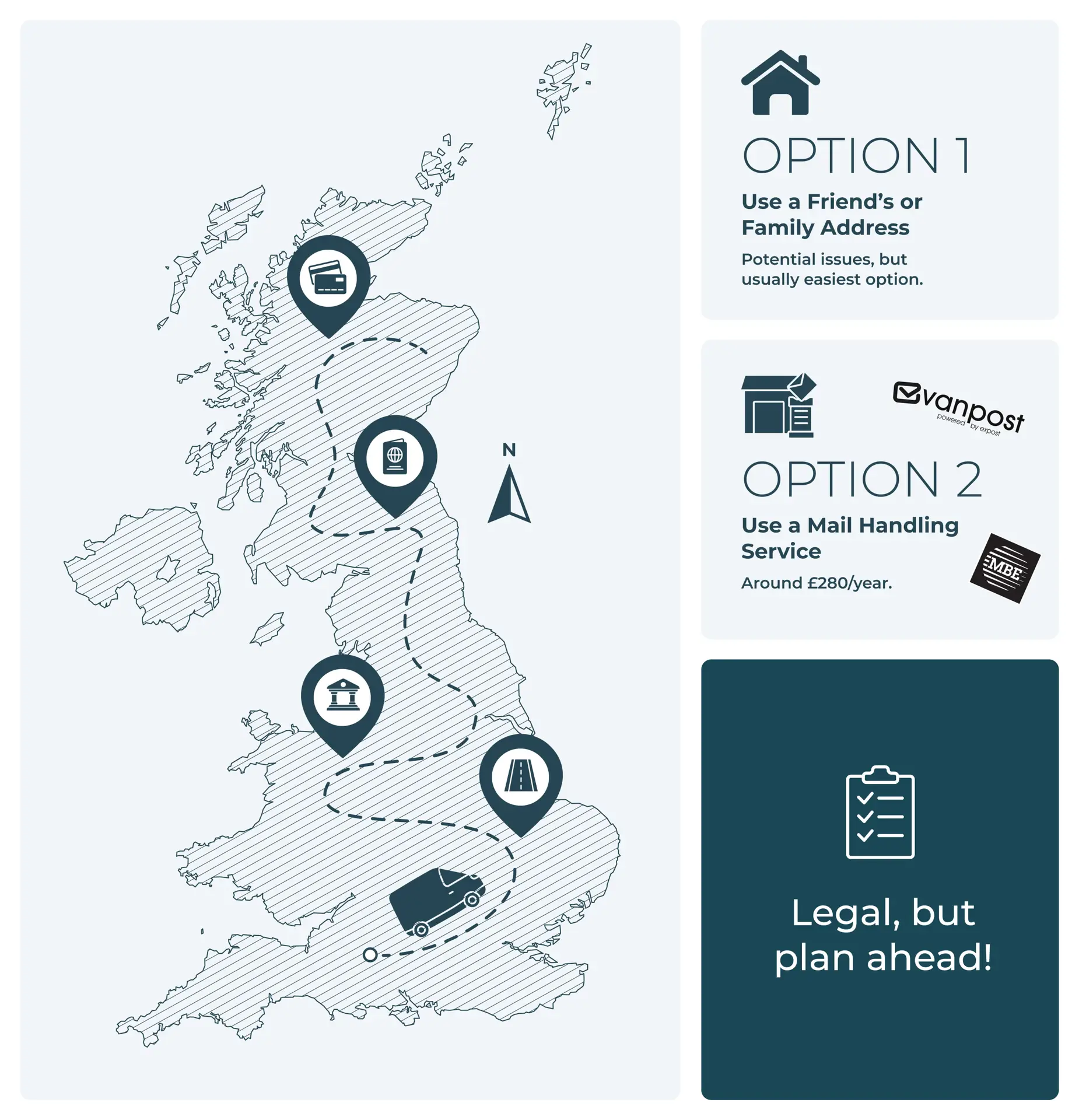
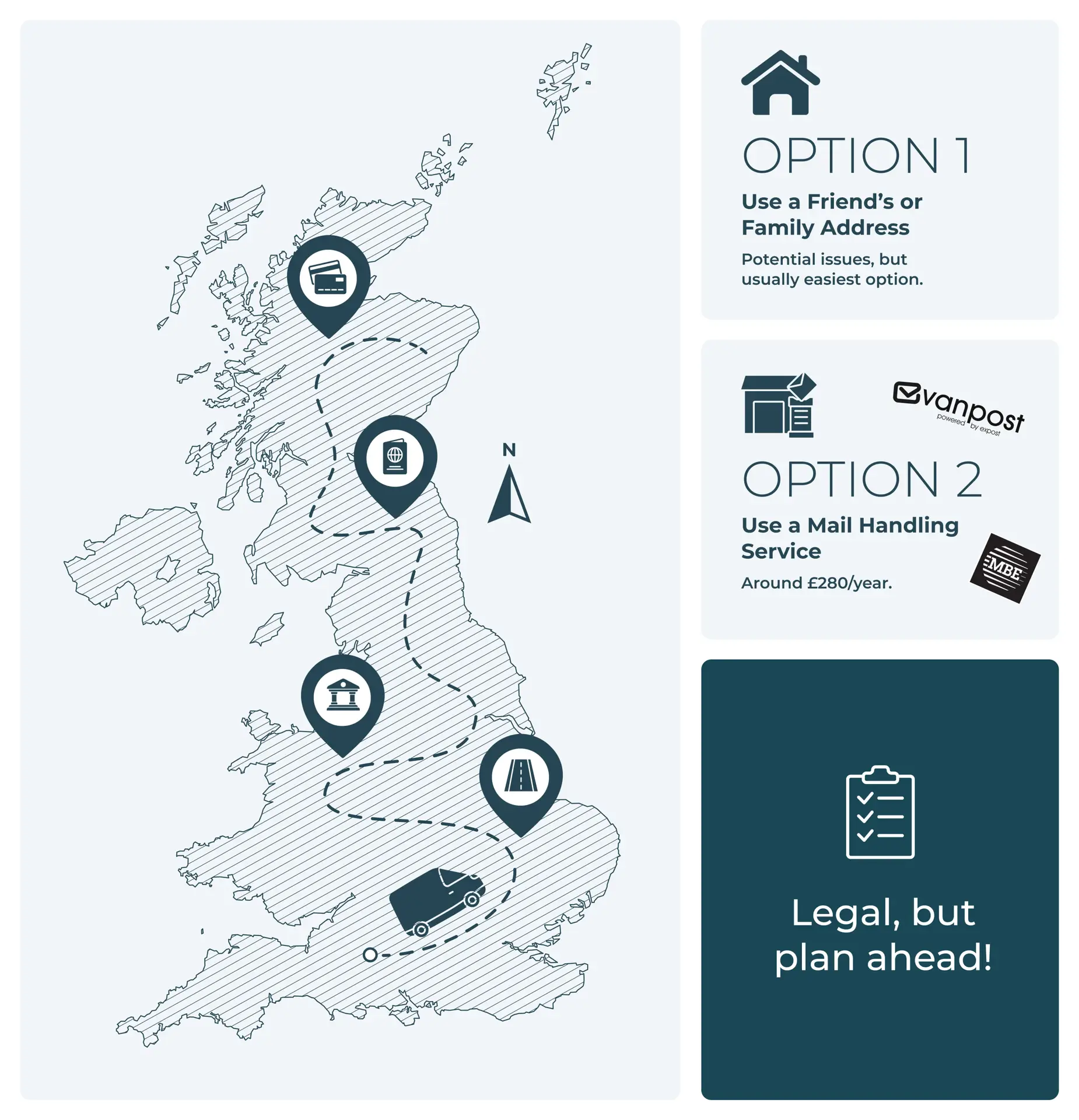
In short, yes, living in a van full-time is legal in the UK. However, this isn't without some important caveats. The first is your address. In the UK, you need a mailing address for things like banks, insurance, credit cards, passports, the DVLA, and, of course, mail, so having a fixed address can still be important even if you have no fixed abode.
There are a couple of options to get around this. It's common to use a family or friend's address for mail as your permanent address. This is normally pretty straightforward, though it's worth mentioning that the number of people living at an address (even on paper) can affect things like tax credits, benefits, and other allowances.
If this might be the case with your family or friends, the other option is to use a dedicated service specifically designed for solving the issue of mailing addresses for full-time vanlifers.
Services like Vanpost, a virtual mailbox service for vanlifers, allow you to set up a remote site which serves as your mailing address, with the service then accepting, storing, and forwarding your mail and parcels when needed. These services typically come in at around £280 per year.
You'll also need to consider the laws around where you park up and sleep.
Laws
There's nothing to stop you parking a campervan anywhere a registered, road legal vehicle can park, provided it is taxed, insured, and has a valid MOT; however, sleeping in the vehicle then enters something of a grey area.
Technically, there's no specific UK law that prohibits you from sleeping in a parked vehicle if it's parked properly. However, local regulations, signage, and landowner permissions may come into play depending on where you are. You cannot simply park and sleep anywhere without permission, and overnight parking regulations can involve different rules from one UK local council to another.
Councils and police also have the authority to ask you to move on if your presence is considered an obstruction, trespass, or breach of local by-laws. However, if you aren't overtly causing trouble, the chances of getting into actual legal trouble are relatively slim.
This is why stealth builds are popular, with many vanlifers specifically setting up their campervan in a way which makes it look like a regular van from the outside to avoid any hassle.
Let's cover the main terms you need to know when navigating the UK's legal landscape in regards to vanlife.
Tresspass
Trespass in England and Wales is generally a civil matter, so parking on private land without the landowner's permission is trespassing and remains a civil matter. That means if you park on private land without permission and are lacking the landowner's permission, the landowner has the right to ask you to leave. However, despite what an angry farmer might say, that means it's usually an issue between you and them instead of something the police would automatically get involved in.
If you refuse to move, they can escalate the matter through a civil court, but even then, it's rarely treated as a criminal offence unless other factors like criminal damage are involved. Frankly, if it's got to that point, something has gone seriously wrong with your summer holiday!
Obstruction
Obstruction, on the other hand, is usually more serious. If your van is clearly blocking a public highway, pavement, access road, or emergency route, then the police can order you to move immediately under the Highways Act 1980. Failure to comply can result in fines or your vehicle being forcibly removed and towed away.
Loitering
Loitering is another term worth understanding, particularly if you plan to stay in urban areas. While there's no law against simply existing in a parked vehicle, loitering rules can be leveraged by the police if you're deemed to be acting suspiciously in a residential or commercial area by the locals, especially if they formally complain.
Signage
It's also worth noting that while individuals may erect “No overnight parking” signs in their local area or popular tourist spots, these aren't always legally enforceable unless they're backed by an official bylaw. Without the accompanying order or regulation cited, they're advisory, not compulsory.
The Vunked bottom line: Sleeping in your van is, fortunately, a grey area and generally ok. Park legally, use your common sense, and try not to bother the locals. Follow these guidelines, and you shouldn't have an issue with parking up and sleeping in your van. If you plan to frequently park in urban areas, maybe look at a stealth build, and if you do run into trouble, simply move on without hassle. If worst comes to worst, you're unlikely to get into serious trouble.
Police powers and public space protection orders (PSPOs)
While UK vanlife isn't fraught with serious legal implications, the police aren't completely powerless, and you still need to be careful where you park up.
The most common tool in use by local councils and police to regulate camper van parking is the Public Space Protection Order (PSPO). Introduced in 2014 under the Anti-social Behaviour, Crime and Policing Act, PSPOs let councils ban specific activities, such as overnight vehicle dwelling in designated areas, and local authorities can enforce them.
If this is the case in a given area, there will usually be clear signs to let you know that sleeping overnight in a vehicle is prohibited. Failure to comply can lead to a fixed penalty notice of £100 or more.
With the explosion of UK vanlife in recent years since the pandemic, PSPOs are becoming increasingly common in tourist hotspots to prevent areas of beauty from being affected by too many vans parked up. Common areas you'll see them include:
- Coastal areas of Cornwall and Devon
- The Lake District
- Brighton and other southern coastal towns
- Parts of Wales, especially Pembrokeshire and Snowdonia
There's also the Criminal Justice and Public Order Act of 1994. This gives police the authority to remove a vehicle from private land without the landowner's consent if they think criminal trespass has occurred. In practice, this is rarely invoked unless a group of vehicles is involved, and it's generally nothing to worry about as an individual campervan user.
Where can you stay overnight?
So, vanlife is legal, but where should you be staying? Finding comfortable and hassle-free overnight stops is a skill every UK vanlifer needs to master. Unlike some parts of Europe, the UK doesn't have a network of free motorhome Aires. That means you'll be predominantly staying in three kinds of places…
Wild camping and park-ups
In campervan terms, ‘wild camping' means staying overnight outside of a designated campsite. Think everything from lay-bys, quiet car parks, beaches, forest tracks, and the odd council car park. While tolerated and often not illegal, be aware that these kinds of spots aren't a guaranteed right, and you do not have a legal right to stay overnight on most land without permission.
However, for full-time vanlifers, these kinds of stays will invariably become a staple part of your adventures. Many van lifers also recommend mixing in designated sites for at least some overnight stays to reduce hassle and stay compliant. To help with this, there's a wide selection of amazing community-driven apps like Park4Night and Searchforsites to find suitable park-ups. One of the big appeals is waking up in different locations day to day. You can also pick up useful local advice in facebook groups. It's worth noting that National Parks often have strict rules against overnight parking. Many local councils have introduced restrictions in popular tourist areas.
Our advice is to arrive late, leave early, keep a low profile, and leave no trace when enjoying these kinds of spots.
Industrial estates and quiet streets
In urban areas, industrial estates and residential streets might be the only options available. These areas are generally fine to park up and sleep, just be aware that prolonged multi-night stays may draw attention, and that different councils have different rules for overnight parking on quiet streets and in industrial areas.
If it's a weekend, industrial estates in particular can be a great option as many businesses will often be closed. They're also usually quiet, just make sure you aren't parked on private property without permission.
Though the noise can be an issue on busier roads, quieter residential streets can also work if you blend in and avoid blocking driveways or alleys. Just be sure not to linger too long, as residents may not appreciate their usual spaces being taken up.
Official campervan stopovers and campsites
While the beauty of the previous two options is that they're 100% free of charge, you're probably going to want to stay at a campsite at some point, not least because campsites often provide easier access to electricity and water through mains hook-up and on-site facilities, and a self-contained van can also help in places with tighter overnight parking rules.
Campsites also take the stress out of finding a space or the hassle of dealing with locals, offering a safe, legal place to rest and recharge. Popular options include:
- Brit Stops. A membership scheme with access to hundreds of free stopovers at businesses like pubs and farms around the UK, with the expectation to buy a meal or drink.
- Caravan and Motorhome Club Certificated Locations (CLs). These small, 5-van sites on private land offer cheap stays and basic amenities (sometimes electric hook-up and fresh water!).
- Authorised wild camping spots. Booking platforms like ‘Wild With Consent' connect UK vanlifers to private landowners who offer legal wild camping spots for a small fee.
How often you leverage these kinds of stopovers will depend on your budget, but they're ideal for occasional “reset” days between long stretches of off-grid camping. The mental energy saved on worrying about where to park is also a genuine, tangible benefit, especially when you're living in a van full time.
Scotland vs. England/Wales/Northern Ireland
Rightly or wrongly, Scotland has long been seen as the holy grail of UK vanlife, as under the Land Reform (Scotland) Act 2003, most unenclosed land can be used for recreation, including wild camping. However, Scotland's wild camping rights do not cover vehicles, and Scotland's wild camping rights do not cover motor vehicles, so while sleeping in a van can still be perfectly legal in the right place, you can't just drive onto private land without permission.
In practice, that means the rules differ little from the rest of the UK. However, attitudes mean Scotland is generally more tolerant of wild camping with a campervan, and many rural communities welcome responsible vanlifers.
However, the popularity of places like the Isle of Skye and parts of the Highlands has led to increased restrictions, such as seasonal camping management zones and motorhome bans in some car parks.
In contrast, there are no wild camping rights whatsoever in England, Wales, and Northern Ireland. That doesn't mean it can't be done if you're willing to bend the rules, but you'll be solely relying on discretion, official campsites, and a leave no trace attitude.
How to live comfortably on the road
Whether it's full-time or part-time, UK vanlife offers incredible freedom compared to residing solely in a brick-and-mortar domicile, and you’ll find plenty of inspiration and practical advice in our wider UK vanlife blog guides. However, there's a fair degree of organisation, preparation, and set-up requirements to truly enjoy life off the beaten path in comfort and convenience.
These include the ability to power modern appliances like laptops and chargers, internet connectivity, and even more basic needs such as life support systems and insulation. Since we're the experts on electrical systems, let's start with power!
Power and connectivity
Accessing, managing, and generating electrical power is a critical aspect of van life to keep day-to-day systems like lighting, refrigeration, and plug sockets powered up.
Modern campervans have (or should have) electrical systems which allow for this, letting you live comfortably both at campsites and when wild camping or parking up off-grid.
We'll try to keep this as simple as possible. Essentially, your van has two or more batteries, one to start the engine, and a leisure battery or batteries which power everything else.
When you do things like charging a laptop or running a fridge, these leisure batteries are drained. To live in a van full time, they need to be recharged frequently.
There are generally three ways to do that:
- DC-DC chargers. Also known as battery-to-battery or B2B chargers, these replenish your leisure batteries while driving, converting alternator output into a safe charging voltage.
- Solar panels. These provide clean, renewable energy when stationary, which is great when you're parked up without access to mains electricity.
- Mains hookup. Often called ‘shore power', mains hookup uses the mains electricity at campsites or your house to recharge leisure batteries via an integrated battery charger.
For both full-time vanlife and semi-frequent use, you will likely need a combination of all three of these methods to ensure you have reliable energy in all conditions.
There are also other vital components, such as inverters, which allow you to run 230V mains appliances (like laptop chargers or hair dryers) from the 12V leisure battery, and choosing between different campervan electrical system setups depends heavily on how you plan to use your van.
In terms of what a full electrical setup consists of, we'll use one of our mid-range prebuilt electrical system kits as an example, similar to our range of campervan electrical conversion systems.
The Adventure Seeker kit is designed to comfortably run a fridge, lights, chargers, and occasional AC appliances for a good portion of time away from shore power.
In the kit, you would find:
- 2 x 185W Victron Solar Panels (total 370W)
- Victron MPPT 100/20 Smart Charge Controller with Bluetooth
- 30A Victron Isolated Battery-to-Battery (DC-DC) Charger
- 1200W Victron Multiplus Inverter Charger
- 12V Fuse Board for distributing loads
- Optional Leisure Battery (recommended for off-grid living)
- Lynx Distributor for tidy, safe cable connections
- All required cables, fuses, lugs, and heatshrink
- Detailed installation guide, wiring diagrams, and dedicated technical support
For an idea on price, this kit comes in at around £1800 and is about the minimum you would need to comfortably enjoy extended trips without going overboard and spending money on oversized components you don't need; if you’re starting from scratch, an introduction to campervan electrics will also help you plan the right size system.
Connectivity
With remote work being increasingly possible and the digital nomad lifestyle catching on more and more, you might also need internet connectivity in your van.
With modern technology, this is much easier than it used to be, and you have multiple options available. Common solutions include:
- Mobile Wi-Fi routers fitted with 4G/5G SIM cards
- Smartphones with hotspot functionality and 4G/5G
- Modern technology like Starlink, which offers super-fast internet
Many vanlifers also fit external antennas to improve signal reception in remote areas.
Water, waste, and hygiene
You'll also need to consider water management when on the road, and waste disposal is one of the trickier parts of living off-grid in a van. It's easy to take water for granted with modern mains water supplied, but in a van, it's an area that requires constant attention.
Modern van setups normally involve a freshwater tank (typically 10L to 100L) combined with a 12V pump that's powered by your leisure batteries to provide pressure to sinks and showers, all of which need to be factored into your campervan 12V wiring layout.
In terms of refilling your primary water tank, common UK sources of freshwater for vanlifers include:
- Dedicated service points at campsites
- Public drinking water taps at cemeteries
- Petrol stations (with permission)
- Wild camping-friendly hosts (some allow paid refills)
Some vans also have a dedicated tank to collect wastewater (called grey water), while others use simple portable containers that can be emptied manually. In a van, limited space makes tidy storage important, and limited access to proper waste disposal points can dictate where you stop next.
For minimal hassle, many van lifers also opt to use composting toilets to reduce the frequency of removing and managing toilet waste (or ‘black water'), when compared with a traditional toilet and waste tank.
You'll also need to consider hot water. We have a full guide on water heaters, but essentially, there are a few core options to choose from. These include electric heaters, which are only suitable for campsites, and diesel or propane water heaters, which can be used off-grid. There are also combination units that can heat up both water and the interior of your van.
If a full water system is out of your budget or you're not looking to live in your van full-time, it's worth noting that many UK vanlife enthusiasts are perfectly fine with relying on gym memberships, leisure centres, and even truck stops to stay clean. You can also source items like wet wipes, dry shampoo, and compact washbasins for on-the-road hygiene in a pinch.
Food and cooking
Cooking in your van is a necessity if you plan on spending a good amount of time in it without spending a fortune eating out. How you set up your kitchen will depend entirely on your internal layout, but a key decision to make is electric vs gas.
We've got a whole article on induction hobs vs gas, but the gist is that the right choice for you will depend entirely on where you plan to stay.
An electric induction hob uses a lot of electricity. If you're going to be exclusively staying at campsites with access to shore power, this isn't a big deal. But, for those looking to enjoy venturing off-grid, the power draw is extremely high.
It's not completely unfeasible, and a powerful electrical setup like our premium Overland Explorer kit with a 3000W inverter/charger and 370W of solar will run them with a large lithium battery bank, but power management quickly becomes a concern.
Gas (LPG, aka propane), on the other hand, is ideal if you plan to be doing significant cooking without access to mains electricity. You can also use propane to fuel your hot water or space heater as well, so a tank of it can easily become a tri-use fuel.
You'll also need to think about keeping your food fresh while on the road. 12V fridges like those from Dometic are the gold standard for most vanlifers, and they pull minimal amps compared to thermoelectric coolers.
It's also a good idea to keep a stash of long-life foods like pasta, canned goods, nuts, and energy bars for off-grid days where fresh food shopping isn't an option.
Staying warm (and cool)
You'll also need to consider temperature management more closely than in a regular home. The UK is notorious for its wet and cold winters, but summer can still be extremely hot, and all of this quickly becomes an issue when there's little more than metal panelling between your bed and the outdoor climate in a small space.
Managing temperature starts with insulation. In the UK, insulation is crucial for comfort during cold winters, not just for staying warm but for limiting heat transfer between two different areas. This is important in both winter and summer, especially if you're in the van year round.
We've created a complete guide to campervan insulation, but the short and long is that you'll need adequate protection for full-time UK vanlife. DIY insulation is definitely feasible, with materials ranging from sheep's wool to expanded foam, and costs coming in anywhere between a few hundred quid to £1000+, depending on material choice.
In the colder months, you'll also need interior campervan heating. Popular solutions include diesel heaters from the likes of Webasto and Eberspächer, which can run directly from the fuel tank of your van, heating your interior and expelling combustion gases outside the vehicle through an exhaust port. There are also LPG options as well as combination space and water heaters with either fuel from industry leaders like Truma.
Summer brings its own set of challenges, and a metal van can quickly turn into an oven without adequate ventilation. Roof-mounted vents like the MaxxAir Fan system or Fiamma Turbo vents are excellent, but for the very hottest days or travel to warmer climates than the UK, you'll want to invest in a 12V air conditioning system.
Short-term and cheaper solutions include items like reflective window covers, shade awnings, and strategically parking in natural shade when it's a hot day.
Hidden costs and other realities of van life
With spiralling costs of living and rent increasing year-on-year, UK vanlife is often portrayed as the hassle-free path to freedom and simplicity. While partially true, the reality is that there are ongoing expenses and practical challenges that require careful planning to navigate.
In addition to campsite costs and initial vehicle purchase, fuel is a massive recurring expense that can be difficult to factor into financial planning. UK fuel prices are notoriously high, and a full kitted-out campervan will generally return lower fuel mileage than what's advertised due to weight.
You'll also need specialist campervan insurance, which can cost anywhere between £400 and £1000 annually, as well as regular outlays such as mobile data plans, breakdown cover, ferries, and toll-road fees.
If you're doing lots of miles per year, then wear and tear on the van itself also racks up, with full-time living accelerating mechanical stress on wear items such as suspension bushings, brake pads, clutches, and tyres.
Constant exposure to damp UK weather is also a factor, and combined with coastal air and rough terrain, rust can quickly become an issue. Regularly inspect the underside of the vehicle and factor in preventive maintenance like undersealing into your budget.
Hidden costs and other realities of van life
With spiralling costs of living and rent increasing year-on-year, UK vanlife is often portrayed as the hassle-free path to freedom and simplicity. While partially true, the reality is that there are ongoing expenses and practical challenges that require careful planning to navigate.
In addition to campsite costs and initial vehicle purchase, fuel is a massive recurring expense that can be difficult to factor into financial planning. UK fuel prices are notoriously high, and a full kitted-out campervan will generally return lower fuel mileage than what's advertised due to weight.
You'll also need specialist campervan insurance, which can cost anywhere between £400 and £1000 annually, as well as regular outlays such as mobile data plans, breakdown cover, ferries, and toll-road fees.
If you're doing lots of miles per year, then wear and tear on the van itself also racks up, with full-time living accelerating mechanical stress on wear items such as suspension bushings, brake pads, clutches, and tyres.
Constant exposure to damp UK weather is also a factor, and combined with coastal air and rough terrain, rust can quickly become an issue. Regularly inspect the underside of the vehicle and factor in preventive maintenance like undersealing into your budget.
Planning your UK vanlife travels
A massive advantage of UK vanlife is the sheer diversity of amazing places and landscapes almost anybody can reach within a couple of hours of driving. However, while spontaneity is great, you'll probably want to plan your travels when living in a camper for significant periods of time.
The best UK campervan destinations
While compact, the UK contains a treasure trove of natural wonders, historic cities, and bustling campervan hotspots. Our top recommendations include:
- Cornwall. For its endless beaches, rugged cliffs, and iconic surf towns like Newquay and St Ives. Expect crowds and fierce competition for parking in high summer.
- Northumberland. For big sandy beaches, medieval castles, and one of the darkest night skies in the country. Overnight parking is also easy along the remote coastline.
- Wales. For breathtaking mountainous views in areas like Snowdonia and the stunning surf-friendly coastlines of Pembrokeshire. You'll also find plenty of wild camping opportunities and a more relaxed attitude toward vanlife than in some parts of England.
- The Lake District. For hikes, climbs, and stunning natural landscapes. Be aware that parking regulations are strict the summer months can be absolutely rammed in popular hotspots like Windemere.
Remember that exploration doesn't need to be limited to rural areas, and urban spots like Bristol have a booming and vibrant culture, especially for UK vanlife aficionados. Edinburgh is also great, voted the best city in Europe multiple times due to its friendly atmosphere and unrivalled historic allure —just be aware that parking comes at a premium.
You'll also want to factor in the season when travelling. Summer often sees tourist areas gridlocked and campsites packed, while legitimate ‘No overnight parking' rules may be enforced in natural beauty spots. Research where you plan to go and book campsite stays well in advance to avoid disappointment.
Winter can be quieter, with empty carparks, peaceful trails, and plenty of solitude. Just be sure your van is up to the task with decent insulation and a heater that's powerful enough to evenly warm your whole van.
Icy roads and muddy trails can also limit where you can park, so look at winter or off-road tyres if your trip will take you off the beaten path.
In general, spring and autumn are some of the best times to travel, offering the benefit of quieter locations without the chilly limitations of colder months.
Border crossings
While UK vanlife is a booming trend, there's no need to limit your travels to mainland Britain. While post-Brexit trips to Europe aren't as easy as they used to be, it's still very easy to travel with your campervan to countries within the continent.
The main things to be aware of are Schengen and insurance. UK citizens travelling to Europe can only stay for 90 days in any 180-day period. This doesn't reset when you leave, so if you travelled in France and Spain for 90 days, you would need to be out of the EU for another 90 days before returning.
Insurance-wise, many UK insurers now issue a Green Card automatically, which gives you third-party coverage and legally allows you to drive in the EU and elsewhere. However, not all do, so it's worth double-checking.
Popular European destinations include:
- Ireland. Via ferry from Holyhead or Fishguard.
- France. With fast crossings from Dover to Calais or Newhaven to Dieppe.
- Spain. Via longer ferries to Santander or Bilbao for those chasing winter sun.
You'll also need to place a ‘UK' sticker on your vehicle (not the old-school ‘GB' sticker), though these can be bought on almost all ferries out of the UK.
Embrace UK vanlife with a camper that's just like home
We hope you've found this guide useful and now have a solid foundational understanding of living in a van in the UK. It's a massive step, and you'll learn lots on your journey from house-dweller to vanlifer, especially around vehicles.
One of the most challenging learning curves will be around building your van. Sure, you can buy one pre-built outright, but for many, the extremely high cost will be a serious barrier to entry.
That's why building your own campervan is so popular, and why thousands of people without backgrounds in engineering or mechanics have built their own DIY dream home on four wheels.
However, one of the toughest areas to get right, even for the competent DIY-er, is the electrical system. Endless trawling on forums for components, wiring diagrams, and vague instructions gets old fast. That's why we set up Vunked.
We supply ready-made complete electrical systems to cater for every budget and use case, designed in the UK using industry-leading premium components, and our DIY campervan electrics checklist walks you through everything to consider before you start buying parts.
You'll find everything from punchy set-ups with compact solar panels designed for weekend getaways like the Nomad Basecamp, to full-blown off-grid powerhouses like the Overland Explorer, which let you park up in the middle of nowhere and enjoy the comforts of home.
Plus, if you can't find a pre-built kit that suits your exact needs, you can use our online electrical system builder to configure a custom kit based on the appliances you want to run or even book a free campervan electrics consultation for tailored advice.
Whether you go custom or prebuilt, we'll send you every component, wire, connector, bit, bob, and diagram you need for a clean self-install, including options for expanding into a campervan solar panel kit if you want to stay off-grid longer. We'll also send you full and detailed fitting instructions, and you can always contact our campervan electrics team if you need extra help!
Yes, you can legally live in a van in the UK. However, you'll need to park legally, respect private property, and comply with local regulations like PSPOs.
Is UK vanlife worth it?
For many people, yes. While the UK weather can be challenging and parking isn't always easy, the ability to travel freely and live cheaply thanks in part to lower overheads is a big draw, though the trade-off is limited space and life in a small space year round. These helpful tips matter because the freedom and access to nature still need to be balanced with day-to-day practicality in a way traditional housing doesn't.
Yes, sleeping in a van is legal, as long as you're parked somewhere legally and not obstructing things like footpaths or driveways. Just be sure to check local bylaws or parking restrictions, and move on without a fuss if you do get asked to leave.
Can I buy land and live in a van in the UK?
In theory, yes. However, buying land does not automatically give you the legal right to live in a vehicle there full-time, and planning permission may still restrict permanent use even if you own the site; if the land is not solely yours or has other rights attached, you may also need the landowner's permission. Obtain special permissions legally to avoid hassle.