
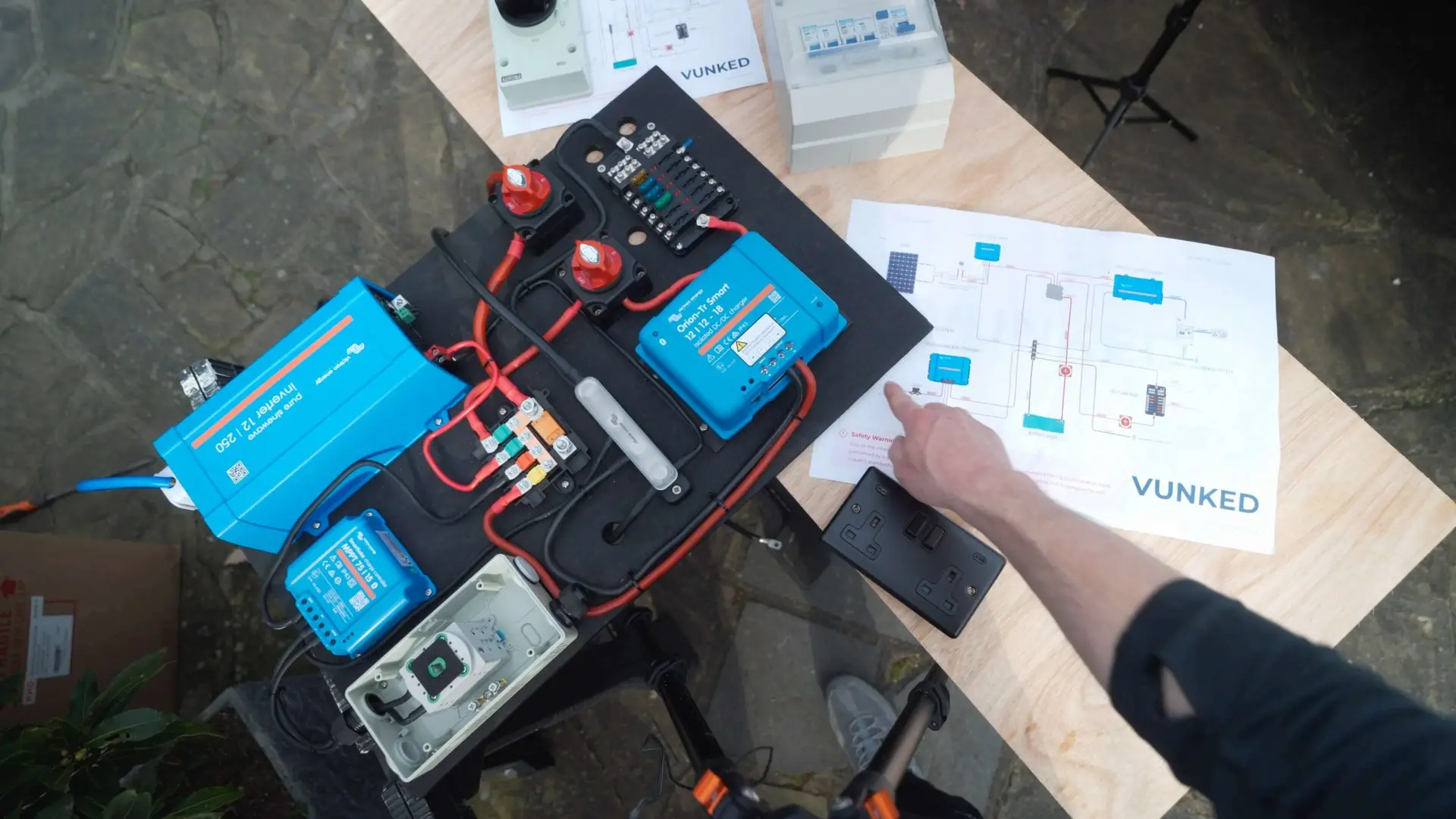
Campervan electrical costs range from £400 to over £4,000, depending on your lifestyle and usage. Planning to work remotely? You'll need more solar panels, larger batteries, and a powerful inverter. Just after lights and a phone charge? A simple 12V with DC-DC charger setup might do.
In this guide, we break down real costs, smart trade-offs, and the components that matter most. First, here's why so many vanlifers underestimate their electrics.
GET AN INSTANT ESTIMATE ON YOUR CUSTOM CAMPERVAN ELECTRICAL SYSTEM
Why Campervan Electrical System Costs Can Be Shocking
Campervan electrics often deliver the biggest shock; not in voltage, but in cost. For many first-timers, it's the part of the project where reality falls short of expectations.
Electrics don't look expensive at first glance, but batteries, solar panels, charge controllers, fuses, wiring, and inverters quickly add up. Even modest systems push past £1,000. Full-time, off-grid-ready setups? Think £2,000 to £4,000+.
"And another issue we found was just the cost. Like everything was so damn expensive. We were just blown away with, like, wow, this is way more expensive than I was expecting." — Steve Yalo (full-time vanlifer living in a skoolie)
It's money well spent if you need the power, but it's not always clear how much you'll need; or what you're paying for.
The problem with all-in-one electrical quotes
Many van-build companies offer vague, all-in pricing. A complete electrical setup might be quoted at "£3,000" with no breakdown. That hides crucial details. Are you getting lithium or AGM batteries? An MPPT or a PWM controller? Can the inverter handle your appliances?
Vunked co-founder Ross Deacon points out: "Some companies simply quote a lump sum… we provide an itemised breakdown of each part so you know exactly where your money is going."
Without that breakdown, you risk overpaying for underperforming gear.
Hidden electrical expenses most vanlifers forget
It's easy to focus on the "big" parts: batteries and panels. But the small stuff adds up. Fast.
Overlooked items that cost real money:
- Quality wiring and terminals
- Fuse boxes and circuit breakers
- Battery monitoring systems
- Mounting brackets and cable glands
- Tools for crimping and testing
Many vanlifers spend hundreds on wiring, fuses, and connectors, costs that are rarely factored into initial estimates. And mistakes here are dangerous. Undersized cable can overheat. Poor connections can lead to fires.
Battery monitors are also often skipped early on, but they are vital for tracking power use and protecting your investment. Skip them, and you risk damaging expensive lithium batteries.
Electrics catch people off guard because they hide their cost, complexity, and risk. They look simple. They're not. Budget realistically. Whether you plan to install the electrics yourself or get a professional, ask for the details so you know what you're building and paying for.
The cost of campervan electrical system can be easier to manage when using a pre-configured kit that includes all essential components.
The Essentials: Core Electrical Components Explained
A campervan's electrical system is only as strong as its weakest component. Each part has a job working together to power everything from your lights to your laptop.
We'll break it down clearly, starting with the heart of the system: the battery bank.
Leisure battery costs
Leisure batteries store energy for use when the engine is off, powering your fridge, lights, fans, sockets, and other appliances. Unlike your van's starter battery, they're built to be discharged and recharged repeatedly.
Batteries are where most of your electrical budget goes—and where mistakes can become expensive quickly.
AGM vs Lithium: what's the difference and what should you choose?

There are two main types: AGM and lithium (specifically LiFePO₄). Each has pros and cons depending on your needs and budget.
AGM (Absorbent Glass Mat):
- Lower upfront cost
- Heavier and larger for the same capacity
- Shorter lifespan (usually 3–5 years)
- Less usable capacity per amp-hour (50–60%)
Lithium (LiFePO₄):
- Much lighter and smaller
- 80–90% usable capacity
- Long lifespan (8–15 years)
- Higher initial cost, better long-term value
How much do campervan leisure batteries cost in the UK?
| Type | Budget | Mid-Range | High-End |
| AGM | £100–£200 | £250–£400 | £400+ (multiple units) |
| Lithium | £400–£800 | £800–£1,200 | £1,500+ (300Ah+, smart features) |
A single 100Ah AGM battery may be enough to get you through a weekend. However, for a full-time or off-grid life, most vanlifers require 200Ah or more. Lithium becomes more cost-effective the longer and harder you use your system.
Anna and Alex built their system on a strict budget. They settled on 200Ah of AGM batteries—enough for lights, devices, and light off-grid use. However, they are aware that their system has its limitations.
"Our electrical system was confined to the budget… those can get pretty pricey." — Anna (full-time vanlifer and musician)
Lauren and Louis, on the other hand, invested in a 230Ah lithium battery. They lived off-grid in Scotland for three weeks without ever plugging in.
"It was a big upfront cost, but it meant we had total freedom." — Lauren & Louis (full-time vanlifer couple travelling across Europe)
With lithium prices having dropped substantially over the past few years, it has become the obvious choice. While still more expensive than AGM batteries, the added cost is well worth it. Lithium stores 20–40% more power, charges 3–4 times faster, and lasts 4–6 times longer.
Solar panel costs
Solar panels convert sunlight into electricity. That energy goes into your leisure batteries, keeping everything running (lights, fridge, fan, laptop, etc.) without relying on campsites or engine charging.
Solar is the backbone of off-grid vanlife. And once fitted, they generate endless free energy ,as long as you have sunshine and effective power management.
What types of solar panels work best for campervans?

There are two main choices: rigid or flexible solar panels. Both serve the same purpose, but their materials and mounting methods differ.
Rigid panels:
- Mounted on roof racks or brackets
- Durable and cost-effective
- Better cooling and efficiency
Flexible panels:
- Thin, lightweight, and curve-friendly
- Ideal for stealth builds, curved roofs or pop tops
- More expensive per watt, less efficient over time
For most UK vans, rigid panels offer better value and longer life. They're also easier to replace or upgrade if damaged.
How much do solar panels for campervans cost in the UK?
| System Size | Typical Wattage | Estimated Cost |
| Budget Kit | 100–150W | £100–£300 |
| Mid-Range Setup | 300–400W | £400–£700 |
| High-End System | 600W+ | £800–£1,000+ |
A single 100W panel might charge your phone and lights. However, serious off-grid use—such as cooking, working, or charging lots of devices—requires at least 300–400W. Bigger systems offer more flexibility and fewer power worries in cloudy UK weather.
"I've got 750W of solar mounted on Z brackets… I needed reliable power for work, including Starlink, and a 240V inverter to support a full-time remote setup." — Lucinda Norris (full-time vanlifer and remote worker)
Solar isn't one-size-fits-all. It's about matching your power needs with your roof space and budget. Next, we explain how to recharge your batteries while driving and why split-charge relays and DC-to-DC chargers are essential in the UK.
Charge Controller Costs
A charge controller manages the flow of electricity from your solar panels to your batteries. Without one, your panels would overcharge the batteries, damaging them over time. It's a small box that plays a significant role in system efficiency and battery health.
There are two types: PWM and MPPT.

What's the Difference Between PWM and MPPT Charge Controllers?
PWM (Pulse Width Modulation):
- Basic and inexpensive
- Works best with low-power panels and matched battery voltages
- Limited efficiency in poor weather
- Typical cost: £30–£50
MPPT (Maximum Power Point Tracking):
- Smarter, more efficient
- Extracts more energy from the same panels
- Performs better in low light and with higher-voltage arrays
- Ideal for UK conditions with inconsistent sun
- Typical cost: £100–£300
PWM is sufficient for a basic campervan electric setup. MPPT is better suited for mid-range or off-grid applications, especially in the UK's cloudy climate. If you're installing more than 150W of solar, consider a top-of-the-range MPPT charge controller.
DC-to-DC charger (alternator charger) costs
Driving charges your batteries, but only if your system's wired for it. Alternator charging provides a backup when the sun disappears, which is particularly important in winter or during heavy use.
There are two primary methods: split-charge relays and DC-to-DC chargers.
What's the best way to charge campervan batteries while driving?

Split-Charge Relay (VSR):
- Connects your van's starter and leisure batteries while the engine runs
- Cheap and simple
- Doesn't work well smart alternators
- Not suitable for lithium batteries
- Typical cost: £50–£100
DC-to-DC Charger
- Designed for smart alternators and lithium compatibility
- Provides a stable, multi-stage charge
- Charges batteries faster and more efficiently
- Supports proper voltage regulation and battery health
- Typical cost: £150–£250
- High-end units (50A+): £300+
"I have a split charge system, which means that when the engine is running, it will then recharge my leisure batteries… I went for gel batteries because I went over budget and couldn't afford lithium." — Lucinda Norris (full-time vanlifer and remote worker)
If your van is newer (post-2015) or you use lithium batteries, a DC-to-DC charger is essential. It ensures your alternator charges your batteries safely and reliably without damaging or undercharging them.
Campervan inverter costs
An inverter converts 12V DC power from your batteries into 230V AC power. If you want to use anything that plugs into a standard wall outlet (such as a laptop, blender, or induction hob), you'll need an inverter.
There are two types, and the difference matters.
What's the difference between modified and pure sine wave inverters?

Modified Sine Wave (MSW):
- Cheap and basic
- Works for simple devices (lights, some chargers)
- Can damage sensitive electronics
- Often noisy and inefficient
Pure Sine Wave (PSW):
- Clean, consistent power
- Essential for laptops, induction hobs, fridges, medical gear
- More expensive but far more reliable
How much do campervan inverters cost in the UK?
| Inverter Type | Typical Use | Estimated Cost |
| Basic MSW | Lights, phone chargers (low draw only) | £100 |
| Mid-Range PSW (1000–1500W) | Laptops, tools, kitchen appliances | £250–£500 |
| High-End PSW (2000–3000W) | Kettles, hobs, full off-grid setups | £600–£1,200 |
The more wattage you need, the more you can expect to pay. Always size your inverter for your peak load, and ensure your wiring and battery bank can support it.
Real-world lesson: why cheap inverters fail
Professional campervan converters Brown Bird & Co. started their vanlife with an £80 inverter. It didn't last.
"Word of warning; we initially installed a cheap inverter (cost approx £80), but it blew up and could have potentially caused a fire in the van. Luckily, we got our money back, but a lesson learned: cheap is not always good! We then upgraded to a remote-controlled wireless pure sine wave inverter, and it works brilliantly. It's installed next to the leisure batteries and is simply turned on or off with the remote control. Don't ever leave an inverter on or in sleep mode, as it will still drain your batteries!" - Brown Bird & Co.
The lesson? Don't cut corners on inverters (or any electrics). If you plan to work remotely or cook using electricity, invest in a quality pure sine wave inverter from the start.
Monitoring systems and safety feature costs
Every wire, fuse, and switch in your van has a job: protect your gear and prevent fire. Skip a safety step, and you risk frying your system—or worse, burning down your home on wheels.
This is where safety gear and monitoring tools come in. They protect your components and provide a live picture of how your system is performing.
What safety features should every campervan electrical system have?
Let's start with the non-negotiables. Your campervan electric system must incorporate these parts.
Fuses and Circuit Breakers:
- Protect your wiring and gear from overloads
- Each circuit must be fused correctly
- One of the most overlooked (but essential) costs
Battery Isolators
- Safely disconnect sections of your system for maintenance
- Prevent power drains or short circuits during faults
Correct Cable Sizing
- Undersized cables can overheat and melt
- You'll need different gauges for different loads
How do campervan battery monitors work?
Battery monitors track your system in real-time. The good ones don't just show voltage—they display how much power you're using, what's going in, what's coming out, and your remaining battery capacity.
Shunt-based systems are the gold standard. They give accurate, reliable data.
What do monitoring and safety components cost in the UK?
| Component | Estimated Cost |
| Basic voltmeter | £20–£50 |
| Shunt-based battery monitor (e.g. Victron BMV or SmartShunt) | £100–£150 |
| Bluetooth-enabled monitor with app support | £150–£300+ |
| Full wiring, fuses, isolators and safety hardware | £100–£300 (varies by system size) |
Monitoring becomes even more valuable with lithium batteries. These don't show signs of failing until they die completely—a good monitor can catch issues before they turn into breakdowns.
Full Campervan Electrical System Cost Scenarios
Campervan electrical systems range from bare-bones to fully off-grid. Your budget determines what you can run, how long you can stay off-grid, and the level of comfort or convenience you can expect.
Below are three realistic setups (budget, mid-range, and high-end) with suggestions on where to allocate your budget and where to make savings.
| Component | Budget Build | Mid-Range Build | High-End Build |
| Battery | Used AGM | 150–200Ah AGM/LiFePO₄ | 200Ah+ Lithium |
| Solar Panels | 100–150W | 200–300W | 400–800W+ |
| Charge Controller | PWM | MPPT | MPPT (premium) |
| Inverter | 300–500W MSW | 1000–1500W PSW | 2000W+ PSW |
| Alternator Charging | Basic Relay | DC-to-DC (20–30A) | DC-to-DC (30–50A+) |
| Battery Monitor | Voltmeter only | Basic shunt | Smart shunt (Bluetooth) |
| Wiring, Fuses, Safety | Essential | Essential | Essential |
Budget build (£600 - £1000): best for weekend use or minimal draw
A basic system using second-hand or entry-level parts. Good for lights, phone charging, and a small fridge or fan. You'll need to keep power use low and stay in the sun.
Priorities:
- 100Ah Lithium battery
- Split-charge relay or campsite hook-up with battery charger
- Fuses and wiring (don't skimp on safety)
Where to spend:
- Wiring, fuses, and isolators. Even on a budget, safety must be a priority.
USE OUR ELECTRICAL BUILDER TO VIEW AND EDIT THIS BUDGET SYSTEM
Mid-range build (£1000–£2000): Balanced setup for creative work or part-time travel
Enough power for working remotely, running a fridge, and short periods off-grid. Components are a mix of new and second-hand but balanced for reliability.
Priorities:
- 100–200Ah lithium battery
- 200–300W of solar with an MPPT controller
- 500W pure sine wave inverter
- DC-to-DC charger or upgraded relay
- Basic battery monitor
Where to spend:
- Inverter and charge controller—better components prevent system failures
- MPPT gives better returns, especially in cloudy UK conditions
USE OUR ELECTRICAL BUILDER TO VIEW AND EDIT THIS MID-RANGE SYSTEM
High-end build (£2,000–£4,000+): Full-time, off-grid, gas-free living
A system designed for digital nomads, content creators, or anyone wanting long-term, off-grid flexibility and freedom. Fully electric cooking, heating, and working.
Priorities:
- 200Ah+ lithium battery
- 400–800W+ solar
- MPPT controller
- 2000W+ pure sine wave inverter
- High-capacity DC-to-DC charger
- Shunt-based smart monitor
- Proper isolation, fusing, and wiring
Where to spend:
- Battery bank, inverter, and solar
- Monitoring—avoids damage to expensive lithium gear
USE OUR ELECTRICAL BUILDER TO VIEW AND EDIT THIS HIGH-END SYSTEM
Spend based on how you plan to live. Even a budget system needs proper safety gear. But if you're working remotely, travelling full-time, or cooking on electricity, invest where it matters most.
Estimated UK Costs for Individual Campervan Electrical Components
Here's a summary table for estimated individual component costs and what you can expect to pay:
| Component | Low Budget (£) | Medium Budget (£) | High Budget (£) | Key Considerations/Notes |
| Leisure Battery (AGM, 100-120Ah) | 70 - 120 | 120 - 180 | 180 - 250+ | Shorter lifespan vs Lithium, heavier, good for budget/light use. |
| Leisure Battery (LiFePO4, 100Ah) | 170 - 250 | 250 - 400 | 400 - 700+ | Long lifespan, lightweight, high usable capacity, higher initial cost but better long-term value. |
| Solar Panel (price per 100W, rigid) | 60 - 90 | 90 - 120 | 120 - 150+ | Efficiency varies; consider roof space and typical sunlight. |
| Solar Charge Controller (PWM) | 7 - 20 | 20 - 35 | N/A | Basic, dont recommend unless on an extreme budget |
| Solar Charge Controller (MPPT) | 40 - 80 | 80 - 150 | 150 - 250+ | More efficient, essential for maximising yield in UK, handles wider panel voltage range. |
| Power Inverter (MSW - Modified Sine Wave, 500W-1000W) | 30 - 60 | 60 - 100 | N/A | Only for non-sensitive appliances; risk of damage/malfunction to others. |
| Power Inverter (PSW - Pure Sine Wave, 500W-1000W) | 50 - 100 | 100 - 200 | 200 - 350+ | Essential for sensitive electronics, laptops, motors; clean power. |
| DC-DC Charger (18-30A) | 100 - 180 | 180 - 250 | 250 - 400+ | Crucial for modern smart alternators and optimal leisure battery charging while driving. |
| Mains Battery Charger (10-20A) | 50 - 100 | 100 - 150 | 150 - 250+ | For charging from shore power; often integrated into higher-end inverter/chargers. |
| Wiring, Fuses, Basic Ancillaries (kit) | 100 - 200 | 200 - 350 | 350 - 500+ | Non-negotiable for safety; cost often underestimated. Includes cables, fuses, basic switches, lugs. |
| Consumer Unit (for 230V AC hookup) | 30 - 60 | 60 - 100 | 100 - 150+ | Essential safety device for mains hookup, includes RCD/MCBs. |
| Battery Monitor (Shunt-based) | 40 - 80 | 80 - 150 | 150 - 250+ | Provides accurate state of charge and power usage; vital for battery health. |
| Overall Ancillaries (switches, isolators, bus bars, terminals, heat shrink etc. - bundled estimate for a full system) | 150 - 300 | 300 - 500 | 500 - 800+ | The total of many small but essential parts adds up significantly. |
Campervan Electrical Setups by Lifestyle: What to Prioritise and What to Spend
These are generalised setups based on common vanlife lifestyles. For the most accurate results, we recommend using our builder tool to design a custom system tailored to your power needs.
Remote Worker Electrical Setup Priorities
| Component | Priority | Recommended Spend |
| Leisure Battery (200Ah Lithium) | Essential | High |
| Solar Panels (400W) | Essential | High |
| Charge Controller (MPPT) | High | High |
| Inverter (2000W Pure Sine Wave) | High | High |
| Battery Monitor (Smart/Shunt-Based) | Medium | Low |
| DC-DC Charger (20A) | Medium | Medium |
| Wiring, Fuses, Mounts | Essential | High |
Content Creator Electrical Setup Priorities
| Component | Priority | Recommended Spend |
| Leisure Battery (200Ah Lithium) | Essential | High |
| Inverter (2000W Pure Sine Wave) | Essential | High |
| Solar Panels (400W) | High | High |
| Charge Controller (MPPT) | High | Medium |
| DC-DC Charger (20A) | Medium | Medium |
| Battery Monitor (Smart/Shunt-Based) | Medium | |
| Wiring, Fuses, Mounts | Essential | High |
Seasonal Worker Electrical Setup Priorities
| Component | Priority | Recommended Spend |
| Wiring, Fuses, Mounts | Essential | Medium |
| Leisure Battery (100Ah AGM) | High | Medium |
| Solar Panels (200W) | High | Medium |
| Inverter (500W) | Medium | Low |
| Charge Controller (PWM) | Medium | Low |
| Split-Charge Relay | Medium | Low |
| Battery Monitor (Basic Voltmeter) | Low | Low |
Retiree Electrical Setup Priorities
| Component | Priority | Recommended Spend |
| Wiring, Fuses, Mounts | Essential | Medium |
| Leisure Battery (200Ah Lithium) | High | High |
| Charge Controller (MPPT) | High | Medium |
| Solar Panels (200W) | Medium | Medium |
| Inverter (1000W Pure Sine Wave) | Medium | Medium |
| Battery Monitor (Smart/Shunt-Based) | Medium | Medium |
| DC-DC Charger (20A) | Medium | Medium |
Part Timer Electrical Setup Priorities
| Component | Priority | Recommended Spend |
| Wiring, Fuses, Mounts | Essential | Low |
| Leisure Battery (100Ah AGM) | Medium | Low |
| Solar Panels (200W) | Medium | Low |
| Split-Charge Relay | Medium | Low |
| Inverter (500W) | Low | Low |
| Charge Controller (PWM) | Low | Low |
| Battery Monitor (Basic Voltmeter) | Low | Low |
Campervan electrical system costs in the UK range from a few hundred to several thousand pounds. There is no one-size-fits-all. The "right setup" depends on how often you travel, what you power, and how long you stay off-grid.
Still unsure where to start? Use this guide along with our builder tool to design your ultimate campervan electrical system. You can experiment with various components and configurations to create a system that suits your needs and budget.