

AGM vs Lithium vs Lead Acid Battery Lifetimes
Quick answer:
- AGM battery: typically 3-8 years
- Lithium battery: typically 7-35 years
Big range, right? That's because it all comes down to one thing: how hard you use your battery day to day (more on that below).
So why does this actually matter for your van build? A few reasons:
- Lithium batteries cost 2-3x more upfront than AGM
- But they can last 5x longer in some cases
- Choose the wrong one for your usage, and you could end up replacing batteries way sooner than you needed to (expensive and annoying!)
The good news is, working out which is right for you isn't guesswork. In this guide, we'll walk you through:
- How battery lifetime is actually calculated
- A side-by-side of AGM, lithium and lead acid, using three real campervan owners as examples
- How to figure out which battery makes sense for your kind of adventures
Let's get into it. This blog is for anyone looking to install a leisure battery in their campervan, boat, or any other small space.
Campervan Leisure Battery Terminology
We'll break down a battery lifetime assessment and show what it could mean for you and your van conversion. But before we do, here is a quick explainer for those new to battery terminology. If you're already a battery wiz, skip ahead to our assessment.
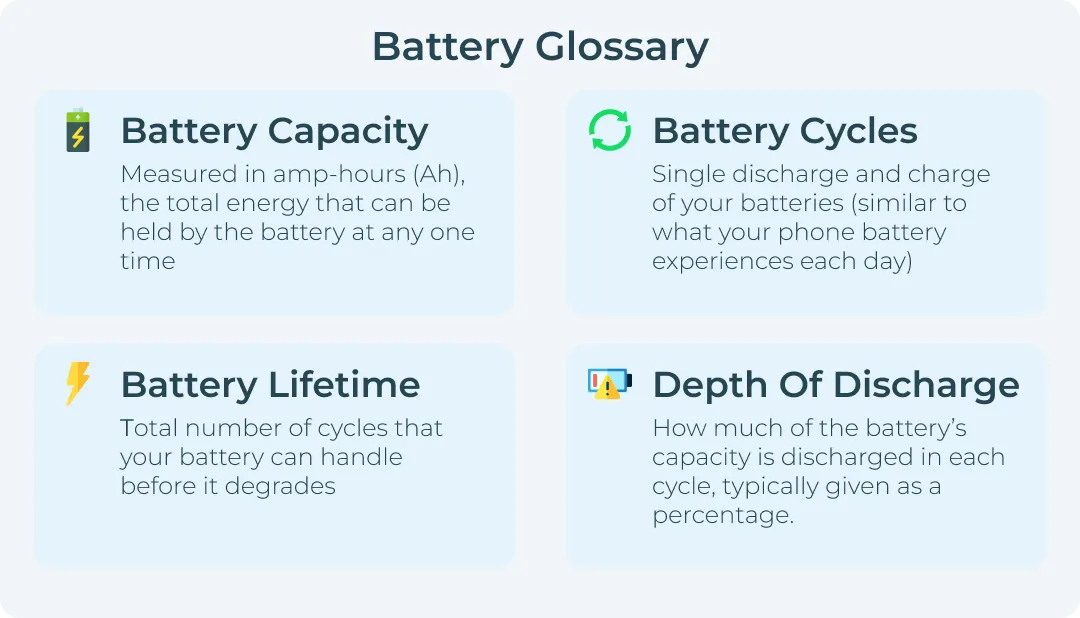
- Capacity - measured in amp-hours (Ah), the total energy the leisure battery can hold at any one time
- Cycles - a single discharge and charge of your batteries (similar to what your phone battery experiences each day)
- Lifetime - the total number of cycles that your battery can handle before it degrades
- Depth of Discharge (DoD) - A percentage figure describing the amount of energy drained from your leisure battery (Ah) during each cycle. The DoD is relative to the battery's capacity. (50% DoD for a 100Ah battery is a 50Ah discharge)
Which Campervan Leisure Batteries Have We Used?
For our assessment, we've used batteries we have experience with and verified their quality. Our AGM example is the 100Ah TN Power Deep Cycle AGM, an absorbent glass mat model, and our lithium example is the Victron Energy LiFePO4 100Ah offering. We've used the manufacturers' information on how long these batteries are expected to last, with battery type being a key variable in the comparison.
Battery Lifetime Case Study
For our battery lifetime assessment, the results depend on several factors, but we have created three profiles for people that have campervans. Each has a different use for their campervan and, as such, has different campervan electrical systems, showing how these factors influence the lifespan of a leisure battery in real-world use, much like broader guides to the best campervan electrical systems for different users. To make the comparison easy, all our van users will have a 100Ah campervan leisure battery.
Three Example Campervan Users:-
Monica - Small Usage
- How does Monica User Her Campervan? - Monica uses her van for day trips and the occasional overnight trip and only needs a few 12V appliances.
- What electrical system has Monica got? - Monica has a small electrical system in her campervan. She has a 140W solar panel, a 12V fuse box and one 100Ah leisure battery. On her travels, she uses lights, a fridge and 12V USB chargers with a daily consumption of 30Ah. The equivalent of a 30% DoD for a 100Ah battery.
Joey - Medium Usage
- How does Joey use his campervan? - Joey uses his vans to go on weekend trips around the UK. He particularly enjoys exploring the north of Scotland as he is away for weekends and needs a way to heat his van and charge his laptop.
- What electrical system has Joey got? - Joey has a medium-sized electrical system in his campervan. Joey has a 215W solar panel, an 18A DC-DC charger, a 100Ah leisure battery, a 375W inverter and a 12V fuse box. Joey needs a bit of juice to power his lights, USB sockets, roof fan, gas heater, laptop and projector. His daily consumption is 50Ah, with his 100Ah battery - equivalent to 50%DoD.
Graeme - Large Usage
- How does Graeme use his campervan? - Graeme is what we call a full-time van-lifer. He lives in his van all year round and thus needs a lot of energy to power all his appliances, particularly his larger appliances like his microwave and blender, making his setup suitable for off grid living.
- What electrical system has Graeme got? - Graeme has a large campervan electrical system built for high daily demand and longer off grid adventures. It contains a total of 450W of solar, a 30A DC-DC charger, a 100Ah leisure battery, a 12ooVA Multiplus and a 12V fuse box. He needs to make sure he can power his van daily, as he has a daily consumption of 80Ah - equivalent to 80% DoD for a 100Ah battery, and high-draw appliance use should be kept to a minimum when he is not on mains hook-up.
We have done our best to represent some standard scenarios but everyone's campervan electrical system is different, and if you’re starting from scratch it’s worth understanding how to choose a battery and solar panel kit that matches your usage. Lets have a look at how each persons batteries will do over time...
Depth of Discharge
One crucial fact to remember is that the maximum number of cycles your batteries will handle before degrading depends on the depth of discharge, which can significantly impact battery performance and a leisure battery's lifespan. Battery manufacturers agree that deeper cycling will wear out the batteries in fewer cycles, and frequent deep discharges or repeated deep discharges can drastically reduce the battery's lifespan.
Your batteries will perform more cycles at 30% DoD than 80%, so it is usually best to avoid deep discharges where possible. The typical lifetimes of AGM and lithium batteries are shown below.
Using the three van user examples, we can see how many discharges each person will get from their campervan leisure battery.
Monica will get 600 cycles from a Deep Cycle AGM battery and 5000 cycles from a Lithium battery.
Joey will get 500 cycles from a Deep Cycle AGM battery and 3500 cycles from a Lithium battery.
Graeme will get 400 cycles from a Deep Cycle AGM battery and 2500 cycles from a Lithium battery.
Great, but how does the number of cycles relate to how long does a leisure battery last in practical use? Using Monica, Joey, and Graeme, let's look at this.
Battery Lifetime
Our battery lifetime assessment is shown below as an average lifespan estimate for each usage pattern. We have compared how long we expect batteries to last, in years, based on how many days they are used per year, though battery life will vary with use patterns rather than following these figures exactly. At the lower end, 48 days use a year works out to four days a month or two weekends. At the higher end, 365 days corresponds to full-time van life. This should show how long a 100Ah battery could last in your van based on how you intend to use it.
Battery Lifetime - AGM vs Lithium
By comparing the AGM and Lithium graphs above we can make a few observations:
- Lithium batteries have a longer lifespan than Deep Cycle AGM batteries, lasting significantly longer by between 2 and 3 years depending on your usage
- Deep Cycle AGM batteries have a shorter lifespan under heavy cycle use and degrade a lot quicker than lithium batteries
We have not discussed this here, but Lithium batteries are usually 2-3 times more expensive than deep-cycle AGM batteries. So the better performance that comes with lithium batteries does come at a cost, although fewer replacements over time can make them more cost effective, especially when you factor them into the overall campervan electrical system budget!
How Long Will Batteries Last For our Three Campevan Users?
Monica - Small Usage
We estimate from our plots above that Monica's 100Ah AGM battery could last around 7-8 years. This is pretty good going. However, if she chooses a Lithium battery, it would last her 35 years. Monika realises she does not need her battery to last 35 years, so the added cost of lithium batteries means the Deep Cycle AGM battery is best for Monica.
Joey - Medium Usage
We reckon Joey's 100Ah AGM battery will last 3.3 years. Not bad, but if he intends to keep his van for the foreseeable future, it may be worth investing in lithium, which we think could last 23.3 years.
Graeme - Large Usage
We estimate Graeme's lithium batteries will last around seven years, and a well maintained leisure battery can still deliver reliable service for years even under heavy use, whereas an equivalent AGM will last around a single year. It's, therefore, a no-brainer to invest in a superior lithium battery, especially as lithium can provide more power for demanding appliances in this kind of setup.
How Much Will a Campervan Leisure Battery Cost?
Now for the juicy part - how does this affect your wallet? For our 3 van-owning friends above, we've looked at what they could expect to spend on batteries if they owned their vans for 5, 10 or 15 years, and how investing in a complete campervan leisure battery kit might change those long-term costs.
When assessing the cost, it is essential to look at the cost of batteries across the whole life of your campervan, because battery type can significantly impact long-term spend. Based on our research, we have assumed, on average that AGM batteries last 7 years, whereas lithium batteries last 15 years, and traditional lead acid batteries and lead acid batteries often need more replacements over the same ownership period.
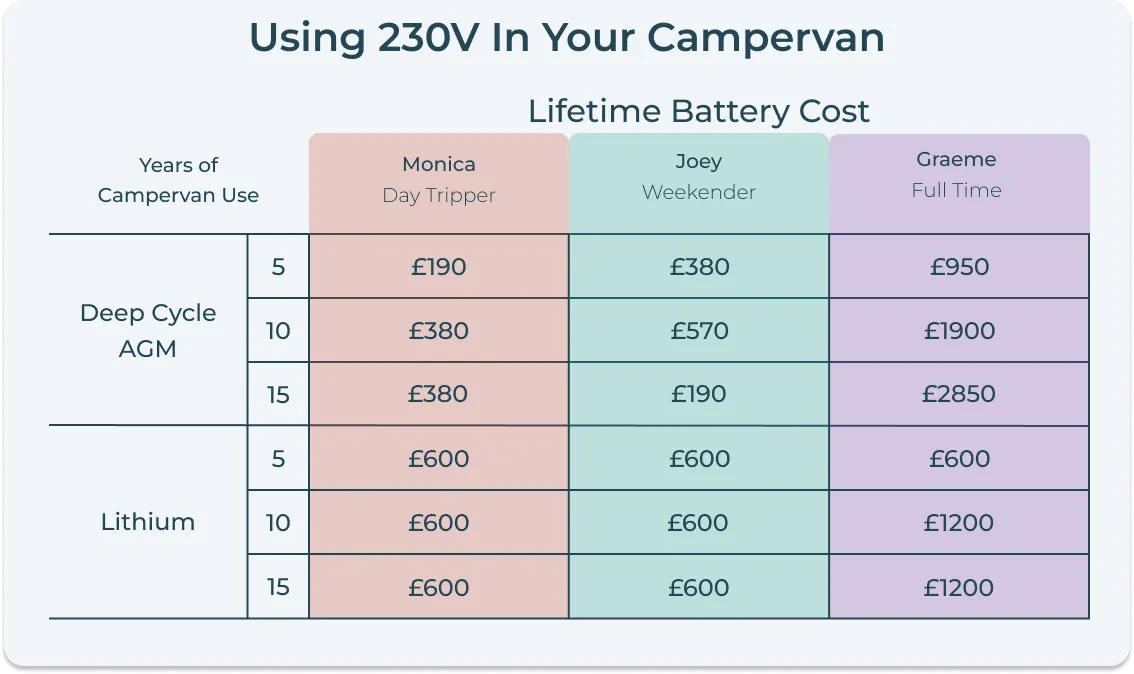
As you can see from the table, how often and for how long you intend on using your van changes whether AGM or Lithium leisure batteries are the best investment for your campervan adventures.
If you are a day tripper like Monica, AGM will be the cheapest option across the van's lifetime.
If you think you are similar to Joey and will head out for most weekends, deciding whether Lithium or AGM is best can be trickier. We suggest considering how long you think you will keep your camper.
Finally, lithium leisure batteries are the clear winner if you are a full-time van lifer. Your high usage and hence the high number of cycles means you will need a lithium battery to keep up with the pace of your exploring, and its longer service life can make it a more cost-effective new leisure battery choice over time.
What Else To Consider, Including Solar Panels, When Choosing a Campervan Leisure Battery?
Our battery assessment is reasonably simple and excludes a few leisure battery matters that can affect a leisure battery's life. We'll discuss each of these, and how they also affect proper care and long-term battery life, and what we've assumed below, but if you’re still choosing a setup it’s worth reading a full guide on how to choose a campervan leisure battery.
Larger Leisure Batteries
We've only modelled 100Ah batteries above to make the maths easier. If a larger 200Ah battery is used compared to 100Ah, then your DoD for each daily cycle will decrease. An 80Ah consumption from a full-time van lifer is 80% for a 100Ah battery, whereas it is 40% for a 200Ah battery. In effect, larger batteries will last longer as they will have a lower depth of discharge for the same daily power consumption.
Weather
Lithium batteries are known to have issues in extreme temperatures. They can't be charged if the temperature drops below zero, and some batteries won't begin charging again until it reaches five °C to protect the batteries, which can leave them in a discharged state for longer if charging is restricted. Keeping storage and operating conditions stable helps keep the battery healthy and can also help prevent overheating in some systems.
Maximum Depth of Discharge
Historically, lead-acid AGM batteries have been limited to as low as 50% depth of discharge, while lithium is generally considered more tolerant of deeper use. However, current manufacturers claim deep cycle AGM batteries can be discharged 100% without causing significant degradation. Others claim 80%, and the same variation exists in lithium battery suppliers. Batteries that are regularly fully discharged also tend to age faster. Lithium is believed to be the safer option for deep discharging, but it depends on who you ask, and proper charging matters even more if you regularly use most of the battery's capacity.
High Discharge Currents
High discharge currents can also cause quickened degradation of batteries. This applies mainly to large inverter systems with significant power draws, so the charging process and high current draw should be managed carefully to protect battery health. If you intend to use an inverter 2000W or larger, we recommend lithium batteries to help protect you, and ensure you follow best practice when you install a leisure battery in your campervan.
How long Will My Campervan Leisure Battery Last Summary
Lithium batteries can cost significantly more than AGM batteries, and we've discussed the pros and cons briefly in a previous blog. However, we take from this assessment that lithium batteries are well worth the added expense if you expect your van and electrical system to see heavy use or value longevity, as they can be more cost effective over time because they last significantly longer and need less maintenance than traditional lead acid options, particularly when used in well-designed LiFePO4 campervan battery kits.
Lithium batteries typically cost three times that of AGM but can handle at least five times as many cycles, even under worst-case conditions. AGM will likely offer you the optimum solution if your van is intended for weekends only. Whatever type you choose, avoid leaving it discharged for long periods or using it heavily for extended periods, and use a trickle charger during storage if needed.
It's worth bearing in mind that estimating how long a battery will last you in the real world is very difficult, and proper charging plus regular maintenance have a significant impact on the lifespan of a leisure battery. All batteries will degrade after Around ten years, regardless of how much use they have seen. For upkeep, focus on cleaning terminals, checking electrolyte levels on lead acid batteries, topping up with distilled water where required, and apply petroleum jelly to battery terminals to help prevent corrosion; visible corrosion or swelling on the battery suggests a fault and should not be ignored. A strong rotten egg smell is a sign of overheating and needs immediate attention. Charging from solar panels using solar power through a charge controller can help, and an electrical hook up is useful when available, especially in a combined campsite hook up campervan electrical system. A battery monitor also makes it easier to keep an eye on the battery's state. Lithium batteries are far superior to AGM but carry a heavier price tag, and any replacement should fit the battery box securely because car batteries are not designed for this kind of deep-cycle use.