
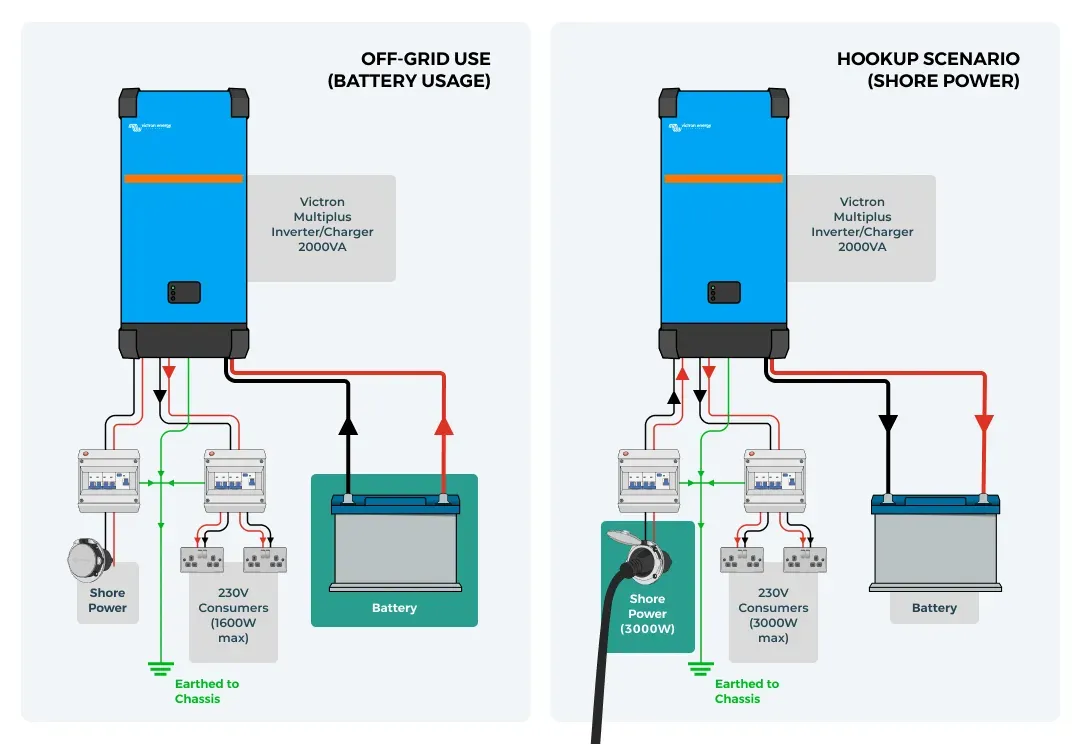
The Victron Multiplus offers seamless power management in a compact, efficient design. Whether you plan to stay off-grid for weeks or rely on campsite hookups, the Multiplus is an essential kit for powering your home on wheels.
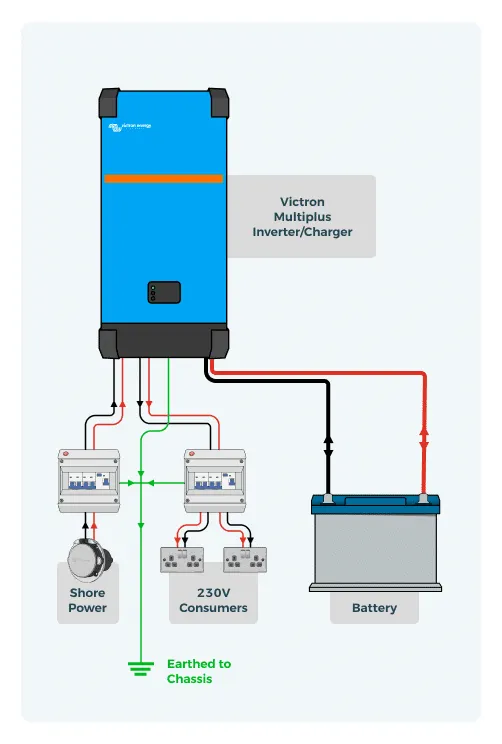
Your van's electrical system is the foundation of your vanlife experience. It determines your appliances and how long you can live off-grid. Building the perfect van power setup can feel overwhelming, especially when choosing the right equipment—like the Victron Multiplus with its many variations and kits.
You can simplify this by choosing a complete victron campervan kit designed to include everything you need in one compatible system.
This guide breaks down everything you need to know about the Victron Multiplus, its installation, and the right model for your vanlife adventures, and sits alongside our broader introduction to campervan electrics and our service for designing complete campervan electrical systems for planning your whole system.
What is a Victron Energy Multiplus Inverter/Charger?
The Victron Multiplus combines a true sine wave inverter charger in one compact, efficient unit, making it a favourite among vanlifers who value reliability and simplicity. If you’re new to inverters, our guide on how campervan inverters work explains the basics in more detail. This powerhouse ensures seamless power management—whether connected to shore (hookup) power or off-grid.
At its core, the Multiplus converts DC power from your batteries into AC power for your 230V appliances. When connected to your mains, it uses a sophisticated battery charger with adaptive charging for efficient battery management while powering your van simultaneously.
The Multiplus has a built-in transfer switch with a UPS function and AC power UPS function, with high speed AC transfer automatically activated during grid failure so sensitive connected equipment continues running, including electronic equipment and other electronic equipment, in less than 20 milliseconds. This versatility makes it perfect for everything from running your kettle in the morning to keeping you powered during an important Zoom meeting in the middle of nowhere.
The Multiplus provides us vanlifers with three key benefits: compactness, efficiency, and adaptability. Its small footprint saves valuable space, while its high efficiency means more power for longer—and, most importantly, more time on off-grid adventures.
Get the right Victron Multiplus for your needs
BUILD YOUR CUSTOM CAMPERVAN ELECTRICAL SYSTEM IN MINUTES
Understanding VA vs. Watts: What Do They Mean?
Now, let's get into the details because while the Victron Multiplus packs efficiency into every watt, there's a twist—it's VA-rated power, not watts.
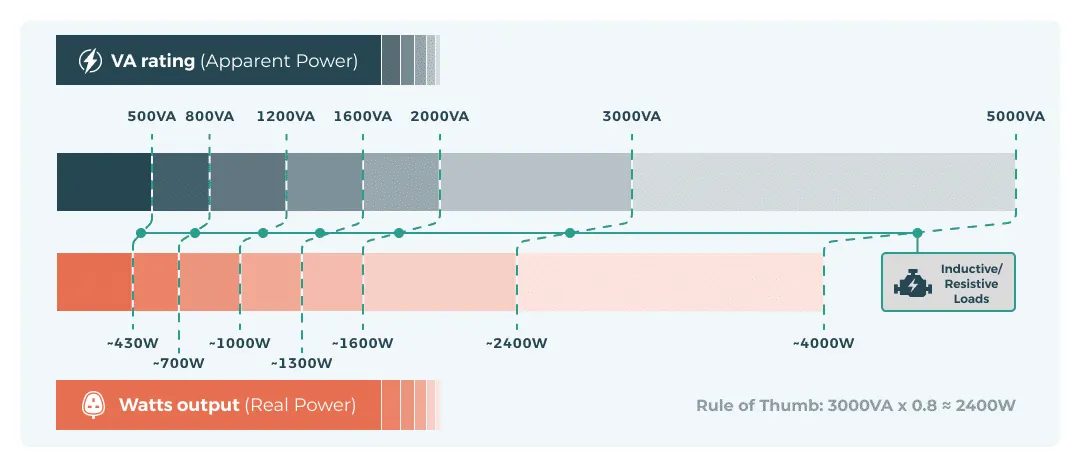
This distinction matters, especially when planning your van's electrical setup and choosing the right campervan inverter size. Let's break it down.
What is VA?
VA stands for "volt-amperes" and represents apparent power. It's the total power an inverter can supply under perfect conditions. In contrast, watts measure real power (or true power), the actual amount delivered to your devices. Due to inefficiencies and the nature of electrical loads, VA ratings are always higher than actual wattage.
For example, a 3000VA inverter might only provide 2400 watts of usable power. This gap arises because some energy is lost when voltage and current fall out of sync. That sync—or lack of it—leads to phase shift.
How temperature affects wattage
As the temperature rises, the wattage it can deliver decreases, significantly impacting your Multiplus's performance. This drop becomes noticeable in extreme conditions, such as temperatures around 60°C (140°F), where the usable wattage can fall to 50-60% of the VA rating.
For example:
- At 25°C (77°F), a 500VA unit delivers 430W.
- At 40°C (104°F), it drops to 400W.
- At 65°C (149°F), it plummets to 300W.
This decline is due to heat affecting the inverter's efficiency. To mitigate this, ensure proper ventilation for your Multiplus, especially in confined van spaces. Placing the unit away from direct sunlight or other heat sources can prevent performance dips.
Practical tip: Consider oversizing your inverter for hotter climates to account for potential wattage loss. This provides a buffer during peak temperatures, ensuring your system remains reliable.
While temperature influences long-term wattage, some appliances demand sudden bursts of power—introducing the concept of surge current.
Understanding surge current and uninterrupted AC power
Surge current is the brief current spike when you power on certain devices. Motors, compressors, or any equipment with a spinning component typically cause surges, which can be 2-3 times higher than the device's rated current.
The good news is the Victron Multiplus handles surge currents effortlessly. Its design allows it to manage peak currents for a few seconds without requiring you to oversize your inverter. For example:
- A 500VA unit can handle surges up to 900W.
- A 3000VA model supports peaks up to 6000W.
So, you don't need to size your inverter for these brief surges, like starting your fridge or running a blender, because the Multiplus can handle the extra sudden load.
Takeaway: When selecting an inverter, focus on your appliances' continuous power needs; tools like a campervan inverter size calculator can help you match real-world usage. Trust the Multiplus to manage surge currents for seamless power without over-engineering your system.
In addition to handling surge currents, the type of device you're powering can affect how efficiently your inverter performs, as seen with phase shifts.
The impact of phase shift
Not all devices draw power the same way. Resistive loads, like a toaster, use energy predictably, with voltage and current aligned. But inductive loads—think motors or compressors—create a phase shift. This mismatch reduces real power output.
Here's how this impacts van setups:
- Due to phase shift losses, a 1000VA inverter might only run a 750W motor.
- The solution? Oversize your inverter. Choosing a Multiplus** with extra VA ensures your system handles demanding appliances without overload**.
Practical tip: If your van features high-wattage devices like an induction hob, consider the VA and watt requirements when sizing your Multiplus
Should you worry about VA?
For most vanlifers, understanding VA helps with one thing: picking the right inverter. The takeaway is simple. Always size your Multiplus with a buffer between the VA rating and your devices' combined wattage. This ensures your setup handles real-world conditions without a hitch.
The VA-watt difference is negligible if your setup leans toward essential appliances like LED lights and a laptop. But for high-demand setups, knowing this difference can save you from system overloads and frustration on the road.
A quick (rough) rule of thumb to get the Wattage - multiply the VA by 0.8. For example, 3000VA * 0.8 = 2400W.
Off-Grid Power vs Hookup Power: How Multiplus Adapts
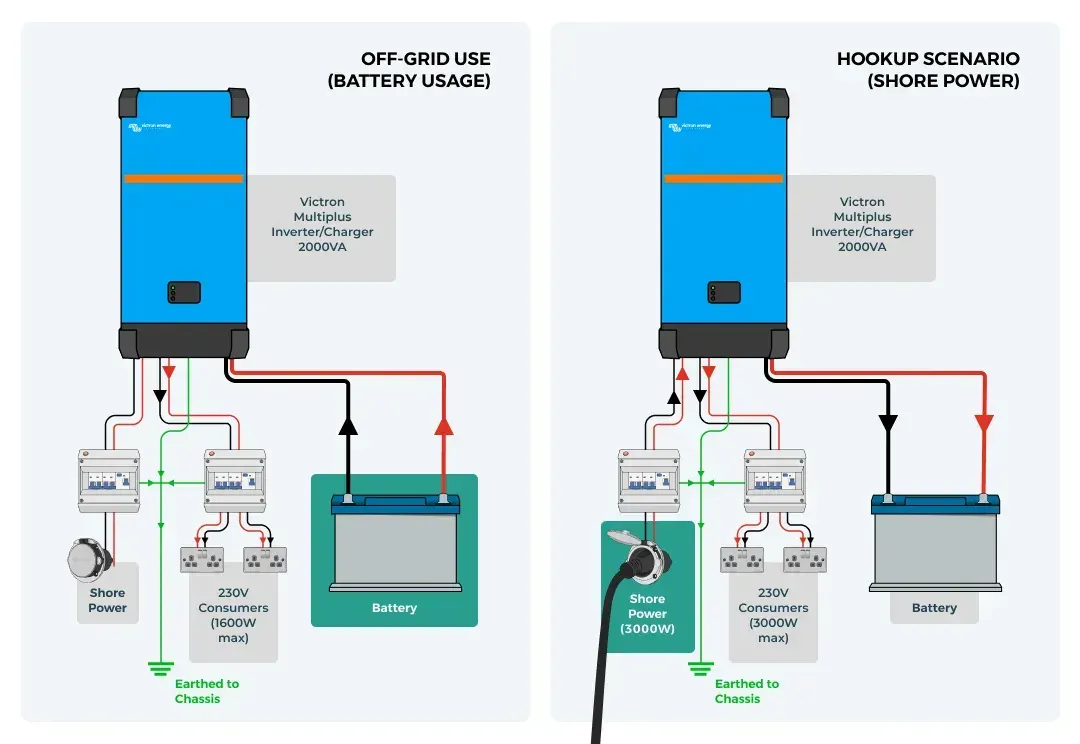
Let's look at how the Multiplus adapts to different power scenarios, ensuring your van runs smoothly, whether off-grid or connected to a hookup, with a built-in speed AC transfer switch that moves from shore power connection to inverter power within 20 milliseconds if the AC supply drops, helping mains powered appliances stay on.
Off-grid wattage: VA ratings in action
The Multiplus relies entirely on your batteries when you're off-grid, and the VA rating determines its output. VA represents apparent power, but real-world conditions mean the actual watts available are slightly lower.
For example, a 3000VA Victron Multiplus delivers closer to 2400-2500W off-grid. This drop accounts for inefficiencies and phase shifts.
The takeaway? Always check the VA and wattage to ensure your Multiplus can handle the load, ideally as part of a broader DIY campervan electrical system checklist. Vanlifers relying on smaller batteries or lower-rated inverters should plan carefully to avoid overloading the system.
Hookup power (3000W consistent output)
When connected to mains, the Multiplus shifts gears. It can consistently provide its full 3000W, bypassing battery limitations, and its hybrid PowerAssist technology can briefly boost limited hookup input when demand spikes beyond available shore or generator power, while managing the ac system, charging batteries, and supplying connected loads.
Hookup power allows you to run high-wattage appliances without straining your system. The Multiplus uses mains electricity directly while simultaneously charging your batteries—ensuring your van stays powered and your battery bank is replenished, much like our dedicated campsite hook-up campervan electrical system setups.
That makes it a key component in campervan energy storage systems, especially where solar or grid tie pv inverters support the wider energy storage setup.
Practical energy-saving tips:
- High-power appliances on hookup: Plug into a campsite's hookup and enjoy full access to high-wattage devices like a kettle, microwave, or induction hob. The 3000W capacity ensures these energy-hungry appliances perform without issue.
- Low-power devices off-grid: When off-grid, stick to lower-wattage items like LED lights, laptop chargers, and fridges. These ensure your inverter runs efficiently without draining your batteries too quickly.
Planning your setup around these two scenarios keeps your van flexible and ready for any adventure.
Cost-saving tips when choosing a Victron Multiplus
For vanlifers on a budget, you don't always need to purchase the biggest Multiplus for your buck. A 500VA unit might be enough for basic 230V needs, like charging electronics or powering small appliances, especially in streamlined off-grid Adventurer campervan electrical systems.
Here's the bonus: if you're a campsite or hookup power regular, even a 500VA Multiplus can still supply 3000W when hooked up. That's plenty for high-power appliances during a stay at a campsite.
Smaller units also save money on the ripple effects of downsizing, and they integrate neatly into complete Victron campervan electrical systems:
- Smaller batteries: Less capacity needed for smaller inverters.
- Simpler solar setups: You require fewer to recharge smaller batteries.
- Lighter wiring: Lower current means thinner, less expensive cables.
So, don't always go for the biggest and baddest Victron MultiPlus system; you can save money without sacrificing performance where it matters most, especially with balanced setups like an Adventurer campervan electrical system that prioritise real-world usage over headline specs, or higher-capacity Nomad Victron campervan electrical systems for full-time living.
Not sure which Victron MultiPlus system is right for you?
BUILD YOUR CUSTOM CAMPERVAN ELECTRICAL SYSTEM IN MINUTES
Core Components of a Victron Multiplus System
Let's explore the core components of a Victron Multiplus system, what's included and how it all comes together to power your van. Every Vunked Victron Multiplus system has everything you need for installation, including a handy guide and campervan 12V wiring diagrams, plus additional resources on wiring a campervan inverter safely.
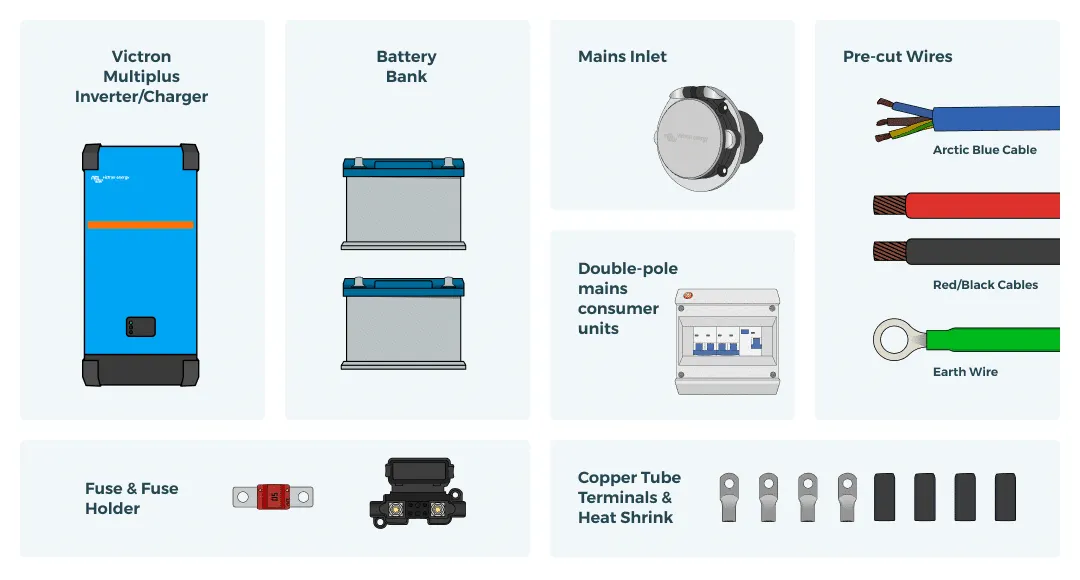
- Victron Multiplus Inverter/Charger: Each system features a Multiplus inverter/charger tailored to your power needs, often forming the heart of our Victron solar kits for campervans as a single compact unit that also integrates cleanly with solar systems via a solar charge controller, and our guide to installing a Victron inverter in a campervan walks through this process step by step. The model determines the off-grid wattage, battery charging rate, and overall capabilities. It combines a pure sinewave inverter, battery charger, and ac transfer switch for smooth changeover to available AC power, using toroidal transformer topology for stable performance. For instance, the 500VA unit delivers 430W off-grid, while the 2000VA unit provides up to 1600W. The charger section has one output for the main battery bank and a separate voltage output intended to maintain a starter battery.
- White flush mains inlet: This is your connection point to hookup power. It ensures safe, reliable access to external electricity for charging your batteries and powering appliances.
- Double-pole mains consumer units: Each system includes two consumer units—one for the Multiplus 230V input and one for the output. These handle power distribution, support circuit protection, and maintain compliance with safety standards.
- Pre-cut wiring: Systems come with pre-measured wires for easy installation, and the unit needs only a single set of battery cables. This includes:
- Arctic Blue Cable (10m) for mains connections.
- Earth Wire (3m) for grounding.
- Single-Core Red and Black Cables (2m each) with varying gauges based on system size (16mm² to 70mm²), while ac cable size should still be matched to load, run length, and protection.
- Fuse and fuse holder: Each setup features a fuse holder and fuse rated for the system, ranging from 100A for smaller units to 300A for the largest. These protect against overcurrent and short circuits.
- Copper tube terminals and heat shrink: The kits include terminals and heat shrink for secure, durable cable connections. These vary in size to match the cable thickness of each system.
Choosing the Right Victron Multiplus Model for Your Van
Selecting the right Victron Multiplus model is about matching your van's power system to your lifestyle, expected loads, battery type, and charging setup, and it supports various battery chemistries, including lithium, AGM, and gel batteries, within a wider campervan electrical system that suits your trips from Victron Energy.
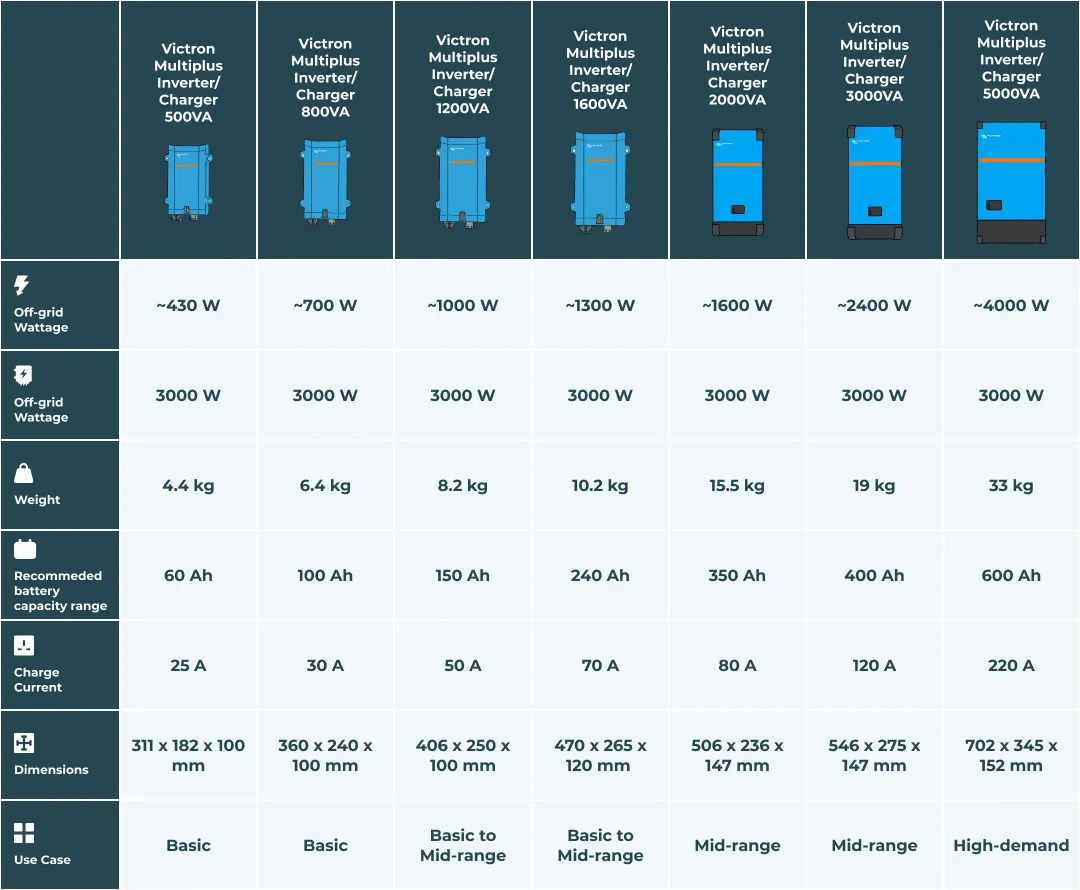
Here's a step-by-step guide to help you make an informed choice:
Step 1: Assess your power needs
Start by listing the appliances and devices you'll power:
- Low-wattage essentials: LED lights, phone chargers, and laptops, which are typical of a Weekender campervan electrical system.
- High-wattage appliances: Induction hobs, kettles, microwaves, or air conditioners.
Determine if you'll use these off-grid or primarily when connected to hookup power. Off-grid setups need an inverter with enough wattage to handle simultaneous appliance use. Hookup power users have mains power, so a smaller inverter might suffice.
Step 2: Check your battery capacity and type
The Multiplus relies on your battery bank. Ensure your campervan batteries can handle the inverter's demands:
- Smaller models (e.g., 500VA) pair well with modest battery setups like 100Ah lead-acid or lithium.
- Larger models (e.g., 2000VA or 3000VA) require higher-capacity batteries (e.g., 300Ah or more) to support larger loads without rapid depletion.
Lithium batteries are ideal for higher loads because of their efficient discharge rates. For a broader perspective on building and upgrading van power, our overview of popular campervan electrical upgrades pulls these ideas together. MultiPlus-based systems can also be remotely monitored and controlled through the VRM portal when paired with a GX device such as Cerbo GX. Access is available through the VRM app or the VRM portal website from phones, tablets, or PCs across multiple operating systems.
Step 3: Ensure a sufficient battery discharge rate
For a 3000W inverter, your battery must deliver a high discharge rate. Without this, even a large-capacity battery won't meet your inverter's demand
You can achieve the necessary discharge rate in one of two ways:
- Choose a high-discharge battery: Models like the Fogstar Drift PRO 12V 230Ah feature a 300A discharge rate, making them ideal for high-demand setups and supporting one full power output.
- Wire two batteries in parallel: Most lithium batteries, like the standard Fogstar Drift 12V 230Ah, have a discharge rate of 150A. By wiring two in parallel, you double the capacity and achieve a 300A discharge rate to match the inverter's requirements.
For larger builds, the MultiPlus can operate in parallel with up to six units for increased power output.
Practical tip: Batteries like the Fogstar Drift PRO offer robust features such as built-in heating for cold climates and Bluetooth connectivity for easy monitoring.
Step 4: Evaluate your solar panel setup
Consider how your campervan solar panels contribute to recharging your batteries:
- Minimal solar: A smaller Multiplus like the 500VA or 800VA can work if your battery charging relies on hookup power.
- Robust solar: If your system features multiple panels, larger inverters like the 2000VA or 3000VA allow you to fully utilise your solar array by powering appliances directly or recharging large battery banks faster.
Step 5: Factor in weight and space
Size matters in a van build. Compare:
- Compact models: Lightweight and space-saving, ideal for tight setups.
- Standard models: Larger and heavier but better for high-demand systems with room for installation.
For example, a 500VA compact model (weighs 4.4kg) saves significant space compared to a 3000VA standard version (weighs 18kg), which may need reinforced mounting and more ventilation.
Here's a quick breakdown of standard Victron Multiplus options:
- 500VA: Powers up to 430W off-grid. Best for small setups running basics like lights and laptops. Saves space and works well with 100Ah batteries.
- 800VA: Supports up to 700W off-grid. A versatile mid-range option for modest van builds.
- 1200VA: Handles up to 1000W off-grid. Ideal for medium setups with appliances like fridges or a coffee maker.
- 2000VA: Delivers 1600W off-grid. Suitable for vans with larger appliances like an induction hob.
- 3000VA: Provides up to 2400W off-grid. The go-to for high-demand users with robust solar and battery setups. Will need a high discharge rate lithium battery or two normal lithium batteries wired in parallel.
If you're still feeling lost and overwhelmed, don't worry! We've designed a helpful tool to simplify your van electrics. It even creates a parts list to purchase—delivered anywhere in the UK within days.
Get the right Victron Multiplus for your needs